
As the annual report meeting approached, a youth organization secretary searched for photos from last year's community service event. She scrolled through the old committee's WhatsApp group, until her fingers ached. Some of the photos were left with a gray box that read "media unavailable." Others had disappeared along with the old committee's broken phone. The activity was real, the funds were neatly recorded in the books, but there was barely a visual trace left.
A healthy organization thrives on records. Meetings have minutes, money has bookkeeping, programs have reports. All of these things make a management accountable and sustainable. Surprisingly, photographic documentation is rarely treated as seriously. Yet, photos are often the only evidence that an activity is actually taking place, and the only way new members can experience the community's journey.
Recording activities has never been easier. Nearly every member carries a camera in their pocket. The problem is storing it. Photos from community service, 17th-anniversary competitions, school art performances, and even alumni reunions all end up in one place: WhatsApp groups. Yet WhatsApp groups were never designed to be filing cabinets.
There, photos are compressed to the point of degrading quality. History is buried under thousands of other messages, from meeting invitations to chain messages. When management changes, the archives go with the old numbers. No one intends to lose them. They disappear slowly, without anyone noticing the loss, until one day they're needed.
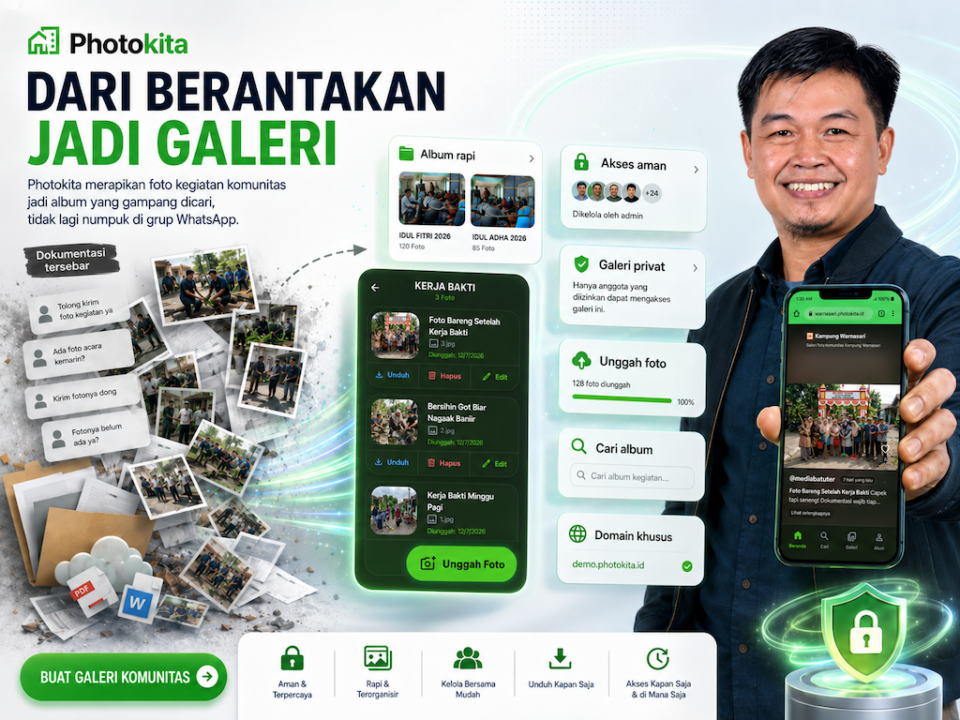
This kind of anxiety is what Photokita, a private gallery service for archiving community activity documentation, seeks to address. The idea is simple. Every community, whether neighborhood committees, youth organizations, alumni associations, schools, hobby groups, or event committees, has one home for all its documentation. Photos are grouped by activity album, labeled with names and dates, so last year's community service can be found in seconds, rather than having to struggle scrolling through screens.
The gallery is private. Only registered members can browse its contents, not just anyone online, and it's not mixed with public content like on social media. Photos are stored in full quality and can be downloaded at any time, so documenting major events is no longer dependent on a single person's phone. Each community has its own gallery address, such as namakomunitas.photokita.id, which can be shared with members to join.
Control remains in the hands of the administrators. Who can upload photos, who manages albums, and who can simply view them is all managed through roles within the dashboard, which can be understood without a technical background. There's no limit to the number of members who can register. If administrators want to be more cautious, there's an approval mode that can be activated at any time, allowing new members to wait for approval before viewing the gallery's contents.
It's free to start. Open photokita.id, create a community gallery, choose a name for its address, and then share it with members. They can log in using their Google accounts from their mobile browsers, without needing to install any additional apps. For larger communities, paid plans are available with more photo space, full album downloads, and the option of a custom domain address.
In five or ten years, the current management will be replaced by the next generation. Financial reports may still be neatly stored in the secretariat's cabinet. The question is, where are the photos? An organized archive is the simplest legacy for the management after us. They can see what we've done, learn from it, and then pass it on. It can all start small: an album for this month's activities, in photokita.id.