
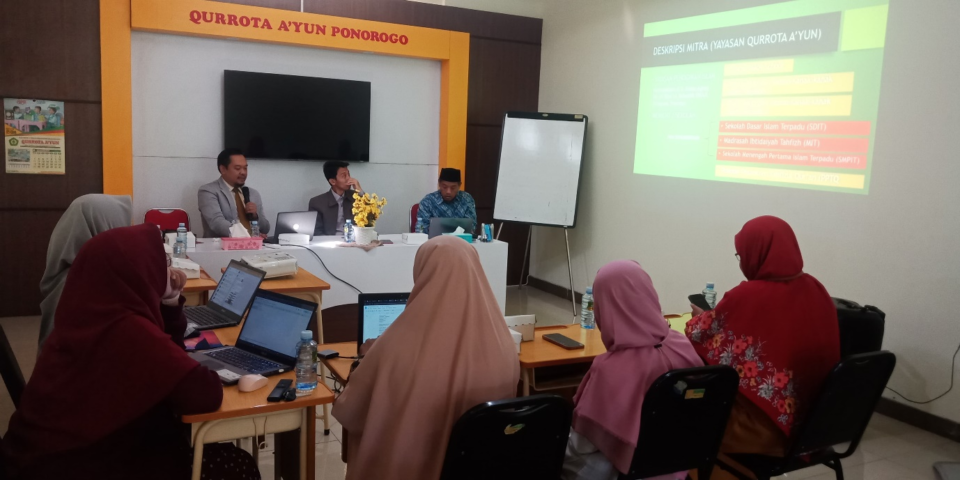
The concept of leadership is a perennial topic of discussion among Muslims. To cultivate leaders with an Islamic mindset, a distinctively Islamic leadership education is required. This theme was developed as a partnership program between the UNIDA Gontor Postgraduate Program and the Qurrota A'yun Foundation (YQA), both based in Ponorogo. The program, which ran from August to December 2024, produced a conceptualization of leadership.
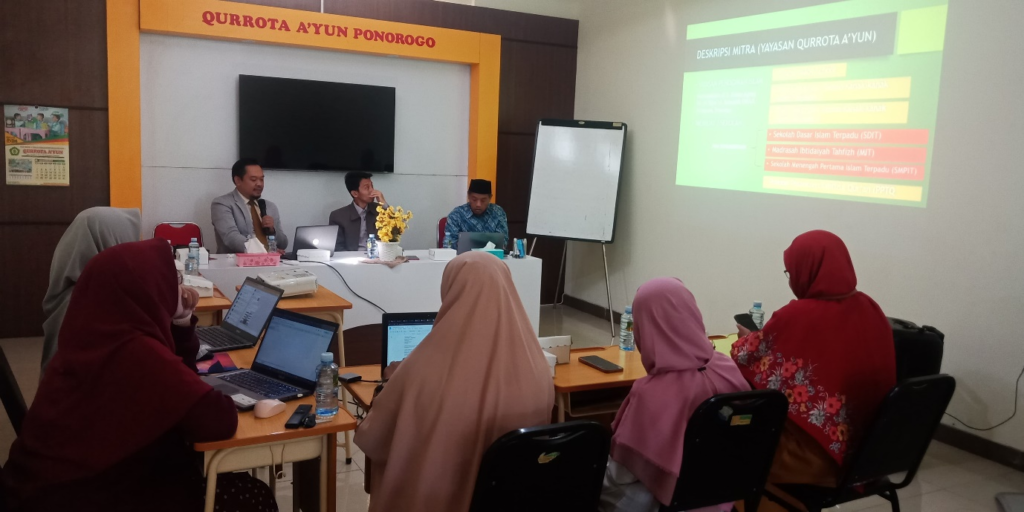
The partnership program is carried out in several stages, including problem identification, planning, outreach, implementation, control, and evaluation. UNIDA Gontor postgraduate students are also involved in this partnership. Many programs are conducted with Focus Group Discussion (FGD) on each theme discussed.
This partnership program produced a conceptual map of Islamic leadership education. The map is as follows:
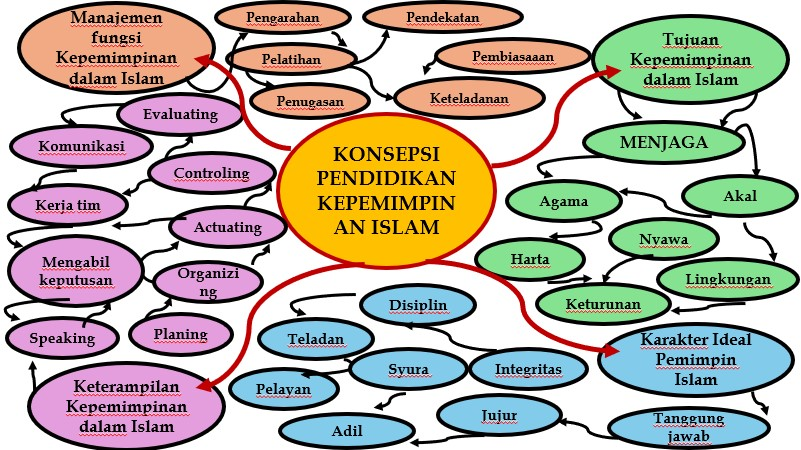
The image above shows the concept of Islamic leadership education. The concept map contains four main concepts: the purpose of leadership in Islam, the ideal character of a leader, Islamic leadership skills, and functional management in Islamic leadership.
First, The objectives of Islamic leadership include protecting religion, protecting life, protecting reason, protecting descendants, protecting property and protecting the environment.
Second, The ideal character of a leader in Islam includes responsibility, integrity, honesty, discipline, being a role model, serving, being fair, and being fond of deliberation.
Third, leadership skills in Islam include planning (planning), organizing (organizing), implementation (actuating), control (controlling), evaluation (evaluating), communication, teamwork, decision making and public speaking.
Fourth, Islamic leadership management functions include direction, training, assignments, habituation, role modeling, and approaches. These approaches include a humane approach, a program approach, and an idealistic approach.
The above concept of Islamic leadership education is the main concept in compiling the curriculum and practice of leadership education in various educational units, including early childhood, elementary, middle, high school and even higher education. "Hopefully, what has been produced in this partnership program can provide benefits in the realm of Islamic education." Said Yusuf, one of the partnership members.
This program is a partnership between the UNIDA Gontor Postgraduate Student Creativity Program (PKM) team and the Qurrota A'yun Foundation in Ponorogo. Funding was obtained from UNIDA Gontor through its internal Community Partnership Empowerment grant scheme for the 2024 fiscal year.

1 comment