
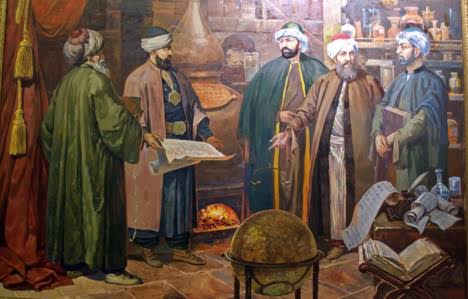
Islam is the only religion with an undeniable scientific genealogy. Scientific facts are still maintained and preserved through a tradition known as scientific awareness. (self-consciousness).
The process of scientific awareness will give rise to a number of researchers who specialize in scientific studies. These scientific studies will then become a forum for knowledge called the 'scientific community' or in Islamic terms, 'ulama', namely the pioneers and forerunners of the birth of scientific civilization in Islam. [Page 3]
The sources of knowledge in Islam are the Quran and the Hadith, both of which are vertical elements based on revelation. These two sources have been studied and researched over a long period of time, ensuring that the chain of transmission of knowledge is not interrupted. Therefore, it's easy to imagine that the process of knowledge in the Islamic tradition did not simply emerge and emerge; it took years, even centuries, through a long process of scientific research.
Looking at this scientific tradition, science is born through a series of processes identified as the Scientific Process. (scientific process). This scientific process is then divided into three stages; First, problem stage, namely when the study of the problem is carried out separately and individually within a certain time period.
Second, The disciplinary stage is when a tradition is born as a result of general (conventional) agreement among scientists. It is at this stage that methods and problems are determined. Third, the naming stage of the activity. Namely, naming the scientific field that is in accordance with the problems from the first and second studies. [Page 4].
The scientific tradition discussed in this book places Islamic worldview (Islamic worldview) as a source derived from revelation that then supported the scientific tradition and the development of sciences in Islam. It was this worldview that led to scientific development and progress since the first century of Islam.
After the Prophet Muhammad migrated to Medina, he began to build special institutions which later became a model for education in Islam in subsequent periods. Madrasah the mosque is known as Ashâb al-Suffah or Ahl al-Suffah (people seeking knowledge), this institution or madrasah was founded by the Prophet himself, located in Medina. Suffah itself was originally built as a residence for new arrivals or specifically for local residents who looked poor.
Read more..
