
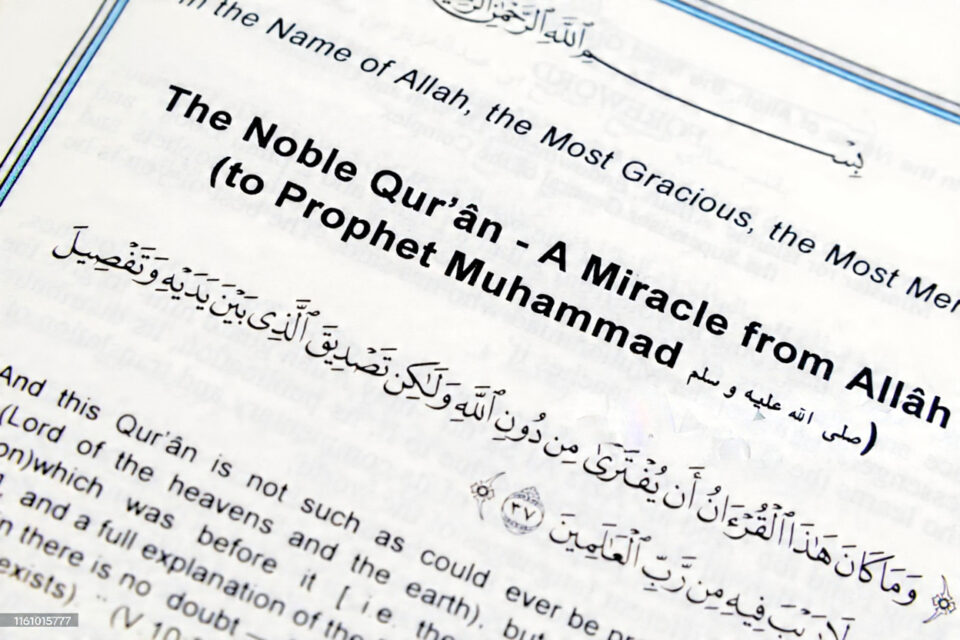
The most severe accusation made by Western orientalists, as well as by some adherents of other schools of thought, against Muslims concerns the authenticity of the Muslim holy book, the Quran. Some orientalists consistently accuse the Prophet Muhammad of authoring the Quran. For them, the Quran is not a revelation or the Word of God.
Orientalist figures who stated that the Qur'an was written by Muhammad include; A Sprenger, William Muir, Theodor Noldeke, Ignaz Goldziher, W. Wellhausen, Leone Caetani, David S. Margoliouth, Richard Bell, and W. Montgomery Watt.[1] They are people who harbor 'negative sentiments' towards Islam, especially towards the Prophet Muhammad.
Despite everything, the Quran, through the ages, has never been "tainted" in the slightest in its authenticity and purity. On the contrary, Allah has provided clear and obvious evidence that the Quran is truly His word, not the work of Muhammad. Forever. argument this will not change. Even until the end of time.
One of I'jaz The (miracle) of the Qur'an is the style of language, the choice of words (diction) contained within it. For example, the Qur'an's style of language in using the word 'cane' to refer to the staff of the Prophet Solomon (peace be upon him) and the staff of the Prophet Moses (peace be upon him). The two styles of language in explaining these two words are very different. Here's the proof.
In the Letter Saba' verse 14 Allah tells of the fragility or destruction of the body of Prophet Solomon (AS).
فَلَمَّا قَضَيْنَا عَلَيْهِ ٱلْمَوْتَ مَا دَلَّهُمْ or مَوْتِهِۦٓ إِلَّا دَابَّةُ ٱلْأَرْضِ تَأْكُلُ مِنسَأَتَهُۥ
“So when We decreed death for him (Solomon), nothing showed them his death except termites which devoured his flesh. his stick ‘'Minsa'atahu” (QS. Saba' Verse 14).
In Arabic, the most common word used to indicate the meaning of stick is عَصًا ('Asha). Even the Qur'an uses the word ‘'asha'’ repeatedly to mention the stick of the Prophet Musa (as). As in the letter Thaha verse 18. قَالَ هِيَ عَصَايَۚ “"He (Moses) said; this is my staff 'Asha.'‘
The interesting thing is, why does the Qur'an use different vocabulary or words that are rarely used in Arabic grammar when describing the 'stick' of Prophet Solomon (peace be upon him)? Minsa'ah. Why does Allah not say in a Surah Saba' verse 14, using words ‘'asha'’ Ta'kulu 'Asha (eat his stick)? But instead, choose the word Minsa'ah?
From the differences in language style or diction, we can see the beauty and perfection of the language of the Qur'an. The root word, (Na-sa-'a) ن- س-ا in Arabic means to delay, procrastinate, or postpone. In terms of jurisprudence of transactions we know the term Riba' Nasi'ah, namely usury that occurs due to delays/extensions in payment. Therefore, in terms of language, Minsa'ah does not just mean 'wooden stick' but is a tool or instrument for delaying time.
Let's investigate more deeply, by combining the meaning of the language with the story in Surah Saba' verse 14. Why does Prophet Sulaiman's staff use the word Minsa'ah? Because there is a delay or delay in time. If we continue to the last verse of Surah Saba' verse 14, it explains how a piece of wood (stick) functioned to delay the jinn from learning about the death of Prophet Sulaiman AS.
Meanwhile, in explaining about the staff of the Prophet Musa (a.s.), Allah suspended his words ‘'Asha'’ which comes from the root word '‘Ain- Shad'’ ع – ص which means to collect or hit. The staff of Prophet Musa (as) is active stick or action stick; functions to hit rocks, turn into a snake, split the sea, herd goats, shed leaves and other miracles.
As for the stick of Prophet Solomon (AS), it was passive stick, silent and dead. The staff of the Prophet Solomon (peace be upon him) only served to delay or freeze time. Therefore, the Qur'an uses the vocabulary Minsa'ah to explain the status of the stick of Prophet Solomon as, rather than using the diction ‘Hope which explains the function or status of the stick used by the Prophet Moses.
Seeing the differences in the use of vocabulary explained in the Qur'an, further strengthens the position of the Qur'an as Miracles Prophet Muhammad SAW. It is not better to weaken, but rather to strengthen the authenticity and sacredness of the Qur'an as the word of Allah. (words of God), not the words or composition of the Prophet Muhammad SAW as accused by orientalists.
The Quran never makes mistakes or happenstances in its choice of synonyms, diction, vocabulary, or style. Therefore, there is no doubt about the truth of the Quran, brought by the Prophet Muhammad (peace be upon him). And it must be acknowledged that the Quran produces terms that never overlap, are not ambiguous, or are not... debatable (debated).
I'jaz The miracles or wonders of the Quran are true. There is no doubt about them. It cannot be denied that blasphemy and accusations against the Quran will always exist. They will continue to be spread forever. Accusations against the Quran will never cease, until one day the Quran will prove them wrong and arrogant.
Thus, the truth of the Quran is undeniable, even if it is criticized, blasphemed, or demeaned by the enemies of Islam. The more it is criticized, the more it is blasphemed, and the more it is demeaned, the brighter the light of the Quran becomes, and the dimmer and more contemptible the critics, blasphemers, and anyone who demeans the Quran becomes.
And Allah knows best
[1]Read, Muhammad Mohar Ali, The Qur'an and Orientalists. (Oxford: Jam'iyat 'Ihya' Minhaaj Al-Sunnah, 2004), p. 2
