
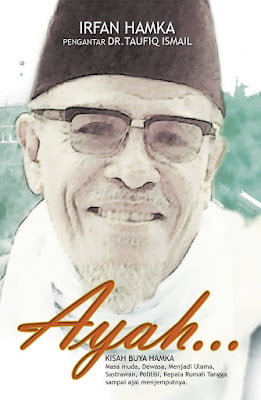
Who doesn't know Buya Hamka? A figure who is constantly referenced by scholars, writers, and even heroes throughout Indonesia. It's said that Buya Hamka is renowned not only in his own country but also throughout Southeast Asia. His track record of thought and life journey continues to inspire everyone. This scholar, who was a figure with a vast scope of knowledge, left a legacy that no one has been able to surpass, whether in terms of writing books, steadfast faith, or anything else.
The book "FATHER... The Story of Buya Hamka" by Ifran Hamka tells the story of Buya Hamka, who not only played the role of father to his family, but was also a cleric, intellectual, politician, statesman, writer, and even renowned for his mastery of martial arts.
In part one, readers are invited to reminisce about Buya Hamka's wise advice on married life. Beautiful advice on how to preserve a family and prevent divorce, how husbands and wives must fear God, and how to advise children to prevent them from becoming proficient liars (pages 1-11).
Next, readers are invited to explore Buya Hamka's struggle to save his family. Everything was done to avoid the grip of the Dutch colonialists. In part two, the author also tells the story of Buya Hamka's role as a father, husband, Koran teacher, civil servant, politician and martial arts warrior. His spirit of courage, firmness and authority never disappeared. (pp. 13-55).
In this section, the author captivatingly recounts how Buya Hamka reconciled with the genie in their new home. Buya Hamka's courage in engaging in dialogue with the supernatural creature led the genie to submit to Buya Hamka's commands. This third section is both tense and hilarious (pp. 57-77).
The story of how Buya Hamka, his wife (Ummi Siti Raham), and the author went on the Hajj. A very tense event, from Baghdad to Mecca while crossing the Sahara desert they were chased by a desert cyclone, then about their driver who fell asleep while driving and the obstacle when they were almost hit by a flood in the black granite mountains. The author explains in detail in parts four and five (pages 79-169).
In this part the author is very skilled at draining the reader's tears. Parts six and seven of the author explain the breadth of Buya Hamka's understanding of religious knowledge (Sufism). Next, the author tells the story of Ummi's polite manners in keeping in touch with her family. Ummi's loyalty, toughness, prowess in facing slander and insults. However, the strong woman left Buya Hamka first. (pp. 171-214). Specifically in part eight, the author tells the story of Buya Hamka's favorite cat, "Yellow". Until Buya Hamka died, Yellow sat on his master's grave. (pp. 215-227).
In part nine, readers will be amazed by the great and forgiving soul of Buya Hamka towards three national figures, Soekarno, Mr. Moh. Yamin and Pramoedya Ananta Toer. It was Soekarno who put Buya Hamka in prison for two years and four months. However, at the end of Soekarno's life, Buya Hamka was the one who led his funeral prayer. Mr. Moh. Yamin was a nationalist figure who opposed Buya Hamka's decision when the 1945 Constitution with the State Foundation Based on Islam. However, when Mr. Moh. Yamin was sick, Buya Hamka visited him and recited the shahada when he was in his deathbed. Pramoedya Ananta Toer, through the Bintang Timur Daily newspaper, slandered Buya Hamka's Roman book. However, Buya Hamka was willing to accept his son Pram who wanted to study Islam with him. (pages 229-272).
In the final section, the author recounts how Buya Hamka suffered from lung, kidney, and brain disease, and ultimately died. Thousands of worshippers prayed for him, including his funeral (pages 273-287).

1 comment