
Prologue
Before analyzing and reviewing literature, we will first briefly touch on the development of the literary world in Indonesia. Next, we will explain a clear definition of literary criticism and several explanations related to the literary world from the author's perspective. Why is this done? Because the author observes the vastness of the literary world; it's not enough to simply digest it; the most important thing is to "chew" every bit of its crunchy and soft aspects.
In his book, Literature and Literary Studies, A. Teeuw explains the meaning of the word literature. Literature in Indonesian according to Teeuw, comes from the language Sanskrit; root word hs– in derived verbs means to direct, teach, give directions and instructions. The suffix -ing–tra usually refers to a tool or means. According to Teeuw's research, the word "susastra" does not exist in Sanskrit or Old Javanese. Therefore, "susatra" is a Javanese and Malay creation that emerged later.1
Apart from the brief meaning of literature and literature above, as an extension of writers and artists, the Jakarta Arts Council (DKJ) [https://dkj.or.id/] committee of the Indonesian literary and arts director's hall with its various agendas has opened up the horizons of literary knowledge in society. Event or competitions such as criticism, writing scripts, manuscripts, novels, theater and anything related to literature continue to be encouraged.
I salute the hard work of the Jakarta Arts Council (DKJ). Their enthusiasm and commitment to building interest and spreading the benefits of Indonesian literature are crucial. This is crucial as a means of educating the public, especially in the literary world, which still needs educational activities. Therefore, the world of literature and the arts, whether a forum for appreciation or criticism, must not stagnate at this point; it requires support from all literary and arts activists.
The World of Literature and the Role of Media
The world of Indonesian literature is incredibly diverse and continues to transform its language. This is demonstrated by the development of literary studies in both academic and general settings. One of Ahmad Badrun's books, entitled “Fundamentals of Literary Psychology” This book is designed as material for the Psychology of Literature course. Psychology of Literature is a branch of literary criticism.2 It is further explained that students must first pass the courses in Literary Theory, Literary History, and Literary Criticism.3
Overall, the Indonesian literary world has never waned from the spotlight, as new writers emerge every decade. They come from a variety of backgrounds and fields, including novels, short stories, poetry, and so on. So many literary innovators have been able to voice great hope through their phenomenal works.
The messages conveyed through novels, short stories, poetry, and other writings are clear and inspire readers to take action and absorb the message with their hearts and minds. Thus, the messages they read give rise to real solutions that can be put into practice in the real world.
In fact, the intended role of literary criticism is to promote literary works, both on social media and in the real world. For example, the novel Rainbow Troops appreciated as one of the best-selling and world-class works thanks to the services of literary critics and the mass media 4. Mass media, social media, films and book reviews can increase the popularity of literary works. The role of literary critics and the media has resulted in high literary value, not only appreciated locally but also sought after in other countries.
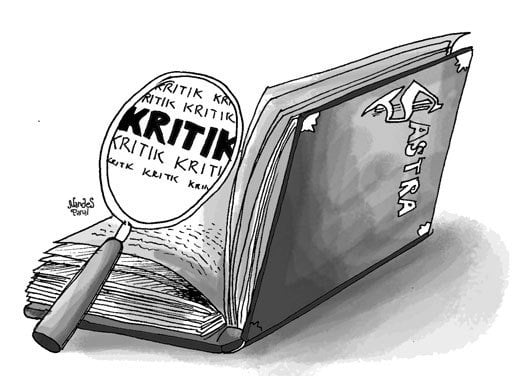
In the Big Indonesian Dictionary, the word criticism means condemnation or response, sometimes accompanied by consideration of the good and bad of a work.5 While literature is 1.) Language (words, style of language) used in books (not everyday language). After looking at the meaning of the two words criticism and literature above, it can be defined that literary criticism is a consideration of the good and bad of a work of language used in books.
In another definition, according to Rachmat Djoko Pradopo (1997) in the book “Principles of Literary Criticism” defines that literary criticism is a branch of literary science to judge a literary work.6 Meanwhile, according to Rosina Rysova, literary criticism is a field of literary discussion that through reviews and other texts aims to interpret, evaluate and clarify literary works.7
After reading the definition of literary criticism above, we can conclude that literary criticism is the appreciation of other people's works by evaluating their content. It should not be the opposite, aiming to degrade the literary work being criticized. Nor should it be flooded with excessive praise, which would diminish its value. The goal of literary criticism is to distinguish the actual from the unreal in literary works, and to assess and evaluate the quality of literary works.
Linguistically, literary criticism is highly susceptible to misunderstandings. Without a deeper examination of the meaning of literary criticism, people will misunderstand its true meaning. Therefore, the author strongly discourages misunderstandings about the definition of literary criticism or literature itself. At first glance, this may be a misconception about literature and needs to be clarified. Specific literary terms are part of literary studies.
Epilogue
Literary phenomena observed by literary scholars often require specific terms to explain the prevailing literary phenomena in various periods of literary history. The tradition of literary criticism often produces specific literary terms. It is understandable that in the Indonesian literary world, this tradition of literary criticism has not yet demonstrated a vibrant literary movement.
Some parties acknowledge the lack of development of literary criticism so that the emergence of specific literary terms seems very limited.8 This means that the Indonesian literary world must improve itself in finding standard terms for literature so as not to give rise to misinterpretations of meaning.
Reference
- A. Teeuw, Literature and Literary Studies, (Bandung: Pustaka Jaya, 2015), 5th edition, p. 20
- Ahmad Badrun, Basics of Literary Psychology. (Mataram: Mataram University Press, 2005), p. V
- Article By; Suroso, Literary Criticism The Open Door: Preserving Indonesia's Literary Heritage, (Yogyakarta, 2015), p. 3.
- ibid,
- Big Indonesian Dictionary offline version 1.5.1
- Literary criticism – Indonesian Wikipedia, free encyclopedia.htm. accessed (June 11, 2017)
- Article By; Suroso, Literary Criticism The Open Door: Preserving Indonesia's Literary Heritage, (Yogyakarta, 2015), p. 6
- Language Center of the Department of National Education, ENCYCLOPEDIA OF MODERN INDONESIAN LITERATURE, (Bandung, ROSDA KARYA, 2003), pp. vii-viii.
