
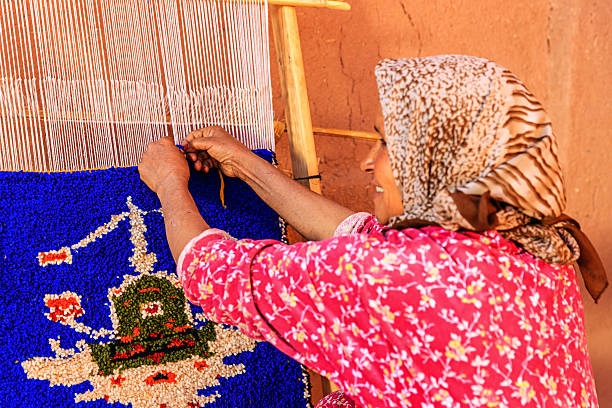
There's a familiar scene in classical Arabia: a woman sits intently, her fingers twisting fiber after fiber, building a strong, neat thread. She devotes energy, time, and patience. Her thread grows longer and stronger, ready to be woven into useful cloth.
But suddenly, for no apparent reason, he destroyed everything he had built. He unraveled the once-strong threads, leaving them tangled, disorganized, and no longer functional. All that was left was fruitless fatigue, meaningless effort.
This scene is immortalized by Allah in the Qur'an as the most vivid parable of human stupidity that destroys one's own deeds. Allah says:
God willing قُوَّةٍ أَنكَاثًا تَتَّخِذُونَ أَيْمَانَكُمْ دَخَلًا بَيْنَكُمْ أَن God willing, God willing, God willing, God willing يَبْلُوكُمُ اللَّهُ بِهِ ۚ وَلَيُبَيِّنَنَّ لَكُمْ يَوْمَ God willing كُنتُمْ فِيهِ تَخْتَلِفُونَ
“"And do not be like a woman who untangles her tightly spun thread and becomes scattered again. You make your oath (agreement) a tool for deception among you, because there is one group that is more numerous than the other groups. Indeed, Allah is only testing you with that. And indeed, on the Day of Resurrection, He will explain to you what you previously disputed."” (QS. An-Nahl: 92)
The woman in this parable, according to most scholars interpretation like Al-Qurthubi And Ibn Kathir, is a real figure in the past Jahiliyah He was known for his foolish habits. He spun thread with great difficulty until it was strong, then had his slave unravel it as a sign of arrogance and waste. But deeper than this literal story, Allah made it a symbol for every human being who builds something strong—whether it be a promise, a commitment, or a good deed—and then destroys it with his own hands.
Let's bring this analogy into the space closest to our lives today: the moon. Ramadan which has just passed. Thirty days we are faced with extraordinary spiritual momentum. We spin threads of piety: enduring hunger and thirst, taking care oral from lies and gossip, train patience, increase recitation The Quran enlivens the night with prayer and supplication, extending our palms to give charity. Each day is a new spun. Each night strengthens our bond with God. We build spiritual strength we haven't felt in previous months. We spin these threads tightly, hoping they will become a fabric that will protect us throughout the year.
But the question is: after Ramadan has passed, are we among those who care for the thread, or do we unravel it again with negligence? Do we maintain our former routine of congregational prayer, or do we abandon the mosque again? Do we still read the Quran every day, even if only one page, or does it return to gathering dust on the shelf? Do we still control our anger and guard our tongues, or do we again become easily provoked and habitually gossip? Do we still set aside alms, even if not as much as during the fasting month, or do we stop giving alms altogether?
If the answer is that we go back to the way we were before Ramadan, or even worse, then we are doing what the spinning woman did: naqaḍat ghazlahā min ba'di quwwah —describes the spin after being strong. We have worked hard to build it, then with our own hands we have torn it down. This is what is called by Al-Hasan al-Basri as “the most grievous loss.” He said: "Indeed, Allah made the month of Ramadan as a field for competing in obedience. So whoever does not plant in that field, he is the one who loses. And whoever plants and then leaves it to rot after harvesting, then he loses more."“
Al-Hasan's words touch on our psychological aspects. From an Islamic psychological perspective, what happens after Ramadan is often related to the phenomenon of cognitive dissonance-a mismatch between a previously high spiritual awareness and the reality of subsequent behavior. When someone experiences the sweetness of worship during Ramadan, they build a self-image as a devout servant. However, when worldly temptations return, they face an inner conflict: maintain that new identity or return to their old comfort zone. Unfortunately, without a strong foundation, many choose the easy path: returning to the way things were. This is a form of spiritual relapse, and Allah reminds us not to be like that.
Ibn Qayyim Al-Jauziyyah in Madarijus Salikin He explained that istiqamah—consistency over obedience—is the highest position after faith. He said that Satan never gives up tempting a believer, and the moment after the peak of obedience is the most vulnerable. Satan says, "Let him worship during Ramadan. After the month is over, he will return to me." This is Satan's strategy, as Allah warned in His Word:
إِنَّهُ لَكُمْ عَدُوٌّ مُِ
“"Indeed, he (Satan) is a real enemy for you."” (QS. Al-Baqarah: 168)
Satan will never stop. When he fails to tempt us during Ramadan because he is chained and the gates of hell are closed, he will wait until Ramadan is over, then return with a more deliberate attack. So, if we are careless, we will be like the spinning woman: after a month of hard work, we allow Satan to unravel all our spinning with seemingly trivial tricks—little by little, abandoning good habits, and then suddenly we realize that the fabric of piety that was once almost finished has fallen apart.
In the perspective of modern Islamic psychology, developed by figures such as Prof. Malik Badri and Dr. Abdul Hamid al-Ghazali (in works on tazkiyatun nafs), This phenomenon is related to the concept of habituation and self-regulation. Ramadhan is actually a program intensive habituation designed by Allah to form new, lasting habits. In psychology, a habit takes between 21 and 66 days to form. Ramadan gives us 30 days, almost reaching that threshold. However, what makes the difference is the internalization of values—the extent to which the habit has become part of one's identity, not just a seasonal routine.
If someone performs worship during Ramadan simply because they are "forced" by circumstances or social pressure, then they have not internalized those values. When Ramadan is over, they return to their normal routine. Conversely, if they perform worship out of awareness and a desire to be closer to God, then the habit will persist. This is what is meant by Sheikh As-Sa'di In his interpretation: "Worship that is done out of love and hope in Allah will leave a mark in the heart that is not easily removed." However, if worship is only out of habit or following the crowd, it will disappear along with the disappearance of the moment.
The scholars the Salaf really understand the essence of this. They never underestimate the period after Ramadan. Al-Fudhail bin 'Iyadh said: "In the past they prayed to Allah for six months so that they would meet Ramadan, then they prayed for six months so that their deeds in that month would be accepted." Imagine, their worry is not only about whether they can meet Ramadhan again, but whether the deeds they have done are accepted - and the sign of acceptance is the taufik to continue doing good deeds afterwards. If after Ramadan we are further away from Allah, it could be a sign that our commitment during Ramadan is not solid, perhaps even not accepted.
Allah Himself in this verse links the parable of the spinning woman with the prohibition against turning oaths and agreements into deception. In the post-Ramadan context, the covenant is our bond with Allah which we renew every day during Ramadan: Iyyaka na'budu wa iyyaka nasta'in-Only You we worship and only You we ask for help. Haven't we promised real practice for a month? So, abandoning this practice after Ramadan is a form dakhalan-self-deception. We pretend that our commitment to God only applies during certain months, while other months we are free.
This verse also mentions the motivations that often cause people to break promises: an takūna ummatun hiya arbā min ummah -because there is a group that is larger in number. In the context of Jahiliyah, They broke their agreements with weaker tribes when a stronger tribe emerged. In our context, the "more" or "stronger" factor could be worldly temptations that seem more enticing: "more" busyness that takes up time so that worship is neglected, "greater" material gain that leads to a halt in charity, or "more crowded" social life that leads to the abandonment of congregational prayer. Allah reminds us that the measure of truth is not quantity or worldly power. He is the One who tests us with these differences, and He will make everything clear on the Day of Judgment.
This verse also teaches that Allah not only forbids us from being like the spinning woman, but also informs us that we are being tested. The post-Ramadan test is part of the divine plan. Allah wants to see which of His servants are truly pious, not only during the season of worship, but in every breath of our lives. He wants to see if we will remain steadfast in His path when the encouraging "Ramadan atmosphere" is no longer there. He wants to see if we are capable of being rabbaniyyun consistent, not just Ramadhaniyyun seasonal.
From an Islamic psychological perspective, this test is part of ibtilā' which builds mental resilience. (resilience). Trials are not meant to derail us, but to elevate us. Every time we overcome the temptation to abandon good habits, we strengthen our "faith muscle." Conversely, every time we succumb to negligence, we unravel the fabric we have built. Therefore, every day after Ramadan is an opportunity to either maintain or destroy the fabric of piety.
Let's stand in front of the mirror for a moment. For thirty days, we have been avid spinners. Our fingers—which previously rarely touched the mushaf—are now familiar with the holy verses. Our lips—which were previously attached to backbiting and vain words—are now wet with dhikr And ask forgiveness. Our hearts—previously hard and negligent—are now soft and longing for Allah. We wake up in the third part of the night, weeping in prostration, feeling His presence so close. We truly feel that we have spun the threads of piety firmly.
But now, in these days Shawwal At this point, we are faced with the most honest question: are we still holding on tightly to that thread? Or have we begun to unravel it, piece by piece, citing busyness, the temptations of the world, or the exhaustion of a full month of worship?
The spinner in the parable didn't ruin her weaving for someone else. She ruined it with her own hands. So do we. Post-Ramadan spiritual decay is rarely caused by major external factors. It occurs due to small, repeated neglects: the fajr prayer that begins to fall short, the tilawah that begins to be neglected, the charity that begins to be forgotten, the tongue that begins to gossip again. Little by little, imperceptibly, the strong thread becomes tangled, and we return to the person we were before Ramadan.
Ibn Mas'ud may Allah be pleased with him said, "Indeed, the hardest deed for the soul is istiqamah." How hard it is to maintain consistency. But behind the difficulties, there is such a beautiful promise. Rasulullah ﷺ said:
أَحَبُّ الْأَعْمَالِ إِلَّ
"The deeds that Allah loves most are those that are continuously done, even if they are small."” (Narrated by Bukhari and Muslim)
Allah does not require us to have the same enthusiasm for the month of Ramadan throughout the year. He only demands that we not untangle the bonds we have built. Let the thread continue to weave, even though the pace is not as fast as in Ramadan. The important thing is, never disconnect it. If in Ramadhan we read one juz of the Koran every day, then after Ramadhan, keep reading even if it's only one page. If in Ramadhan we pray every night, then after Ramadhan, we still pray at night even if only once a week. If in Ramadhan we give alms every day, then after Ramadhan, continue to give alms even if only once a week. What is small and consistent is more beloved to Allah than what is big but intermittent.
Ultimately, the spinner who ruined her weaving is not just a fool in the parable, but a warning to us all. Every time we abandon the good habits we've developed during Ramadan, we repeat the same foolishness. And every time we maintain them, we demonstrate that we are servants who understand the purpose of Ramadan: to be pious, not only during the fasting month, but in every breath of life until death.
So, don't let the threads you have spun with tears and prayers in the nights of Ramadan become tangled by negligence in the days of Shawwal. Don't let the almost perfect weave of piety be torn with your own hands.
Remain steadfast, for steadfastness is proof that Ramadan has truly changed you. And in the future, what will be judged before Allah is not how high your spirits were during Ramadan, but how consistently you maintained the thread after the holy month has passed. For the best thread is one that is continually strengthened, not one that unravels after strenuous effort.
And Allah knows best