
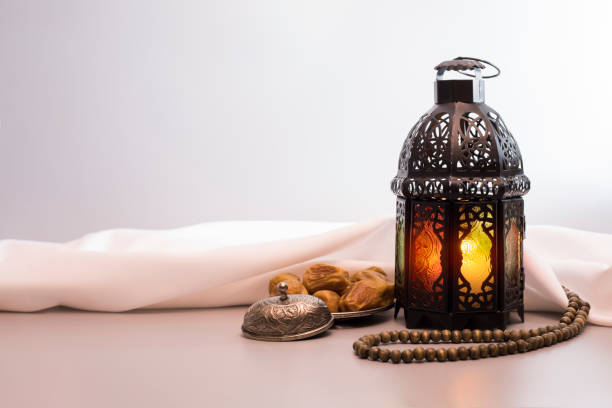
(Tadabbur Verses on Fasting, QS. Al-Baqarah: 187)
Second year Hijri, The first obligatory Ramadan had just begun. But the atmosphere in the Prophet's city was filled with confusion and tension. Behind the walls of humble homes, married couples avoided each other at night, treating the darkness not as a moment of relief after a day of starvation, but as an extension of the daytime abstinence.
Because verse 187 was revealed, as narrated in Sahih Bukhari And Muslim, It begins with an illuminating true story: several companions, including Umar ibn Khattab, came to the Prophet with faces full of regret. They had had intimate relations with their wives during the night of Ramadan, violating a prohibition that was then understood to apply for 24 hours.
There's another story about an Ansar who worked hard all day, returned home exhausted, and then fell asleep before eating. Upon waking, he immediately began fasting again without having time to eat or drink. It was from this human reality—from the unstoppable biological urges and the sheer physical exhaustion—that a verse was revealed that revolutionarily changed the relationship between the body, time, and spirituality in Islam.
Verse 187, is not just a technical correction to the practice of fasting, but a turning point. legislation A socio-religious paradigm that shifts the paradigm of the relationship between the sacred and domestic dimensions. As a refinement of the evolution of the law of fasting from verses 183-186, this verse places human experience as an integral part of worship.
In the modern sociological theory of law on “responsive law” (responsive law), We see how this revelation dynamically responded to the concrete needs of the Medinan community as it was forming a new identity—a community that had to find a balance between spiritual demands and anthropological realities. From this emerged the principle that worship in Islam is not an escape from the world, but rather a sanctification of life within it.
The legal transformation regarding marital relations during Ramadan represents a major shift in the concept of purity. Fasting practices in Jewish traditions (such as Yom Kippur) and early Christianity often involved complete abstinence from sexual intercourse during the fasting period. Even in pre-Islamic Arab traditions, fasting was often associated with extreme asceticism.
The beginning of the Ramadan fasting law also follows this pattern, where the prohibition on intimate relations applies in full for a month. However, verse 187 expressly cancels the prohibition for the night: “It is lawful for you on the night of the fast to have intercourse with your wives.”
This is a radical theological correction: chastity is no longer positioned in opposition to legitimate sexual pleasure, but rather as a discipline of time that makes space for both. Anthropological approaches show that Islam transforms the concept of purity from ontological status (being “holy” by avoiding contamination) to practical-temporal (being “holy” by managing time and intention).
At the heart of this transformation lies the keyword: ‘'ar-rafats'’. A linguistic deconstruction of this term reveals fascinating insights. The root word ر-ف-ث in pre-Islamic Arabic literature has a spectrum of meanings ranging from sexual intercourse itself to intimate conversation and seduction.
In classical Arabic dictionaries such as the work of Ibn Faris, “"rafats"” can refer to both physical actions and verbal actions leading up to it. Classical scholarly debate reflects this ambiguity: does the prohibition against "approaching" one's wife during fasting only apply to intimate relations or does it include the prelude to them? Al-Thabari, in his interpretation, tends toward a specific meaning (intercourse).
Meanwhile, Al-Razi considered a broader meaning. A comparison with the concept of ihram in the Hajj is interesting: in ihram, the prohibition on sexual intercourse is total for a specific period, while in fasting the prohibition is cyclical daily. This demonstrates the careful differentiation between types of sacredness in Islam.
However, the beauty of this verse does not stop at the change of law, but culminates in the most intimate relational metaphor in the entire Qur'an: “hunna libāsun lakum wa antum libāsun lahunna”-they are clothing for you and you are clothing for them.
This metaphor of clothing is a masterpiece of relational hermeneutics. In Lakoff and Johnson's cognitive metaphor theory, clothing is not simply a covering for the body, but rather a complex conceptual system: it represents identity (clothing indicates social status), protection (from the weather and from prying eyes), intimacy (which is attached directly to the skin), and modesty (covering the genitals).
When a wife and husband become each other's "clothes," they give each other a new identity (status as husband/wife), protect each other (from temptation and loneliness), experience inseparable intimacy, and cover each other's "aurat" weaknesses.
What is revolutionary is mutuality (reciprocity) The absolute in this metaphor—there is no hierarchy, only functional equality. This is the philosophical basis for Islamic sexual ethics, which views intimate relationships not as a blemish that diminishes purity, but as a bond that perfects humanity.
While the metaphor of clothing governs horizontal relationships between people, the timing of fasting governs vertical relationships with the Divine. The revelation of the verse about the “white thread from the black thread” creates one of the most vivid hermeneutical moments in the history of interpretation.
Some companions—such as Adiy ibn Hatim—understood this phrase literally, so they tied white and black threads around their feet, observing them until they could distinguish the colors. The Prophet then laughed and explained that he meant “the darkness of night and the light of day.”
In classical commentary, Al-Tabari saw this as a lesson in how Qur'anic language works: using metaphors that then require authoritative explanation. Al-Razi added a philosophical dimension: time in Islam is an objective entity recognized through natural phenomena, not a subjective one dependent on feelings.
Contemporary applications of this principle have resulted in interesting fatwas for regions with extreme natural phenomena, such as the Scandinavian countries with their white nights or the polar regions. The OIC Fiqh Council recommended various solutions, from following Mecca's time to following the normal time of a nearby country, demonstrating flexibility in maintaining the spirit of time discipline.
The duration of the fast from dawn to dusk is no coincidence. From Emile Durkheim's sociological perspective, ritual time serves to synchronize communities, creating a "social time" distinct from profane time. This fast, lasting approximately 13-17 hours (depending on the season and geography), aligns with the body's natural circadian rhythm.
Contemporary medical research shows that intermittent fasting (intermittent fasting) Fasting of similar duration has significant physiological benefits: metabolic reset, improved insulin sensitivity, and enhanced cognitive function. Psychologically, fasting trains “time consciousness”-awareness of each moment, because every hour without food and drink feels different. This is the temporal discipline that shapes spiritual awareness.
The logical continuation of this time discipline is i'tikaf—solitude in the mosque during the last ten nights of Ramadan. Linguistically, the root word ع-ك-ف implies seclusion, self-isolation, and complete concentration. This practice has roots in Semitic traditions, much like spiritual retreats in Judaism and Christianity. However,, i'tikaf in Islam has specific characteristics of fiqh.
Phenomenology i'tikaf contemporary, facing interesting challenges and innovations. In urban areas modern, large mosques turned into “retreat center” during the last ten days of Ramadan, with complicated logistical arrangements. There is talk of “digital i'tikaf”-is it okay to be alone in the room with the lights off? gadget can be considered i'tikaf? While debatable, this demonstrates the need for contemplative spaces in an era full of distractions. From a psychological perspective, i'tikaf is a digital form detox And mindfulness very strong, a “fast” from the excessive stimulation of the outside world.
Behind all these regulations, there is a deep legal philosophy. “ʿafa Allāhu ʿankum” (Allah has forgiven you) at the beginning of the verse is not merely an introduction, but rather a fundamental paradigm of Islamic legislation. It is an acknowledgment that humans are fallible, that understanding of revelation evolves, and that Allah prefers ease over hardship. In theory maqasid al-shari'ah, This reflects the balance between the zhahir (formal law) and batin (spirit of law). The concept of rukhshah (leniency) is a realistic recognition of the imperfect nature of human beings.
This verse also creates a dynamic sacred-profane dialectic. Daytime becomes sacred time—with taboos on eating, drinking, and intimate relations. Meanwhile, nighttime becomes profane time where these things are permitted. However, this distinction is not an absolute dichotomy, as sexual intercourse at night with the intention of strengthening marital bonds can also be considered an act of worship. This is a brilliant synthesis between asceticism And engagement worldly, between spiritual discipline and the recognition of legitimate physical pleasures.
The contemporary relevance of this verse spans various fields. In psychology, fasting trains emotional and impulse regulation—a skill much needed in a world full of instant stimulation. Healthy sexual relationships within the framework of Islamic marriage, guided by the metaphor of "garment," serve as the foundation for family mental health. I'tikaf as a practice mindfulness offering alternatives to culture “always on” in the digital era.
From a gender perspective, the metaphor of "clothing" has been a productive topic of discussion in Islamic feminism. Kecia Ali, in her work, examines how this metaphor can be read as a foundation for relationships of mutuality, not domination. Women's bodily authority during fasting—including the right to abstain from fasting during menstruation, pregnancy, or breastfeeding—demonstrates a recognition of women's biological realities that does not diminish their spiritual purity.
In advanced capitalist societies, the Ramadan fast becomes a form of silent resistance to the logic of consumerism. While shopping malls are actually crowded during Ramadan, the true practice of fasting invites us to redefine “needs” and “wants.”. I'tikaf is a protest against productivism that measures everything by output material.
Ultimately, verse 187 is a symphony of time, body, and meaning. From the confusion of the companions tying the thread around their feet, to the metaphorical intimacy of husband and wife as garments; from the discipline of dawn to Maghrib, to the solitude of the last ten nights—all are part of a unified spiritual education. This verse teaches that purity is not an escape from the body, but rather a wise management of the body.
That discipline is not a rejection of time, but rather a respect for its rhythm; that obedience to God is not the destruction of human nature, but the perfection of our most complete humanity. In every recurring Ramadan, in every sahur and break the fast, in every night that is turned on with prayer or legitimate intimacy, this verse continues to resonate as a reminder: true spirituality is one that embraces, not rejects, the full pulse of human life.
And God knows bestm bish Shawaab