
INTRODUCTION
This book is the result of a serious study of the facts occurring in the current era of globalization. It is a process in which nations are conditioned to accept cultures, traditions, and values considered global or universal. One of the most dangerous challenges is Westernizationi (Westernization) which was pioneered by Western nations, and forced other nations to follow their life.
Eastern nations, including Islam itself, are being forced to adopt Western lifestyles. Currently, the Islamic world, particularly Indonesia, is experiencing WesternizationOne form of this is liberalization in various areas of life. The most noticeable is the liberalization of Islamic religious thought.
I. THE NATURE OF WESTERN CIVILIZATION
The history of Western civilization is a civilization developed by European nations. They adopted ancient Greek civilization, combined it with Roman civilization, and adapted it with elements of European culture, namely Germany, England, and France.
The fundamental principles of philosophy, art, education, and science were taken from Greece. Principles regarding law and statecraft were taken from Rome. West Asian Christianity was adapted to Western culture.
A. Modern West
The modern West is a historical period in Western civilization that occurred precisely during the rise of Western society from the Dark Ages to the Enlightenment. It was the Industrial Age and the Age of Science. It was a period of darkness. (dark ages).
From the dark ages the West entered the age of enlightenment (Renaissance), the French Revolution (French Revolution) and large-scale industrialization in England. However, before these two eras, they experienced what is known as the Translation Ages. In modern times, Westerners have always wondered how to find the truth.
B. Postmodern West
Postmodernism is a movement of thought that arose as a protest against modernism or as a continuation of it. Postmodernism is still based on modernism, which is still dominated by the concepts or thoughts of liberalism, pluralism, nihilism, relativism, equality, (equality) and generally anti-worldview.
II. THE WEST AND ISLAM
Historically, Islam is a civilization that was born, grew, and developed based on a religion guided by revelation. Western civilization, on the other hand, was not formed from religion; religion was merely considered one element of civilization.
III. MEANING AND HISTORY OF LIBERALISM
The history of liberalism stems from ancient Greek. However, if traced back to the Middle Ages, liberalism was fueled by the economic and political conditions dominated by the feudal system. The development of liberalism was marked by the bloodless revolution of 1688. In this context, the author divides the fields of study into which liberalism has infiltrated.
1. Economic and Political Liberalism
Economist Adam Smith was the first to use the foundation for building a capitalist economic system that offered liberalization of economic activity. Meanwhile, political liberalization peaked in the 19th century, when liberalism spread in several European countries, taking the form of ideas of freedom and revolutionary movements. From this, it has been understood since 1900 that liberal politics and economics are closely related.
2. Religious Liberalism
The development of liberalism in religious thought is divided into 3 phases of development.
• The 17th-century French philosopher Rene Descartes promoted the doctrine of rationalism. Belief in human reason, the primacy of the individual, the immanence of God, and Meriolism (human development).
• Late 18th century with the doctrine of Romanticism. Individuals can be sources of value.
• Starting in the mid-19th century to the 20th century. Which emphasized the idea of development (Nation of Progress). Religion is stated as something that develops progressively and is adapted to modern science.
IV. ISLAM AND THE CHALLENGES OF LIBERALISM
What is very clear is that what the West considers "universal" is not so for Muslims. In fact, there are irreconcilable differences between Western concepts and Islam. Examples include fundamentalist Islam, liberal Islam, modern Islam, and so on. These terminologies and concepts are imposed by the West on Muslims.
V. AGENTS OF LIBERALIZATION
The face of western culture, which is extensive with globalization and westernization, actually has agents that are classified into 3 movements.
1. Missionaries. Missionary activities are divided into two:
• Thought Destruction Program. This strategy was proclaimed by Samuel Zwemmer who said that:
“Our main mission as Christians is not to destroy Muslims, but to remove a Muslim from Islam, etc.
• Conversion Program. Missionaries now have a war of ideas, conversions and donations
2. Orientalism. The study of the East. It's no surprise that Orientalism has become an important tradition of study in the Western world, and has become a program in universities. Westerners are interested in studying the East for religious and political reasons. They believe that Islam, a civilization that spread rapidly in the past and dominated world civilization.
3. Colonialism. A political force with a program to spread Western culture and thought so that the thinking of nations around the world, including Muslims, aligns with Western thought and beliefs.
VI. LIBERALIZATION IN INDONESIA
The West has openly and aggressively pursued various strategies to penetrate the Indonesian education system, including pouring funds into its programs. One way is by establishing large foundations, such as the Ford Foundation and the Asian Foundation. These foundations have ultimately published books embodying the mission of Liberalism, Pluralism, Freedom, and Feminism.
VII. IMPLEMENTATION OF LIBERALIZATION OF THOUGHT
1. The Spread of the Doctrine of Relativism
Man is the measure of all things. Protagoras.
“God is Dead.” Nietzsche.
Religion no longer has the right to claim to have absolute truth. It is only understood in the same way as human perception itself, which is relative.
2. Criticizing the Qur'an
The most strategic liberalization step is to critique the Qur'an, the source of Islam's strength, according to Theodore Noldeke. This is done by systematically applying Bible study to the study of the Qur'an.
3. Spread of the Ideology of Religious Pluralism.
4. Deconstructing Sharia
5. Spread of Feminism and Gender ideology
VIII. CONCLUSION
Instilling awareness among Muslims and demonstrating scientific evidence that Western ideologies, such as religious pluralism, secularism, and feminism, are currently sweeping the Islamic world and are incompatible with and contrary to Islam.
Expanding the traditions of past scholars' thinking in various fields.
Think seriously about the steps for developing cadres in the community and the religious sector.
Hope it is useful
And Allah knows best
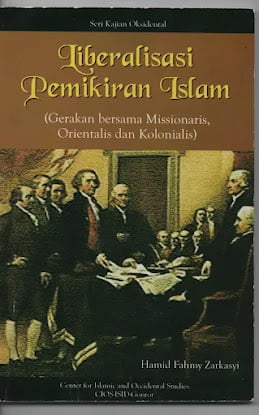
Book Title : LIBERALIZATION OF ISLAMIC THOUGHT (Joint Movement of Missionaries, Orientalists and Colonialists) Author : HAMID FAHMY ZARKASYI Publisher : CENTER FOR ISLAMIC AND OCCIDENTAL STUDIES (CIOS) First Edition : August 2008 Pages : 123 + X Pages.

2 comments
please allow me to quote….barakallah
Please, Brother, please.
Hope it is useful