
Introduction
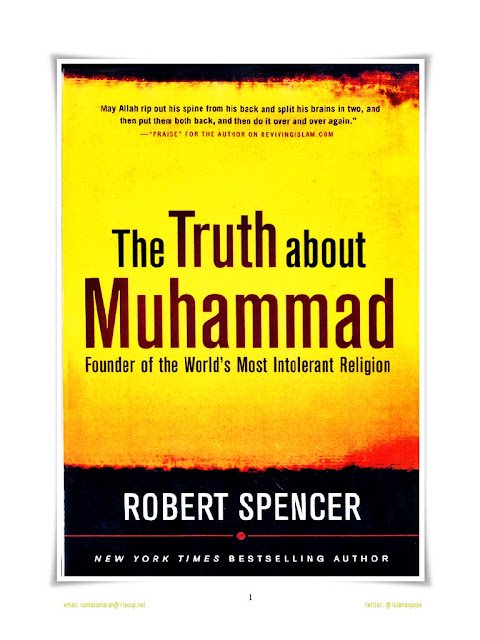
The book is entitled The Truth about Muhammad is written by Robert Spencer. The author, born February 27, 1962, is an American author and blogger known for his criticism of Islam and research on Islamic terrorism and jihad.[1]
This 224-page book is divided into 10 chapters. The first chapter discusses... Why a Biography of Muhammad is relevant today. In this first chapter, Spencer writes a sub-theme about, Is Islam a Religion of peace? Why does it matter? Dueling Muhammad, Why Muhammad matters, Polite fiction are useless.
The purposes of this book, Why I did not want to write this book, Death to “Blasphemer”, Defending freedom of speech and General notes. In the second chapter, Spencer writes about In search of the historic Muhammad, with five sub-discussions. What can we really know about Muhammad? The Qur'an, The Hadith, The Sira and Historical facts and Muslim beliefs.
In the third chapter, he writes about MMuhammad becomes a prophetThis chapter also consists of five sub-discussions. Arabia before Muhammad, Muhammad's early life, Khadija, The first visitation, and The suicidal despair returns. Next in the fourth chapter, Spencer writes about Muhammad revelations and their sources.
In this chapter he divides the sub-chapters into seven discussions. Borrowing from Judaism, “Tales of the ancients” Borrowing from Christianity, Other borrowings, Revelation of convenience? The consequences and Modern shame. In the fifth chapter, Spencer writes, A warner in the face of a terrific punishment. With sub-discussions, difficulties of the Quraysh, The evolution of the command to wage war, The satanic verses and The night journey.
In contrast to the previous discussion, in the sixth chapter Spencer writes very provocatively, Muhammad becomes a warlord. With details of sub-chapters, The Hijrah, The covenant between the Muslims and the Jews, The conversion of Abdullah and tension with the rabbis, The Hypocrites, The Nakhla raid and The break with the Jews and The change of qibla (direction for prayer).
Chapter seven, with a discussion “War is deceit”, with sub-chapters The Battle of Badr Allah's, The Muslims of booty fight for the Muslims, The Qayinuqa uinuka Jews, Ager toward Jew and Christians, Assassination and Decet, The Quraysh strike, Assuaging doubts after Uhud and The Deportation of Banu Nadir.
As for chapter eight, the author writes about Casting Terror into their hearts. With details of sub-chapters The battle of the Trench, Dealing with the Banu Qurayzah, Finding excuses for a massacre, The women of the Banu Mustaliq, Abdullah bin Ubayy and praying for one's enemi, The treaty of Hudaybiyya, The raid at Khaybar, The poisoning of Muhammad and The spoils of Khaybar.
Continued in the ninth chapter, Spencer wrote Victorius through terror. With 12 sub-chapters, The conquest of Mecca, Apostates to be killed, Muhammad at the Kaaba, The battle of Hunayn and the mastery of Arabiya, Invitation to Islam, The Tabuk raid, Collecting the jizya, The last pilgrimage: the right of women and the expulsion of the pagans, The murder of the poets, Muhammad final illness and after Muhammad.
Finally, Robert Spencer wrote about the legacy left by the Prophet Muhammad. This chapter is themed Muhammad's legacy, with sub-chapters, The war on terror, pedophile prophet?, Misogynist, Draconian punishments?, Warrior prophet?, Islamic tolerance?, A kinder, gentler Muhammad, The veneration of Muhammad, Imitating Muhammad today, Frightening reality, and What is to be done.
Criticism of the contents of the book in the discussion of this book provides more comments on the fourth chapter of the sub-chapter. Muhammad's Revelation and their Sources. What Robert Spencer has written in this book is very provocative and departs from his shallow perspective on the truth of the life history of the Prophet Muhammad SAW.
Many Western orientalists have tried to write about and even refute the Quran using their lay knowledge. For example, Spencer, an American author who claims to have studied Islam for 20 years, has made several serious errors regarding the history of the Prophet Muhammad, the Quran, and the Hadith.
Long before this, Ricoldo da Monte Croce (1243-1320)[2] a 13th-century missionary wrote several works on Islam in Latin. In his view, Satan composed the Qur'an and created Islam. Ricoldo's conclusion that the Qur'an was merely a collection of old heresies previously refuted by the Church.[3]
Ricoldo then argued that because the Old and New Testaments did not predict anything in advance, the Quran should not be accepted as "God's law." Furthermore, Islamic doctrines regarding the errors of Christianity and Judaism are unacceptable. He also argued that the Quran's style of language is unsuitable for being called a "holy book."
The ethical concepts in the Qur'an contradict the philosophical statements. And furthermore, the Qur'an is full of internal contradictions.[4] In fact, there are many more types of blasphemy directed at the Qur'an, but the author only takes a few of its statements.
In contrast to Ricoldo with his work Improbatio alcorani (Contra legem saracenorum) The Falsehood of the Qur'an (Challenging Islamic Law), Martin Luther translated Ricoldo's work into Latin, Confutatio Alcorani (Refutation of the Qur'an), Salman Rushdie with his work “Satanic verses” (Satanic verses).
Robert A. Morey (The Islamic Invasion) and several other orientalists, Robert Spencer with his work "The Truth about Muhammad" writes with shallow accusations about revelation in Chapter Four "Muhammad revelations and their sources" or the Source of Muhammad's revelations. It is in chapter four that Spencer writes; "One of the most severe and lingering challenges to Muhammad's claim to be a prophet both during the twenty-three years of his career and throughout the history of Islam, was his apparent dependence on Jews, Christians and other sources."[5]
Translation of his Indonesian book “The Truth about Muhammad” One of the most formidable challenges to Muhammad's claim to prophethood, both during his 23-year career and throughout Islamic history, is his obvious reliance on Jewish, Christian and other sources.[6]
In Robert Spencer's view, Muhammad's claim to prophethood poses the greatest challenge to Jewish and Christian teachings. They assume that Muhammad's prophethood poses the greatest challenge to Judaeo-Christian belief in these claims. Likewise, the teachings brought and conveyed by the Prophet Muhammad are heavily dependent on previous religions, both Judaism and Christianity.
In reality, this accusation is completely baseless, considering that the teachings brought by the Prophet Muhammad were actually as an imam rather than the Jewish and Christian teachings which have been distorted by the compositions and adaptations of human hands who want to adapt their holy books to their own religious interpretations.
[1] https://id.wikipedia.org/wiki/Robert_Spencer_(author)
[2] https://id.wikipedia.org/wiki/Riccoldo_da_Monte_di_Croce
[3] Adnin Armas, MA Bible Methodology in Qur'anic Studies, a critical study. (Depok: Gema Insani Press, 2005) Page 27.
[4] Ibid, p. 27
[5] Robert Spencer, The Truth about Muhammad (Washington DC: Regnery Publishing, INC. 2006) p. 47
[6] Indonesian translation

2 comments
I apologize in advance, I try to address and understand this as a non-Muslim former convert, in my opinion Robert Spencer (RS) has better knowledge than a Muslim who has a deep knowledge of Islam, why? Because RS is non-Muslim, therefore can study "Freely" and "thoroughly" with a Broad and Open Context of Thought, RS is not limited by the dogmas in Islam that limit a Muslim if he wants to learn the truth in Islam. I can say this because I am a non-Muslim, a freedom that I did not get when I became a Muslim. Previously I converted because I saw that Muslims are good people, but the more I understood Islam, the more I lost that goodness, my heart formed a barrier against non-Muslims, my heart was not at peace, there was only hatred for Jews, Christians, Americans, none of whom I knew or who hurt me. Many of my friends who used to be good with Christians, now began to distance themselves, keeping their distance, both in business and social interactions. This opened my mind, why Muslims... the more they understand Islam, don't they become better? Unlike the Christian teachings I used to follow, many Christians who identify as "better" become "better" when they "deeper" know Jesus, on the other hand, many "Good" Muslims become more "Intolerant and Radical" precisely after learning more about Islam and following its creed. Many Muslims are unaware of this because they enter the system and "turn off" their conscience. Because I was previously non-Muslim, I always judged a religious person by their behavior, and when I converted to Islam, frankly I was disappointed, because Islam was not able to make me better, "Peace and Beauty" is just empty propaganda, since childhood "before knowing religion" I was taught to forgive, not to fight or hurt others, even if hit is forbidden to retaliate, but in Islam it is very different, Muslims are taught to hate and even kill. "Peace and Beauty" is only to deceive and build a good image for non-Muslims, because in Islam it is not forbidden to deceive for their benefit, something that is not taught in other religions, this is what made me realize and return to the right path. I realize, Heaven is a Holy Thing, It is impossible for murderers, rapists, cheaters, and those with dirty minds to inhabit Heaven, because according to the law of the state, they deserve to live in prison, let alone according to God, they are definitely the inhabitants of Hell! For Muslims who read my comment, don't immediately blaspheme, please use your remaining conscience...
Let me correct you slightly. There is no such term as "ex-convert" in Islam; there is only "murtad." This means you are a non-Muslim who has left Islam, not a convert from Islam, but an apostate or (converted). Regarding your statement about Robert Spencer having in-depth knowledge and understanding superior to that of Muslims, as far as my article has shown, there is no empirical evidence that he has a better understanding of Islam. Spencer's books and published works are the result of propaganda and the hegemony of Western thought, which in fact rejects the sacredness of religion. Spencer's confusion and shallowness seem to expose who he is and the quality of his true understanding of Islam. So, your standards regarding Spencer's beliefs are unclear. Furthermore, regarding Islam, which when you adhere to it does not grant individual freedom, but the freedom you gain when you become a non-Muslim, I also question your definition of freedom. Isn't it true that when a person is religious, they obey the rules of their religion? This means you are bound by the rules of your religion, unless you choose atheism or simply follow a belief.
Then, regarding the issue of "intolerance and radicalism," I simply want to say that if it weren't for the hospitality of Islam, non-Muslims everywhere would not live in peace, especially in Indonesia. You are living proof that Islam is a tolerant religion.
May Allah give you guidance, my brother.