
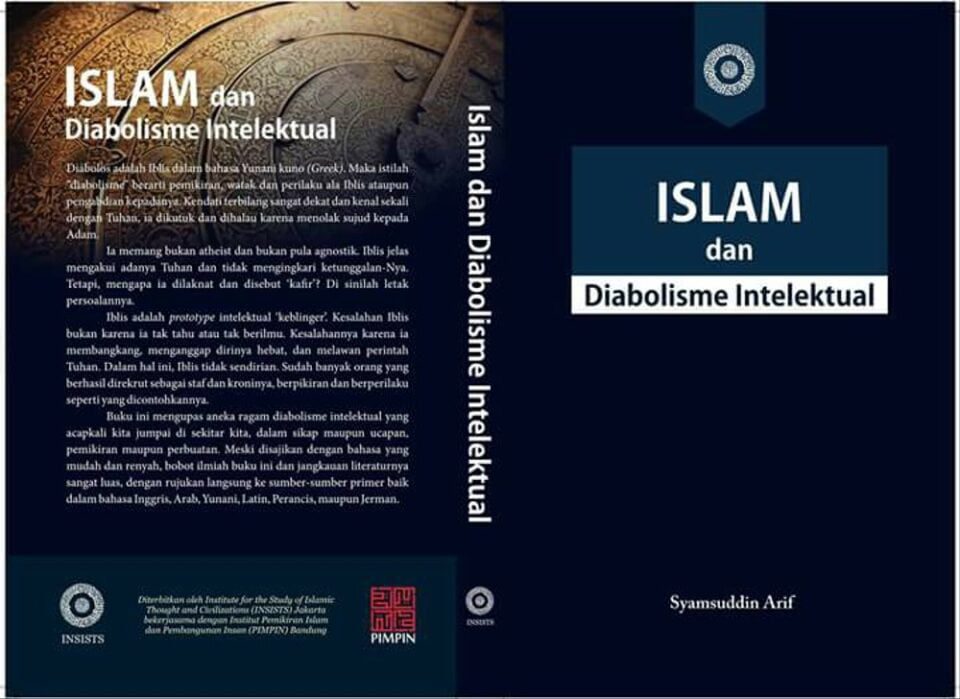
This book, written by Dr. Syamsuddin Arif, provides a thorough explanation of several contemporary issues affecting the Muslim community. The first issue raised is a clear explanation of the definitions of intellectual and ulama. The term 'intellectual' was unknown in the Islamic world until the modern era. People in the Middle East now call intellectuals 'mutsaqqaf' (cultural figures) and 'mufakkir' (thinker).
Meanwhile, in Indonesia, they are termed 'intellectuals'. Intellectuals are scholars who are always at odds with those in power, always critical and rebel against all forms of establishment or status quo. The ulama are people who have an understanding of Allah's religion and then master and teach it. Not only that, the ulama are people who have qualities of knowledge, goodness and excellence in them. (3.15)
In keeping with the title "Islam and Intellectual Diabolism," Dr. Syamsuddin Arif, in a crisp, scientific writing style, explains what is meant by diabolism, and who exactly is included in this diabolical group. Dr. Syamsuddin Arif quotes Arthur Jeffery's statement in his book. “The Foreign Vocabulary of the Qur'an” The term "diabolism" means the thinking, character, and behavior of the Devil or devotion to him. The Devil is the intellectual 'prototype' 'crazy' As narrated in the Qur'an, Iblis begged for his death to be postponed for a while and vowed to drag others into his path by any means necessary. (24-25)
Furthermore, Dr. Syamsuddin Arif criticized the virus of "liberal thought" that has plagued Muslim scholars. The virus of liberalism encompasses three things. First, unlimited freedom of thought, aka freethinking. Second, constantly doubting and rejecting the truth, aka shopismAnd third, a loose and arbitrary attitude towards religion. (loose adherence to and free exercise of religion).(33).
Epistemological Cancer is a contemporary scientific term used by Dr. Syamsuddin Arif when attempting to analyze an intellectual illness that can affect anyone. People with epistemological cancer typically exhibit early symptoms of skepticism (doubt) about everything from trivial matters to matters of principle, especially regarding faith. They constantly doubt the truth and justify their doubts.
Second, people with epistemological cancer hold relativistic views. They assume that all people and groups are equally right, and all opinions (religions, schools of thought, sects, groups, and so on) are true. Finally, people with epistemological cancer experience confusion in their knowledge. (cognitive confusion). No longer able to differentiate between right and wrong, what is haq and what is false. (45-47)
It's undeniable that issues surrounding Islam and politics are also a sharp focus in this book. Dr. Syamsuddin Arif, in his presentation, argues that Islam is the only religion that deeply cares about politics. However, it doesn't see politics as an end in itself, but rather as a means to an end. Several paradigms are adopted by observers and practitioners of 'political Islam'. This radical pessimistic paradigm is represented by political observers such as Oliver Roy, author of the book The Failure of Political Islam (The Failure of Political Islam).
Furthermore, the radical utopian paradigm aspires to establish an Islamic state, rather than simply striving to realize aspirations and defend the interests of the people within the framework of modern democracy. And the moderate optimistic paradigm denies Oliver Roy's opinion. For them, Islam and politics need not be at odds. Religion and state should not be separated. Islamic politics is not a fairy tale, but rather the experience and practice of over a thousand years. And therefore, 'Political Islam' is not a utopia or mere wishful thinking. (49-54)
In addition to addressing intellectual and political issues, religion, and the cancer of epistemology, Dr. Syamsuddin Arif also explained the meaning of freedom. For a Muslim, freedom has three meanings. First, freedom is synonymous with 'nature' namely the original character and nature of humans before they were changed, polluted and damaged by the living systems around them. So free is a person who lives in harmony with his nature.
The second meaning of freedom is power or ability (istita'ah) and will (masyi'ah) and desires (will of god) that God gives us to choose our own path in life. The third meaning, freedom in Islam means 'choosing the good' [ikhtiyar] as explained by Professor Naquib al-Attas, according to the root of the word ikhtiyar requires the right choice and good consequences. (168-169).
The most serious problem in this country is corruption. Over the past few years, the media has reported on corruption cases ranging from the highest levels to the "kindergarten" levels. From the heart of the government elite to the village level. From businessmen to politicians. From district officials to gray-haired officials. Surprisingly, prosecutors, judges, police officers, and even ministers are all corrupt. This was not overlooked by Dr. Syamsuddin Arif in his twenty-second discussion topic (179-183).
Plot twist , this book reviews about “Everroism and Renaissance” A historical memoir long buried in historical memory. The figure of Ibn Rushd now seems to have come back to life. While the santri (Islamic students) know him only as a jurist, the intellectual class admires him as a 'bridge of knowledge' between East and West, a link between the Islamic and Christian worlds. That is the figure of Ibn Rushd, also known as Averroes, a figure who was later referred to as a pioneer of the enlightenment movement in the West. (191).
In conclusion, this book is highly recommended for today's millennial generation of intellectuals, given its dense content and critical messages that resonate with today's current trends.
Advice of the Prophet and the Guardians The roots of the earthly nature
It's good to listen to and obey the Pigeon Boy on the teak branch
Live once in this world to be happy and blessed
There's no use being jealous. Clean your heart before you die
Wallahu'alam bis Showab
Book Title: Islam and Intellectual Diabolism Author: DR. Syamsuddin Arif Publisher: INSISTS and PIMPIN First Edition, 2017. Thickness: vi + 253 pages ISBN: 978-602-19985-7-1

2 comments
Bro, is there a download link for the ebook Islam and Intellectual Diabolism?
The e-book is not available. Please contact Kalibata Bookstore or INSISTS Jakarta.