

14.00
Normal
0
false
false
false
false
EN-US
X-NONE
AR-SA
Here, I have the opportunity to review another book by Dr. Syamsuddin Arif, who is also my lecturer at Unida Gontor, teaching the course "Islamization of Knowledge." Although it's not related to the course he teaches, I'm not sure.
However, Dr. Syamsuddin Arif is not lacking in knowledge outside his area of expertise. This book is a guarantee. His in-depth, insightful, and intelligent discussion, drawing on primary references from prominent Shia figures, will leave readers in awe of the breadth of his knowledge.
This book is straightforward, full of meaning and rich in substance, which will lead the reader to continue reading slowly, sometimes turning the pages again, because they don't want to get caught up in forgetting the 'terms' that are considered complicated but can still be digested by the brain.
If you look at the authenticity of the references he refers to, he could be said to be an expert on Shiite adherents. Very book recommended For students, academics, and the general public, as well as those curious about Shi'ism, especially Muslims who don't want to be infected by Shi'ism.
Happy reading!
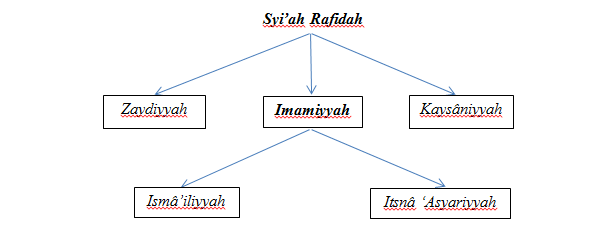
As far as the research that has developed in the history and explanations of the ulama, there are three types of Shi'ism explained by Dr. Syamsuddin Arif is the author of this book. Shia scholars have not been able to dissect the three types of Shiaism. First, Shia terminology; second political Shia; and third ideological Shia. If the pattern is drawn it will look like the arrow below.

The author explains the meaning Shia terminology in terms of language in the general sense according to the dictionary, or literally which originally means group, follower, defender.
In this sense, the author refers to Nusron Wahid, for example, as "Ahok's Shia," meaning Shia in the sense of terminology, as Nusron is one of Ahok's defenders or followers. The meaning, significance, and terminology of "Shia" are discussed at length on page 11 under the subtitle "The Question of Terminology." Furthermore,
Furthermore, political Shia is Shia in a special sense, referring to the word used to refer to the companions who supported, sided with, and faithfully fought alongside Sayyidina 'Ali during the conflict after the death of Caliph 'Uthman bin Affan.
As for the third, ideological Shia what is explained by the author is Shi'ism with its own meaning and significance which falls within the realm of belief ('creed or i'tiqad), mindset, thinking framework (intellectual framework) to the way you view the world (worldview), which will ultimately form attitudes, influence behavior and determine and determine the form of acceptance and rejection of information by people.
Uniquely, it always provides a form of understanding, coloring its interpretation of facts, realities, and events. In another sentence, the author states that this ideological Shi'ism is a splinter movement that emerged later, approximately two hundred years after the death of the Prophet Muhammad (peace be upon him). [pp. 15-16].
Regarding ideological Shi'ism, the author of this book continues his explanation by dividing ideological Shi'ism into three variants. First, proto-Shi'ism (tafdil Shi'ism). Second, (Rafidah Shi'ism), and third, (ghuluww Shi'ism). This type of tafdil Shi'ism merely considers Sayyidina 'Ali as superior, great, and special (afdal) compared to the other companions of the Prophet Muhammad.
This is without being accompanied by denial, rejection, abuse or curses against the three caliphs before Sayyidina Ali, namely (Abu Bakar Sidiq, Umar Bin Khattab and Ustman Bib Affan) as well as against the companions of the Prophet Muhammad SAW. [p. 39].
Shiite rafd/rafidah group which expressed the opinion that Sayyidina 'Ali was the only person who had the right to become the leader of the people after the death of the Prophet. Therefore, this group rejects it
the previous caliphate was illegitimate. So this group was nicknamed al-firqah al-rafidah alias al-Rawafid.
The terms rafidi and rafidah applied to Shiite people have been commonly used since the second century of the Hijrah. If viewed from a lay perspective, this type of Shi'a (rafidah) is famous or popular because many Sunnah scholars often use the term rafidah in their lectures and preaching.
Until Imam Malik and Imam as-Syafi'i called the ideological Shiites rafidah. Their belief regarding the appointment of Sayyidina 'Ali and the Imams after him was firm (bi'n-nass), namely not through deliberation or election. So this Shiite group is also known as the Shiite Imamiyyah. The Shiite imamiyyah group also split into several sects. For details regarding this stream please see [pages 40-43].
The third is Shia ghuluww or 'Ghulat' This is a group that has strange, complex, or intricate beliefs that tend towards disbelief and polytheism. They believe that Sayyidina 'Ali is God in human form. ('ala sûrat al-insân) and believe that God can reside in a person's body (yahullu fi 'l-ashkhâs).
According to this school, the first person created by God was the Prophet Muhammad, that the Holy Spirit was God who was initially in the Prophet and then moved to 'Alî and the priests after him. The human spirit moves by exchanging bodies, until the dead can come back to life, but 'Alî and the priests after him did not die because they will come again at the end of time to fill the world with justice. [matter. 43-44].
Diving into the next chapter, the author, with the breadth of his knowledge, explains about Shi'ism. Takfiri and Taqdisi. These two types of Shi'a not only reject the legitimacy of the caliphs other than Sayyidina 'Ali, but instead consider all companions who followed 'Ali and did not lead after him to be infidels. For this group, Sayyidina 'Ali is also sanctified or purified.
Included in this group are Imami Shiites such as al-Kulaynî, al-Mufîd, al-Majlisî, al-Khomeini and their followers. The Shiite Imamiyyah consider the companions of the Prophet to be infidels and apostates. And in general, for Shiites, the imam is the successor of the prophet. And the position of the Imam is the same as that of the prophet, as proof (hujjah) of God's justice towards humans on earth. [matter. 47].
In chapter ten, the author focuses more on explaining how the growth and development of Shia doctrines from their first appearance to the current condition, which is reviewed in the sub-theme entitled "Evolution
and Doctrinal Innovation” The author presents a chronological map of Shia doctrine from the first to the fifteenth century. [pp. 58-73].
One of the most important things about Shiites is the "Aqidah" they believe in. Why is this considered very important, because the Aqidah of the Shiite group is very different from the Aqidah of Ahlus Sunnah. Aqidah means conclusion. The plural is 'aqâ'id. What is meant is a set of beliefs or beliefs. Another term is i'tiqâdât.
There are several serious differences between the Shia creed and the Sunni creed. The author then explains each of their creeds one by one. These include Bada', Wasi'at, Nass, Sahaba, Ghaybah, Raj'ah, Mahdi, and non-Shi'a. All are clearly explained in the sub-chapter entitled "Shia Creed" (pp. 76-108).
Entering chapter twelve, the author explains "Shia Interpretation" regarding the Shi'ite interpretation of the Koran which tends to be manipulative and distorted. The Shiite group deliberately changes the verses of the Qur'an to justify their beliefs by skipping the zahir meanings of the Qur'an, then giving them meanings according to their wishes. Like verse 85 of Surah al-Qasas.
Which mean, (Indeed, He who obliges you to carry out the Qur'an will indeed return you to your place of return). This verse is interpreted by Shiites as evidence for raj'ah, that is, the return of the Prophet or Imam to this world after their death. Some of their more 'bizarre' interpretations can be found on [pp. 109-118].
In the next chapter, the author explains about "Shia Hadith" which according to Shi'ah hadith are reports of sayings, actions or decisions of holy people who are protected from mistakes and sins. (qawl al-ma'sûm aw fi'luhu aw taqrîruhu) namely, the priests from among 'Ahlul Bayt They consider him to be equal in status to the Prophet and recognize him as the go-to person for religious questions. Essentially, the Imam plays a vital role in the transmission of hadith. Essentially, once the Imam speaks, everyone must remain silent. In the name of the Imam, reason is silenced. [pp. 119-120]
The author also introduces the names of the most recent Shiite hadith books and their contents. For example, 1). Buku al-Kâfî (sufficient book) written by Muhammad ibn Ya'qûb al-Kulaynî (d.329/940).
This book consists of 8 volumes and contains more than 19,000 hadith. 2). The book Tahzîb al-Ahkâm (a filter of laws) written by Muhammad ibn al-Hasan Abu Ja'far at-Tusi alias Sheikh at-Tâ'ifah (d. 460/1067). This book contains approximately 13,000 hadith. 3).
Book al-Wâfi (which fulfills) the writings of Mullâ Muhsin alias al-Fayd al-Kâsyânî (d. 1091/1560) containing around 45,000 hadiths. 4). Buku Bihâr al-Anwâr al-jâmi'ah li-durar akhbâr al-a'immah al-athâr (The sea of light that collects the pearls of the history of the holy priests). Essay by Muhammad Bâqir al-Majlisî (d. 1110/1699). Collected no less than 85,000 hadiths. And there are still several more hadith books that the author has discussed thoroughly [p. 120-122].
In the next chapter, the author explains "Shia Practices." The author attempts to explain the social and ritual practices that are characteristic of Shia. First, Taqiyyah. Second, Bara'ah. Third, Curse. Fourth, 'Ashura' and sixth, Mut'ah. From the practice of Taqiyyah to Mut'ah practiced by Shia followers, it emphasizes a clear difference with Ahlus Sunnah. That these practices are merely splinter teachings that they themselves concocted and processed. [pp. 123-138].
The author concludes the final chapter by examining the development of "Shi'ism in Indonesia." This includes a discussion of the early history of Shi'ism's arrival and emergence in Indonesia. In the "Concluding" chapter, the author summarizes the main discussion on history, faith, legacy, and answers the question: are Shi'ism infidels?
The author explains this answer by quoting the opinion of Imam Abu'l Hasan al-'Asy'arî in his book Maqâlât al-Islâmiyyîn Regarding the various sects (firaq) with different beliefs (Khawarij, Shia, and so on), they are all Muslims. However, their actions are deviant, wrong, misguided, sinful, and their actions are considered major sins.
Way of thinking and perspective (worldview) They are very problematic or in other words their worldview is not Islamic, even their faith may be lost when they say and believe that Abu Bakr, Umar, Uthman are infidels and the accusation is then turned against them. [p. 139/148].
Hope it is useful.
Wallahua'lam bis showab
Book Title: Not Just a School of Thought: Shiite Opposition and Heterodoxy
Author: Dr. Syamsuddin Arif
Publisher: INSISTS (Institute for the Study of Islamic Thought and Civilizations)
Printing: First 1439/2018.
Thickness: xii+204 pages
ISBN: 978-602-19985-8-8
Reviewer: Sofian Hadi, M.Ag

1 comment