
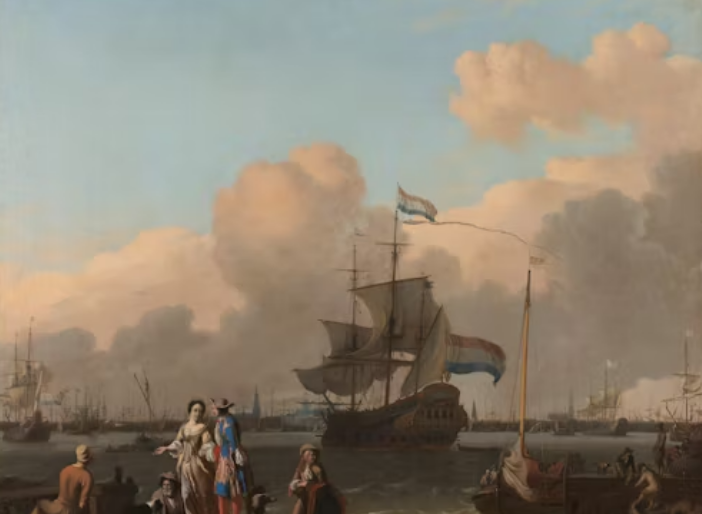
Who's still interested in reading history? Surely, some readers are still interested in reading about history, especially the history of colonialism in Indonesia. This article attempts to...flashback A brief summary of the dark history of how our ancestors lived under the pressure of colonialism.
In the 15th century, Spanish and Portuguese seafarers successfully brought spices to trade in Europe. This aroused great interest and enthusiasm among other European nations, such as the Netherlands, France, and even England.
They then began colonizing the areas they visited. In 1596, a fleet of four sailboats under the command of Cornelis de Houtman arrived at the port of Banten.
To strengthen its position in the Indonesian archipelago, in 1602 the Dutch established a trading company called “Verenigde Oost Indische Compagnie” The Dutch East India Company, also known as the VOC, was often called the "Company" by the natives, or in the villages, "Blanda Urik."
Facing the potential for wide-open opportunities and opportunities to expand its business, the Dutch Royal Government granted the VOC extraordinary rights and powers. These rights were granted to further enhance the VOC's colonial efforts, both in the spice trade and in the indigenous population.
These rights and powers included permitting the formation of an army under VOC command, the right to govern occupied territories, the right to declare war if necessary, and the right to make treaties with kings throughout the archipelago. They also had the right to exercise monopoly power and the right to print and circulate their own currency.
With these rights and powers, the VOC officially became a tool of the Dutch colonial government in Indonesia. Historical records indicate that in 1605, they successfully captured a Portuguese fort in Ambon. This successful capture marked the beginning of large-scale colonization in Indonesia.
The granting of authority, rights, and power to the VOC demonstrated that trade was no longer the primary objective. The original mission of exploring Indonesian spices and natural resources transformed into a display of strength and power, with those who resisted being captured and, if necessary, destroyed.
As time went on, the number and size of the Urik Dutch guards and soldiers became greater. Wider power. They forced kings to make agreements that were detrimental to the native people. Political bring into conflict came into force, in the interests of the Dutch, Urik, who all had to submit to their will and power.
It was in those years that the VOC carried out large-scale earth exploration. Shipping Hongi In 1650, small boats were used to destroy native trees and spice plants. Around the same year, the implementation of the work forced labor (forced labor without wages) for the natives. Forced taxes, and the VOC actually claimed absolute (monopoly) control of the spice trade system.
VOC Disbanded
On December 31, 1799, the VOC was dissolved. Losses or bankruptcy were the reasons for the trade union's demise. All Dutch property rights in Indonesia were taken over by the Dutch government on January 1, 1800.
The transfer of power from the VOC to the Dutch government did not change the implementation of the rules of government at all. Instead, it became even more cunning and deceitful than before. The Dutch government immediately appointed a governor-general on behalf of the Dutch government.
The indigenous people became increasingly oppressed. Monopoly regulations and forced labor continued until 1870. The implementation of the forced cultivation system (1830–1870) continued to inflict pain on the people. The plight of the indigenous people worsened. Oppression and tyranny became a daily occurrence for the people, a consequence of the colonization of a region.
The dissolution of the VOC in 1799, then mandated to Governor General Herman Willem Deandels (1808–1811), further exacerbated the suffering of the indigenous people. Although Deandels represented the French government in his leadership, Dutch regulations were still applied.
During Deandels' leadership, indigenous people suffered numerous casualties. He ordered the construction of a 1,000-kilometer highway from Anyer to Panarukan. Forced labor was again implemented to further the ambitious road project. Indigenous people were forced to work without pay. This road served as a defense line against British attacks. This road later became known as the Deandels Highway.
The Emergence of the Resistance Movement Against the Colonizers
It is important to remember that in the early history of the arrival of foreign nations to the archipelago, the natives welcomed their arrival very happily, because their presence was for business purposes, meaning it would be mutually beneficial for both parties.
However, in the Buya Hamka language, given a heart, wants a heartThe desire of foreign nations (the Dutch) to monopolize trade. They didn't want to lose money, they had to make large profits. Natives were not considered business partners, but rather, they were seen as disruptors of trade and commerce. Natives had to be colonized and their role removed. This was where the seeds of hostility and conflict arose, eventually leading to the outbreak of war against the colonialists.
The people of the archipelago then fought back. They did not want to be oppressed by colonialists. Even willing to die for the honor of their homeland, natives are willing to do so. With steely determination and enthusiasm, the people of the archipelago, the indigenous population, fought to defend every inch of their land and territory from undermining, oppression and the grip of the colonialists' nails.
Such is the true nature of foreign nations. Once they see the material potential and wealth of a country, they will use any means necessary to control it. They will use any means necessary, whether through threats, torture, oppression, or even murder. All for the sake of acquiring worldly goods that will never satisfy their greed.
The forms of colonialism described above clearly illustrate the harshness of colonialism against the Unitary State of the Republic of Indonesia and the suffering of the indigenous people at that time. Therefore, it is both right and proper to resist. Confronting the colonizers is an obligation that must be upheld.
Book References, Commander-in-Chief General Soedirman: The Last Pioneer of Colonialism in Indonesia, (1993). Karya, Tjokropranolo (Lieutenant General (Ret.) Indonesian Army)
Continued to the next part…
And Allah knows best

1 comment