Local Content is one of the subjects at elementary school level, especially in Gumi Tatas Tuhu Trasna Central Lombok Regency. This subject is listed as a compulsory subject for both lower and upper grades.
In fact, this has been regulated in the Minister of Education and Culture Regulation Number 79 of 2014 concerning Local Content of the 2013 Curriculum and is supported by Law Number 23 of 2014 concerning Regional Government.
It states that local content must be taught in every basic education unit as part of the process of forming attitudes, knowledge, and skills of students to know, love, and preserve the natural, social, and cultural environment in their area.
However, this policy is not aligned with the availability of facilities to support the Local Content learning process. One of the problems that has emerged is that subject teachers in these subjects have difficulty accessing teaching materials that can be used to support their learning.
Based on the results of the identification that I conducted, the lack of local content teaching materials causes the Local Content learning process in elementary schools to not run optimally.
As a Community Literacy Volunteer at the National Library, this situation is a key aspect I pay attention to. I strive to find solutions to address this issue in education.
The insight I have in the world of education and writing has become a kind of opportunity for me to present books with local content, while simultaneously realizing the ideals of those involved in learning Local Content.
I am grateful for the good communication network with the Central Lombok Regency Arts Council, which made it easy to hold an audience with the Central Lombok Regency Education and Culture Office.
This audience aims to encourage the Regional Government—in this case the Education and Culture Office of Central Lombok Regency—to create a program for compiling locally-based teaching materials involving local writers and illustrators.
The school will then be able to use these teaching materials in local content lessons. My joy peaked when the Department of Education and Culture appreciated and approved the proposal. Furthermore, as a Community Literacy Volunteer at the National Library, I was also involved in the team tasked with compiling reading materials with local Sasak content.
On Wednesday, July 2, 2025, I, along with Lalu M. Gitan Prahana—a representative of local writers, and Mashur Hadi—an illustrator representative, visited the Central Lombok Regency Education and Culture Office to meet with the head of the office and the head of the division, as well as to align perceptions regarding the model of teaching materials that will be prepared as guidelines for learning Local Content at the elementary school level.
The meeting resulted in an agreement on the preparation of graded teaching materials with local content (in the Sasak language) equipped with illustrations to strengthen the memory of students at each level, exactly like the quality reading materials that have been distributed by the National Library of the Republic of Indonesia.
This decision led the three of us to divide the tasks. I was in charge of compiling local content reading materials for levels B3 (beginning readers for ages 8-10) and C (intermediate readers for ages 8-10).
Then M. Gitan Prahana compiled local content reading materials for levels A (early readers for ages 0-7 years), B1 (early readers for ages 6-8 years), and B2 (early readers for ages 7-9 years); while Mashur Hadi polished each page of each book with illustrations.
Lalu M. Gitan Prahana, Mashur Hadi, and I were given a deadline of approximately three weeks to complete our respective assignments. With this relatively short time, I made every effort to find references—literature that would support my understanding of both book gradation and local Sasak culture.
I did this so that this book would not only be an entity, but could support the learning process of students at the elementary school level in a sustainable manner.
After three weeks of struggling with time and struggling with the writing, Lalu M. Gitan Prahana, Mashur Hadi, and I finally completed our assignment. Five graded books with local Sasak content—levels A, B1, B2, B3, and C—are ready to be submitted to the Central Lombok Regency Education and Culture Office.
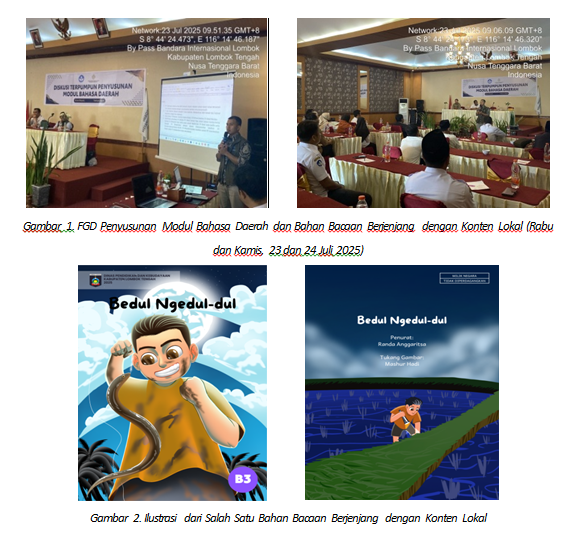
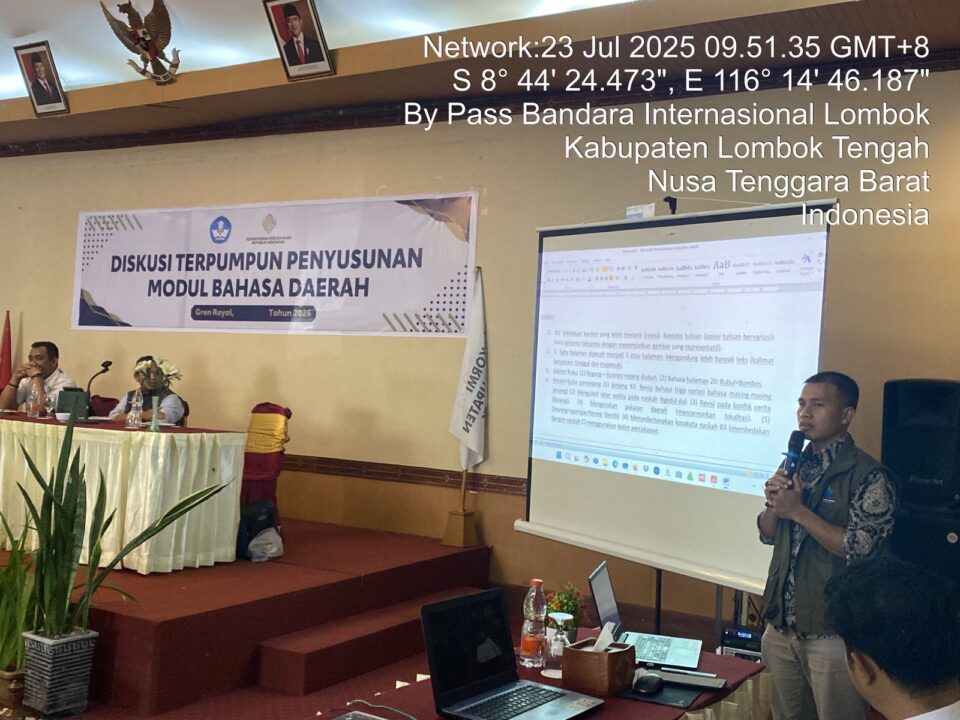
An image of one of the reading materials with local Sasak content is attached to this short article. As a result, the five graded reading materials with local Sasak content that we have successfully compiled were reviewed during the activity. Focus Group Discussion (FGD) with 40 participants from the Central Lombok Regency Education and Culture Office, school principals, and local content teachers.
The event was scheduled to take place at the Grand Royal Batujai Hotel. FGD This time, we are not just acting as writers, but as resource persons who facilitate and receive input from participants, both regarding the depth of the material, diction, graphics, and illustrations at each level.
After being corrected based on the results review When FGD, the graded reading material with local Sasak content has now entered the publishing table in early September 2025, and is ready to be distributed to several schools by the end of 2025.
Graded reading materials with local Sasak content will add to students' knowledge and serve as an alternative to maintain the existence of local Sasak culture in Lombok, West Nusa Tenggara.
As a Community Literacy Volunteer at the National Library of the Republic of Indonesia, I hope that similar activities need to be carried out regularly to increase the quantity and quality of reading, both for schools and the general public.
Writer: Randa Anggarista; (Locus Community Literacy Volunteers, Central Lombok Regency, West Nusa Tenggara Province)