
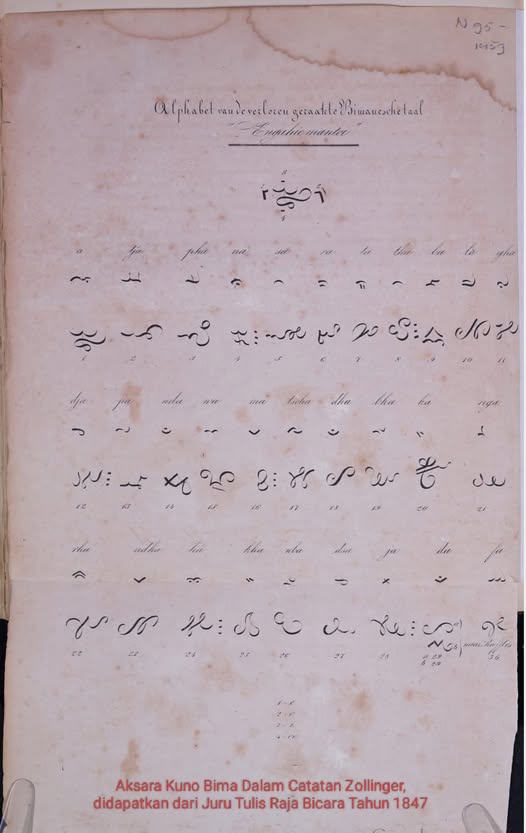
One of the most important and valuable historical and cultural products of the Bima people is their own script. However, this language and script have now been lost. This script is called Engahie Mantoi. When I asked if anyone still knew some of the words in that ancient language, they replied, “No.”
However, in the past, some people still remembered a few words from this language. However, manuscripts or writings in this language no longer exist. Today, no native speakers know anything about it.
I am enclosing a copy of the script provided by Earth of Parasi Koe who was the scribe of King Bicara. (as in the picture, Pen). On the other hand, Raffles also included a copy of the ancient Bima script in his book History of Java.
If you look closely, there are differences between the script I presented and the script used by Raffles. However, the basic form can be found in most of them. What is different in Raffles' copy is Pha, Ra, Tha, Ba, Da, Dha, Ka, Rha, Za, and the last one is Yes. Temporary Za in the copy Raffles refers to DJ in the script my copy is, or perhaps should represent Dsa. The last da in the Raffles appendix is probably more accurate than the one in my copy.
Because in my copy it is completely consistent with Dha first. Therefore, he should use the mark under No. XXVIIIb, instead of mark No. XXVIIIa. On the other hand, Raffles has the same mark for DJ And Dsa, I think that one is not quite right. He marked No. XI twice; while I marked No. XXVI, which is more correct.
Thus, all scripts have the following sound system: : a, ha, wa, ja, ra, rha, la, sa, ma, na, nga, nja, ga, gha, ka, kha, ba, bha, nba, pa, pha, fa, da, dha, nda, ndha, dsa, dja, ta, tha, tja, tscha.
The No. I sign before the letter means a clear and sharp e sound. The No. II sign behind the letter indicates the o and ò sounds. The No. III sign above the letter indicates the i sound. The No. IV or No. III sign below the letter indicates the i sound. oe.
These four characters are also found in the Makassar script. However, the ancient Bima script does not have letters placed above the letters and indicating sounds. eng. What is similar between Makassar and Bima is the sound system. nga, nja, nba, nda, and ndha. Meanwhile, the Makasar script has differences, namely in the sound nga, nka, nra, nja and ntja.
That a script emerged from a very long struggle over time and was then used for a long time. However, when today that language and script suddenly disappear, it becomes something of a mystery.
There is no historical record explaining the disappearance of this language and script. Irrational explanations are certainly unacceptable. So what language and script were they? Could they be a lost Polynesian language and script, or one of the Polynesian sublanguages? These questions require in-depth and lengthy study to answer. I don't have enough time to produce accurate findings.
The Bima language spoken today is very different from Malay. Bima is closer to the mother tongues of the East. Bima shares fewer similarities with Malay than Sumbawa and Sasak, which share many similarities with Malay.
From a phonetic point of view, what is unique about the Bima language is that apart from having a sound system, the Bima language also has a sound system. Ben K, also has a sound f, for example afi, Not fire. Even more remarkable is the uniqueness of the Bima language in combining vowels without inserting consonants. This is a distinctive characteristic of Bima that shows its kinship with languages to the east and the South Sea islands.
To give a clear picture, I show how the Bima language has three different sounds, from e and the diphthongs a and o, namely ò and oh. The following combination was found: ao in the word kao, the same as when saying the word krabben in Dutch. Ñò in words na-ò, the same as the pronunciation of the word trouw in Dutch.
Aau in words wa- au, such as mentioning waarom. а ое in the word da-oe it's like saying the word indigo. ee in words nè-è like the pronunciation of the word willen. ei in the word èï as in the word slaperig zijn. е ое in the word е-ое as in the word baden. io in the word tio. It's like he's in Schelden. iï in words triï as in the word urine. і оe in the word iha ïoe (flaauw vallen). oa in the word meloa as in the word verstandig. oi in the word oi niwa as in the word dierbaar. ò ò in the word ò ò as in the word bamboos. ò ое in words do-oe as in the word mensch. ое-а in the word phaboe-a as in the word mocten. ое-ое in the word roe-oe as in the word voordeel.
There are almost no words that do not combine vowels, some even combine three vowels, such as in: ka- oe-a for the vowels. So Bima tends to omit not only final vowels, but also mid vowels. For example ta-ä which in the Lontara letters mMakasar is called tal-la. Thus ka-oe-a can be traced directly to Malay, just like oe-a in the Sandwich Islands can be referred to the word oedjan (rain). In the same way, Ai (day) can be returned to day. I can give hundreds of examples related to this.
In the final chapter, I compiled a list of Bima words and compared them with other languages on Sumbawa Island to see their kinship. Since the ancient script was lost, Bima currently lacks its own script. And no manuscripts written in Bima script exist.
All manuscripts in Bima today are written in Makasar script and Javanese script. (Malay Arabic). So, the Bima people do not have their own literature. Some historical stories, such as the history of Indra Djamroet, were written in Malay with Arabic script. The only traces are found in Pantun, which is sung in Bima. I show an example to see the sound system in Bima.
Nahoekoe maroe sandini nifi Nahoekoe bola wali woe-a samada. Pahoe di gomie Da loa koe nefa.
Today, people in Bima write using ink on paper. Previously, they wrote with small, sharp knives on palm leaves.
And Allah knows best

1 comment