
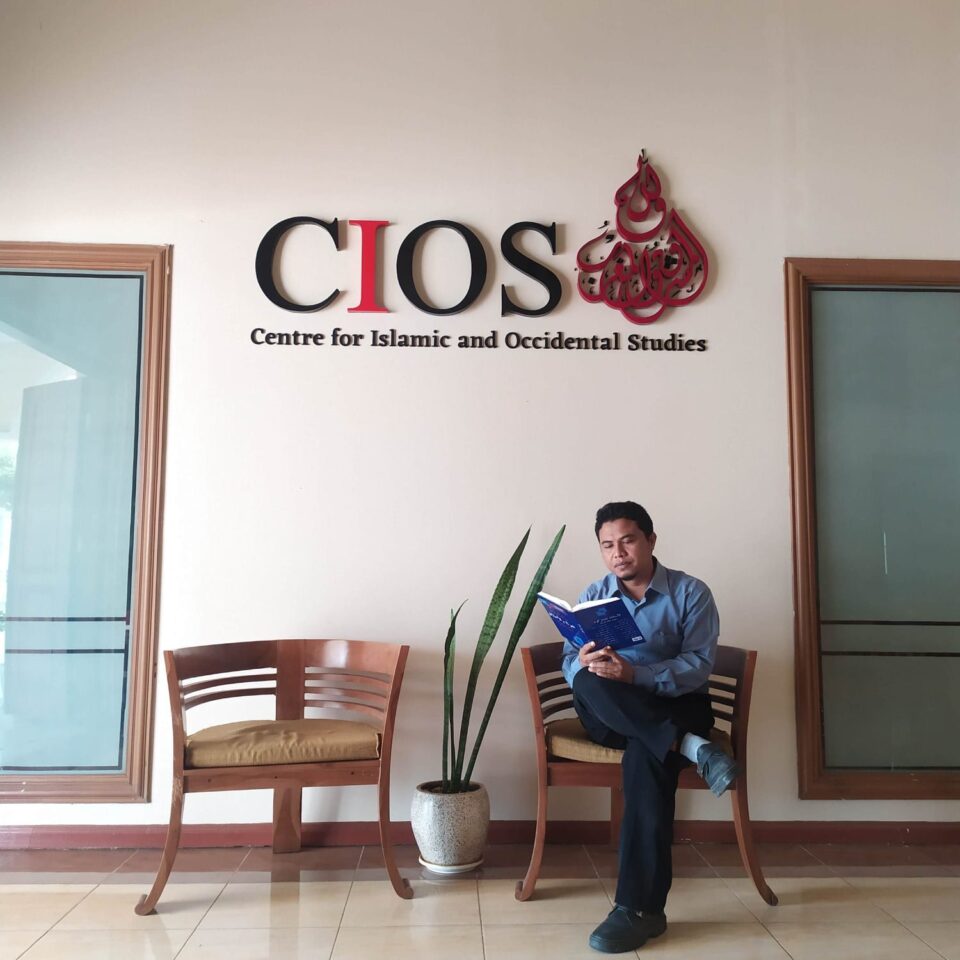
Prof. Raghib as-Sirjani and Amir Al-Madari wrote the book Spiritual ReadingThe book thoroughly examines a recent phenomenon affecting the Muslim community: a lack of interest in reading. It also explains the philosophy of reading, which is not merely a hobby or a passion, but rather a fundamental concept of Muslim life.
Reading, is a treatise originating from dictation Divine. Reading cannot be separated from Islamic culture, whose orders were directly conveyed by the angel Gabriel to the Prophet Muhammad. We certainly understand that Rasulullah SAW is a prophet Mom (can't read and write) but Jibril still guides him to recite "Iqra' Iqra' And 'iqra'. Read, read and read! Until finally the Prophet succeeded in reciting the first words of the Qur'an surah al-'Alâq verses 1-5 “Iqrâ bismirabbikalladzi khalâq……”
It is interesting to analyze the statement regarding the philosophy of reading as a life concept that was touched on by Prof. Raghib as-Sirjani and Amir Al-Madari. This should be a big concern, especially for Muslims who have unconsciously forgotten this big concept. A concept of life, which has led the ulama to succeed in building Islamic civilization in every corner of cities throughout the world.
The concept of reading has given birth to a civilization that is still written in the golden ink of history. From this concept of reading, scholars emerged as writers who translated the results of their reading. Every idea, concept, and thought of the scholars, derived from reading and memorization, was immortalized in writing. Therefore, it is no exaggeration to call the philosophy of reading a universal concept of life.
If reading is a universal life concept, then writing is a civilizational concept. What scholars write is the essence of their reading. This essence of reading is what is called knowledge. Knowledge originates from the thoughts and readings of scholars. A scholar is defined as a learned person or someone possessing extensive knowledge, particularly regarding religious knowledge (Islam).
People with knowledge are called ulama, ulama are those who are close to and afraid of their God. Scholars explore sources of knowledge from the Koran and Sunnah (hadith). The results of their study of the Koran and Sunnah are what they wrote and wrote syarah up to volumes thick.
Therefore, it is not wrong to say that Islamic civilization is a civilization of knowledge. A civilization of knowledge is a civilization built on two primordial sources: revelation and human rationality.
The revelation that Allah sent down to the Prophet Muhammad was then examined, explored, and researched by the companions (ulama) with their rational powers of reason, then read, memorized, and then synthesized into written form.
Maybe it still sticks in our minds, or for a moment Flash back back to the dark history of the Tigris River by thousands, even millions of copies of books burned by the Tartar (Mongol) army, led by Holagu Khan from the Baghdad library during the destruction of the Abbasid Caliphate in 1258 AD.
As you can imagine, a collection of books dating back 6 centuries to the glory of Islam was destroyed. Although in historical records there are still around 68 thousand book across various disciplines, and as many as 1,700 of them are still in manuscript form, remaining from the destruction. [Read on Republika.co.id.]
One key point to emphasize in the above incident is the "writing productivity of the scholars." The thousands, even millions of books destroyed by the Tartar army are clear evidence of the scholars' prolific writing. Yet, if we compare it to today, it's as far apart as the sky and the bottom of a well.
In the past, scholars only had pens and ink, which were difficult to obtain. Meanwhile, now everything is available, internet access, computers, laptops, pens, pencils, ink and so on. Unfortunately, the availability of writing tools nowadays has not been able to match the productivity of the pens and ink of the ulama in the past.
It's ironic to address the decline and weakness of Muslims today, as this isn't unique to Indonesian Muslims, but to most Muslim countries. The enthusiasm for reading and writing still lags far behind that of Western countries, which generally have the highest reading and writing rates. In this sense, they have stolen and usurped our reading and writing culture. Before we know it, we've fallen deep into a hole. malaise, ignorance And stagnation. May we be awakened.
Let's put the above issues aside for a moment and return to the initial discussion of reading as a concept of life and writing as a concept of civilization. These two concepts should be understood holistically, not interpreted in isolation. In other words, reading and writing should complement each other.
Reading is a dialogue with the author. Writing, on the other hand, encourages the reader to think. Therefore, start now to develop a habit of responding appropriately when someone asks, "What are your hobbies?" Don't answer, "My hobby is reading," but say, "My hobbies are reading and writing."
Thus, reading and writing are noble activities, through which civilization is born. From the womb of the writer, the baton of Islamic culture and civilization will become a beacon of knowledge. Never give up, keep reading, keep striving to write what the world does not know.
Write about what nature keeps secret. Tell readers about any challenges. Let them reflect and engage in candid dialogue with your work. Entertain them. Embrace them. Invite readers to soar far with your brilliant thoughts and ideas. In this way, Islamic civilization will once again shine. Amen, O Lord of the worlds.
And Allah knows best

1 comment