
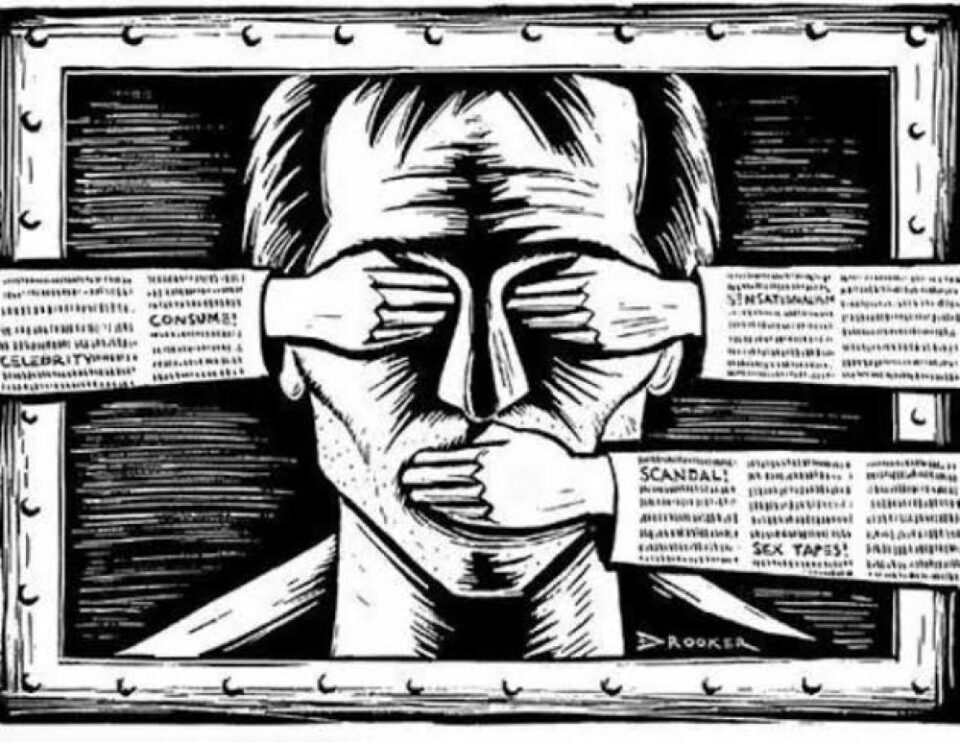
The powerful wave of globalization that is sweeping the world is dragging a new hegemony into the third world[1], which is increasingly revealing a new face of the power of capitalism.
The contemporary world dominated by a handful of modern countries is increasingly at its peak when witnessing the drama of the end of the Cold War and capitalism being considered as the end of the ideological evolution which Francis Fukuyama believes is a signal. “The End of History”.
Today, postmodern Western dominance is increasingly strong, even in many ways and ways, far stronger than before, not only in the economic sphere but also in the cultural sphere. This global culture, largely constructed by the West, is invading through various means, primarily through media globalization.
In the midst of globalization, media is a key element for global communities, and especially Indonesians, to learn about various aspects of the world. Even when individuals cannot learn directly from the media, offline, he can learn from others who may have genius ideas about media digitalization.
Media is the main way that large numbers of people receive information and entertainment. Or as Marshal Mc. Luhan said that The media is the massage, where the media is less concerned with the actual media types than with the media as information transportation mechanism or it has become mass media.
Along with advances in communication and information technology, mass media has transformed popular culture and led to the loss of national and religious morality. Communication and lifestyles have also fundamentally changed. Some segments of society have become contaminated by the world of pleasure, promiscuity, and a materialistic lifestyle as their goal, neglecting religious values and local cultural morality.
Meanwhile, informal social groups dedicated to local culture are fading and being slowly eroded, replaced by immoral celebrity figures in the entertainment industry and mass media. This underscores the importance of studying media and the emergence of new perspectives and phenomena that accompany it.
Etymologically, culture is "the sum total of the attainment and activities of any specific period, race, or people, including their implements, handicrafts, agriculture, economics, music, art, religious beliefs, traditions, language, and story". Meanwhile, according to Edward Burnett Tylor (The founding father of British anthropology) is "Culture or Civilization, taken in its wide ethnographic since, is that complex whole which includes knowledge, belief, art, morals, law, custom, and any other capabilities and habits acquired by man as a member of society“.
As for the opinion that differentiates between culture and culture, Tylor has explained above that culture is "power of the mind" which consists of creativity, feeling, and will, while culture is the result of that creativity, feeling, and will. However, in this article, culture and culture are used in the same sense.
The Domination of Mass Media and the Acts Behind It
The life of Indonesian society today has become the object of a very strong war of influence between Islamic preaching and secularist propaganda. Both parties carry the same (opposite) mission of preaching, but their methods and means differ.
We can see the difference in that Islamic preaching still uses the means of 'classic' (now able to compete) while preaching 'secular' The use of various modern media platforms and their impact on changes occurring in Indonesian society today indicate that secular media dominance is more influential than other media, including Islamic media.
This secularist propaganda is one way for the actors and masterminds of Islamic demonology to spread the word and further their goals. They are none other than three groups working together and allying against the Muslim community, as Sheikh Yusuf Qardhawi termed it. “The triangle of hell with a scary face” namely Jewish Zionism – Crusaderism – Communism.”
In the first Zionist conference in Barcelonn, Switzerland, in 1897, led by Theodore Herzl, the International Jewish community that produced the Protocols of the Zionist Leaders concluded that the ideal of establishing a Greater Israel would not be realized without controlling the mass media.
This is in line with the sermon of a Jewish Rabbi, Rashoron (1869) about the importance of mass media. "If gold is our power to dominate the world, then the world of the press is our second power." And no less important is that a Blum, the writer of vulgar books, in his book "Marriage" suggests that girls should exploit their sexual potential during the premarital period.
So, it is very appropriate if Cardinal Marie Del Vaal said "It has been proven that Jewish hands are always behind the publication and distribution of pornographic books and films that lead people to perversion as a way to control the world."“.
Thus, Zionism has long programmed a mass media imperialism to achieve its goals, which are not only to portray the Jewish nation but also to attack and conquer every power that is considered a threat to them, especially Islam.
So it is not surprising that today, Jews have controlled the main mass media links, including the world's leading news agencies. (news agency), newspapers, (press) and TV/Radio networks, the cinema and TV industry, as well as the printing and publishing industry in various countries, including Indonesia, which implement media presentation patterns or systems like those of Western media by Jewish Zionists.
[1] The meaning of third world as Giddens said “Globalization is the intensification of world wide social relations which link distant localities in such a way that local happenings are shaped by events occurring many miles away and vice versa”. See: Giddens, Runaway World: How Globalization Is Reshaping Our Lives, (New York: Routledge, 1999) In: Idy Subandy, Commodification Communication: Examining Media and Culture in the Dynamics of Globalization, (Jakarta: Pustaka Obor, 2014) p. 36
Continued to part 2 (two)
Image Source: Google.com
Writer: Syaifullah Yusuf, S.Sos are alumni of the PKU (Ulama Cadre Development Program) UNIDA Gontor, Class X in collaboration with the Central MUI

1 comment
It's fascinating how mass media can be a powerful tool in maintaining or changing our cultural values. Do you think we need to be more critical of the media content we consume to protect our cultural and moral identity from negative outside influences?