

فَإِذَا فَرَغْتَ فَٱنصَبْ
It means, "So when you have finished (one business), work seriously on another (business)." (QS. Al-Insyirah, verse 7)
For a moment we will try to examine the meaning of this verse. Buya Hamka through Tafsir Al-Azhar, he emphasized that Allah always reminded the Messenger of Allah and his people to not easily satisfied with the results of his efforts. Therefore, if someone has finish a matter (worldly affairs and their busyness) then you (Muslims) will immediately do other affairs.
This is where it is important that we must manage time. Moreover, we are currently in the holy month of Ramadan. Ramadan is a very valuable moment for Muslims, not only as a time for worship, but also as an opportunity for transformation and even self-improvement. contemplate spiritual individually.
However, during this holy month, we as Muslims often face challenges in managing our time between worship, work, and daily activities. Therefore, good time management is crucial to ensure that every moment is fulfilled. aspects of life must remain balanced.
Effective time management during the month of Ramadan can help us individually to prioritize worship such as prayer, reading the Quran, and other positive activities, while still carrying out our work or study responsibilities.
By planning our worship time in a structured manner, we as Muslims will be able to create a routine that supports our desire to draw closer to Allah without sacrificing performance in other areas.
One way to improve time management is by setting clear and realistic goals. For example, planning a daily schedule that includes time for sahur (pre-dawn meal), prayer, work, and rest, with the caveat that these activities must be arranged in such a way that they don't clash. Proper time allocation not only increases productivity but also... give us space for inner spiritual reflection us during this holy month of Ramadan.
If our target for Ramadan this year is to complete the recitation The Qur'an is 30 Juz, so we must commit to reading 2 pages of the Qur'an every time we finish building a house. obligatory prayers. Furthermore, if we want to increase the number of katam 2 times 30 juice then just increase the multiple to 4 pieces after performing the fardhu prayers 5 times a day.
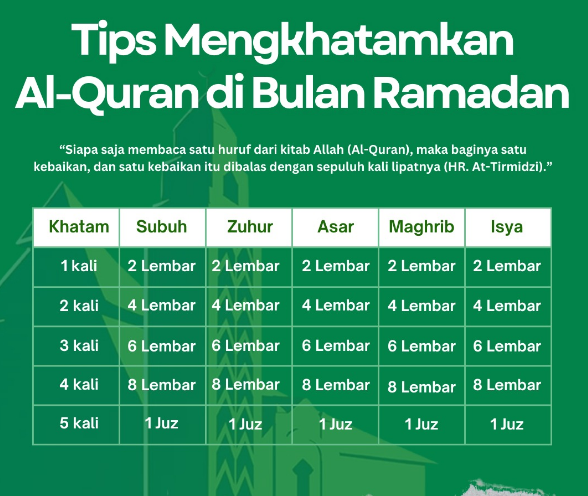
Steps like this make our memorization management more productive. Targets to be achieved during the holy month of Ramadan should be recorded in a diary, making them easier to practice and accomplish.
Create a Daily Activity Schedule
God willing وَاَعُوْذُبِكَ مِنَ الْعَجْـِز وَاْلكَسَلِ.وَاَعُوْذُبِكَ مِنَ الْجُـبْنِ وَالْبُخْـل الدَّيْنِ وَقَـهْرَ
"O Allah, indeed I seek refuge in You from sighing and sorrow; I seek refuge in You from weakness of will and laziness; I seek refuge in You from cowardice and cowardicer; I seek refuge in You from the pressure of debt and human cruelty.” (Narrated by Abu Dawud, 4: 353)
Every year, the month of Ramadan is a blessed time for Muslims worldwide. To commemorate this month, it's important to organize your daily activities so that everything can be managed effectively, especially regarding financial matters. worship and productivityBy having a structured schedule, we can maximize the time we have and ensure that we don't miss out on precious moments of worship.
The first step we take in making daily activity schedule is to set a time for worship. Prayer times and religious activities such as reading the Quran, praying, and performing voluntary prayers can be scheduled regularly.
After we allocate time for worship, the next step is to add time for work or daily activities. Make sure we also allocate time enough time to rest, especially after Iftar and before we perform night prayers, such as tarawih prayers.
It's important to remember that during Ramadan, our bodies may need more time to adapt. Therefore, flexibility in schedule is essentialWe may feel tired more quickly or experience changes in our sleep routine, which can affect our daily performance.
In this regard, it's important to maintain communication with ourselves and understand when the best time to rest is. Furthermore, adjusting your schedule based on your daily needs can help maintain a balance between worship and other productive activities.
By designing and implementing a good daily activity schedule, you can not only increase your productivity, but also be more productive. focus on carrying out worship during the month of Ramadan. In this way, every second that passes in this holy month can be utilized as well as possible and provide deep meaning in carrying out religious teachings.
Increasing Worship Productively, Even a Little
Allah's blessings وَإِنْ قَلَّ
"And know that the deeds most loved by Allah are those which are continuous, even if they are small." (Narrated by Muslim 2818)
The month of Ramadan is a very valuable time for us Muslims to increase our worship. Although Our daily activities can be challengingThere are many ways to maintain the quality of worship despite busy schedules. One effective method is to use your free time to do good deeds, even if they're small but consistent.
Any time between prayers before and after prayer can be used to increase prayer or recite the Quran. These activities not only strengthen faith but also provide peace after a tiring daily routine.
Furthermore, we must pay attention to the timings of sahur and iftar, which are also important aspects of increasing our worship. By scheduling meal times appropriately, we can devote more time to religious activities such as tarawih prayers or prayer. recitation of the Qur'an.
For example, using the time after breaking the fast to pray and meditate can make the moment more meaningful. Furthermore, during sahur, before eating, we can also set aside time to read the Qur'an or perform sunnah prayers.
Another approach is to create a daily schedule that integrates worship into our daily activities. This could include setting specific times for prayer and reflection throughout the day, setting reminders, or using apps that can help. tracking the spiritual goals of our faithIt is important to ensure that these worship activities do not interfere with our work or study commitments.
Therefore, balancing our religious responsibilities with the pursuit of spiritual growth is crucial. Maintaining a structured routine will enable us to fulfill both our religious obligations and daily duties effectively. By following these simple yet profound adjustments, we will be able to spend Ramadan productively, ultimately leading to a more fulfilling Ramadan. increase religious observance and devotion us to Allah SWT.
And Allah knows best
Photo source: Google.com

1 comment
How do you manage your time during Ramadan to stay productive in your worship and daily activities? Are there any specific experiences or techniques that have helped you achieve this balance?