
Cordova Halal Center
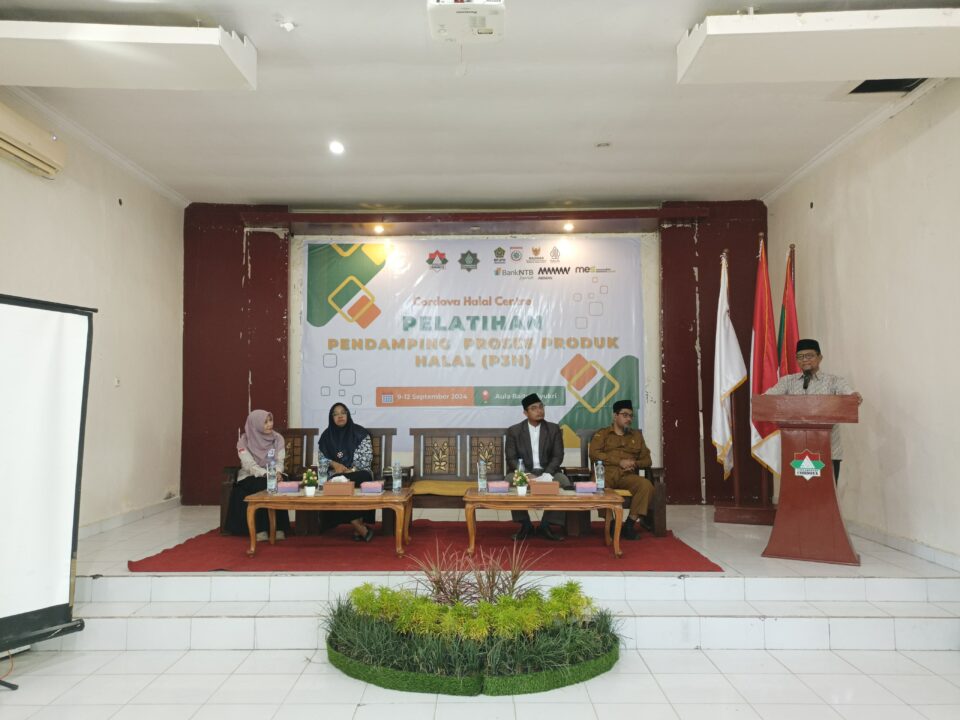
West Sumbawa. To support and accelerate the Halal Certification program launched by the Ministry of Religious Affairs of the Republic of Indonesia, Cordova University, West Sumbawa, is holding a Halal Product Process Mentoring (P3H) program. This program is carried out directly by the Cordova Halal Center, the university's official institution, to educate the community and micro, small, and medium enterprises (MSMEs) within West Sumbawa Regency and beyond.
This training activity is in collaboration with Nahdatul Ulama University, UNU Halal Center NTB which involves 4 (four) presenters. 1. Dr. Duwi Purwati, S.Pd., M.Hum who also serves as the Chairperson of the UNU NTB Halal Center (LP3H UNU NTB) with a specialization in PPH mentoring and assistance materials. 2. Muhammad Iqbal Mansury, Lc., MA who delivered material on JPH policies and regulations. 3. Dr. Nova Kurnia, M.Pd. Material on material knowledge, supporting material documents, and critical material sources. 4. Herman Jayadi, SE,. MM Delivered material on digitalization and registration of HALAL, introduction to MSMEs and business actor licensing.
Ust. Jajang Haris Andi, SE., M.Pd., who serves as the head of the Cordova Halal Center in West Sumbawa, explained that the mentoring training took place over four days, from September 9-12, 2024. The training participants were divided into several categories, including the general public, MSMEs, students, and lecturers at Cordova University. In his report, Ust. Jajang Haris Andi mentioned that the activity was carried out despite... budget (budget) is limited. However, with the spirit of preaching and educating the public about halal products, these activities must still be carried out.
This training program was also opened directly by the Chancellor of Cordova University, Dr. Lalu Zulkifli Muhadli, BA., SH., MM, which was attended by several institutions such as; the Head of the Al-Ikhlas Taliwang Islamic Boarding School, the Ministry of Religion of KSB, Baznas KSB, the administrators of the Sharia Economic Community (MES), the assistant vice chancellors, each faculty dean and head of study program. The training activity was held in the Baitus Syukri Hall, Cordova University, with a total of approximately 60 training participants.
In his remarks, the Chancellor of Cordova University expressed his appreciation for the training and thanked the team from the UNU Center NTB for participating and assisting the Cordova Halal Center at Cordova University in West Sumbawa. The Chancellor explained the importance of halal products. He then mentioned the difficulty of finding halal products during his trip to America, especially in urban areas. "Halal food is hard to find in urban areas; it can only be found in certain places, and even then, in rural areas," the Chancellor explained.
The Chancellor also touched on several issues related to regional government programs and policies, particularly those aimed at assisting the middle class. "Any government official who does not support activities like this will be held accountable for their position in the afterlife. Therefore, I hope that the regional government and relevant agencies authorized to handle training activities like this will be unjust if they do not contribute financially. Activities like this are crucial for the Muslim community as we strive to remind and educate them about the importance of consuming halal products," the Chancellor of Cordova University concluded.
The Chancellor of Cordova University, who served as Regent of West Sumbawa for two terms (2005-2010 and 2010-2015), touched on many other issues. This included the halal tourism program launched by the former Governor of West Nusa Tenggara (NTB), TGB Muhammad Zainul Majdi, who served for two terms. His policies have not yet reduced the circulation of alcohol, particularly in Mataram and the tourist areas of Lombok. How will the public understand about halal food if the government is not serious about carrying out its duties to the community?
The Importance of Halal Products
Halal products refer to goods or services permitted by Islam and meeting sharia criteria. The concept of halal extends beyond food and beverages to encompass all aspects of life, including cosmetics and pharmaceuticals. According to Islamic principles, a product's halal status is determined by the ingredients used and the production process. Therefore, a product must be free from prohibited elements, such as pork and alcohol, to be considered halal.
The importance of consuming halal products for Muslims is not only rooted in religious obligations but also closely related to health. Halal products are generally produced to higher standards, ensuring that the ingredients used are fresh and safe. Research shows that food that complies with halal principles can reduce health risks due to strict supervision. Furthermore, consuming halal food and products is believed to bring blessings in daily life, in accordance with religious teachings that require Muslims to choose the best when it comes to food and drink.
Halal certification is a crucial part of the food and beverage industry. With this certification, manufacturers can demonstrate that their products meet established halal standards, which in turn boosts consumer confidence. The certification process involves rigorous audits, ensuring that all stages, from raw material procurement to production, comply with halal principles. Therefore, halal certification not only benefits consumers but also adds value to manufacturers in marketing their products, making halal products a preferred choice in the industry.
The Role of Cordova Halal Center in the Halal Certification Process
Cordova Halal Center is a non-profit organization that supports the halal certification process. The Center helps producers understand and comply with all applicable requirements. In this context, the center offers a variety of services designed to facilitate the implementation of halal standards in various product types. As a first step, the Center provides halal assistants with information on halal principles. Through the Halal Product Process Assistant (P3H) training program, producers gain in-depth insight into the terms and conditions required to produce halal products.
In addition to educational seminars, the Cordova Halal Center also offers practical training to help the community and halal facilitators apply the knowledge gained. This training involves local business owners and micro, small, and medium enterprises (MSMEs), covering production processes, supply chain management, and quality control. This training prepares P3H facilitators to face the challenges of maintaining halal products, thereby increasing consumer trust and expanding their reach in both local and global markets.
The Cordova Halal Center in West Sumbawa Regency plays a crucial role, both in facilitating the halal certification process and in raising awareness of the importance of halal products among producers and the public. As such, the Cordova Halal Center is a vital partner in the journey towards quality halal products.
Challenges in Implementing Halal Processes in Industry
Implementing halal processes in industry is not simple. A significant challenge faced by many manufacturers is a lack of understanding of halal standards. These standards cover not only raw materials but also production, packaging, and distribution processes. Many manufacturers struggle to source halal-certified raw materials, which can often pose technical and financial barriers, especially for small and medium-sized enterprises.
Furthermore, inconsistent and frequently changing regulations also present challenges. In some countries, the implementation of halal regulations can vary, which can be confusing for producers trying to comply with multiple requirements. For example, the standards of various halal certification bodies are often inconsistent, making it difficult for producers to determine which procedures to follow. This can increase the cost and time required to obtain halal certification.
On the other hand, public perception of halal products also influences the industry. Although consumer awareness of the importance of halal products is growing, stigmas and myths persist that hinder trust in halal products. For example, there are perceptions that halal products are more expensive or of lower quality than non-halal products. This is a challenge that producers must overcome in their efforts to enter a wider market.
The Cordova Halal Center is committed to helping the industry overcome these challenges. By equipping producers with the right knowledge and guidance, the Cordova Halal Center strives to support them in understanding the needs and requirements of halal certification. This initiative is expected to accelerate companies' adaptation to halal standards and increase public trust in halal products in the market.
Benefits of Using Cordova Halal Center's Assistance Services
In addition to boosting consumer confidence, the Cordova Halal Center also provides broader market access. Halal certification serves as a key to entering markets that may have previously been difficult to reach. Many markets, especially in Muslim-majority countries, have stringent requirements for halal products. With Cordova's help, manufacturers can navigate the certification process and ensure that their products meet the standards necessary to successfully compete in the global market. This is not only about increasing sales, but also about creating a more robust and effective distribution network.
Finally, producers who have implemented halal certification with the assistance of the Cordova Halal Center often report increased profitability. When products are well-received in the market and consumer confidence increases, the result is higher sales and greater profit margins. Testimonials from producers who have worked with Cordova indicate that they have not only successfully achieved certification but also experienced significant business growth. The Cordova Halal Center is a strategic partner in achieving success in the halal industry.
