
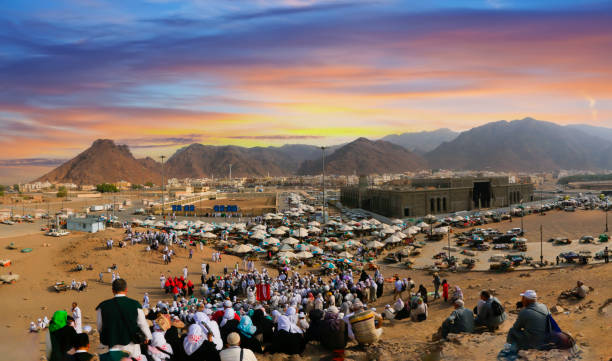
“"These three dimensions (Arafah, Nahr, Tasyriq) are not just separate rituals, but a series of inner transformations that take a servant from recognition to sacrifice, then settling in the eternal protection of makrifat."”_M. Syarif Hidayatullah
The first ten days Dhul-Hijjah are the blessed nights, the days that Allah swears by, and the seasons within them good deeds more beloved to Him than deeds on other days. Among the strands of that great day, there are three stations spiritual which forms a complete journey of the soul: Arafah, Nahar And Tasyriq.
These three dimensions are not simply separate rituals, but rather a series of inner transformations that take a servant from recognition to sacrifice, then to residence in care knowledge Those who live out these three will find themselves reborn as human beings free from slavery to anyone other than Allah.
First Dimension: Introduction to the Soul and Knowledge
The first dimension is Arafah. Stage knowledge and liberation. Words ‘'Arafah came from ‘'arafa, get to know each other directly and intimately, not just hear the news. The day was named Arafah because it is a field of recognition: the soul's recognition of its God without headscarf, recognition of one's own poverty in the face of the absolute wealth of the Creator.
In that barren desert, millions of people were wrapped in only two pieces of white cloth, stripped of all worldly attributes, and stood in spiritual nakedness. It was as if space and time had collapsed, every soul that standing still in that expanse, I heard again the question that had been asked in the spirit realm: “"Am I not your God?"” Allah SWT said:
وَإِذْ أَخَذَ رَبُّكَ مِنۢ بَنِىٓ ءَادَمَ مِن ظُهُورِهِمْ ذُرِّيَّتَهُمْ وَأَشْهَدَهُمْ or بِرَبِّكُمْ ۖ قَالُوا۟ بَلَىٰ ۛ شَهِدْنَآ
“"And (remember) when your Lord brought forth from the grove of Adam their offspring and He took testimony against them, 'Am I not your Lord?' They answered, 'Yes, you are our God, we testify.'‘" (QS. Al-A'rāf [7]: 172)
Day Arafah is the earthly manifestation of the field of testimony eternal That's where a servant reaches knowledge the essential: recognition born of witnessing (musyāhadah), not from mere rational reasoning. At this point, the self experiences mortal'’, melted in the ocean Form the real one.
Rasulullah ﷺ confirmed the central position Arafah with concise and profound words: “Hajj is Arafah” (الحج عرفة). Without standing still in Arafah, the pilgrimage series becomes empty; because without the recognition that makes the ego mortal, all movement and stillness is just a body without a soul. Standing still a moment in Arafah is enough to nullify all the absence of the Hajj, because one breath in true recognition can change forever the direction of the soul's journey.
On stage Arafah Also, this religion is declared perfect. In the presence of more than one hundred thousand friends, the great words came down:
ٱلْيَوْمَ أَكْمَلْتُ لَكُمْ دِينَكُمْ وَأَتْمَمْتُ God bless you
“"Today I have perfected your religion for you, and I have completed My favor upon you, and I have approved Islam as your religion."” (QS. Al-Mā'idah [5]: 3)
The perfection of religion culminates on a day whose essence is recognition and testimony. There is no perfection higher than the descent God's pleasure, and there is no pleasure without knowledge. Islam as a religion that is approval is Islam which reaches the peak of submission in testimony monotheism.
So, revelation about this perfection coming down in Arafah, not elsewhere, for it is there that the perfect form of servitude is collectively manifested.
For Muslims who do not perform the Hajj, the door the grace of Arafah open through fasting. Rasulullah ﷺ said:
صِيَامُ يَوْمِ عَرَفَةَ أَحْتَسِبُ عَلَى اللَّهَ يُكَفِّرَ السَّنَةَ ٱلَّتِى قَبْلَهُۥ وَٱلسَّنَةَ ٱلَّتِى بَعْدَهُۥ
“"Fasting on the day of Arafat, I hope that Allah will erase the sins of the past year and the year to come."” (Narrated by Muslim)
And the highlight of the day's practice was prayer which summarizes the whole monotheism. He ﷺ said:
خَيْرُ ٱلدُّعَآءِ دُعَآءُ يَوْمِ عَرَفَةَ، وَخَيْرُ مَا message ٱللَّهُ وَحْدَهُۥ لَا شَرِيكَ لَهُۥ، لَهُ ٱلْمُلْكُ وَلَهُ ٱلْحَمْدُ وَهُوَ عَلَىٰ كُلِّ شَىْءٍۢ قَدِيرٌ
“"The best prayer is the prayer on the day of Arafah, and the best that I and the prophets before me said is: There is no god but Allah alone, He has no partners, to Him belongs all kingdom and all praise, and He is Almighty over everything."” (HR. Tirmidhi)
Sentence Monotheism this is the essence knowledge, a recognition that strips away every ally in the heart—ambition, love of the world, self-possession—and surrenders all kingdom and praise to the true Owner alone. And at the height of that recognition, God opens the door to unparalleled liberation:
مَا مِنْ يَوْمٍ أَكْثَرَ مِنْ أَنْ يُعْتِقَ ٱللَّهُ فِيهِ عَبْدًۭا مِّنَ ٱلنَّارِ مِنْ يَوْمِ عَرَفَةَ
“"There is no day on which Allah frees a servant from hell more than the day of Arafah."” (Narrated by Muslim)
Liberation from hell, in its inner meaning, is liberation from the fire of separation from Him. Arafah, Allah frees His servants because they have come to the knowledge that no one can save except Him. With great pride, Allah showed them to the angels, not because of their deeds, but because of their most honest emptiness, poverty and humiliation before Him. Rasulullah ﷺ said:
may Allah bless him and give him peace of mind website: ٱنْظُرُوٓا۟ إِلَىٰ عِبَادِى جَآءُونِى شُعْثًۭا غُبْرًۭا
“"Indeed, Allah boasted about the people of Arafah to the people of the heavens. He said, 'Look at My servants, they come to Me in a crumpled and dusty state.'‘" (Narrated by Muslim)
Tangled and dusty, that is the highest symbol of mortality. There was no arrogance of appearance, no glitter of the world. Only the fatigue of the journey and humiliation seeking mercy. So God freed them, because they had come to the knowledge that no one can save but Him.
Second Dimension: Sacrifice of the Primordial Principle of Pride
From the peak of that recognition, the spiritual journey continues to second dimension: Sacrifice or Nahr Day, which falls on 10 Dhul-Hijjah. “"Nahr"” is not just a word for slaughtering an animal; it comes from a root meaning to stick a knife right into the base of the neck, releasing the soul along with a gush of blood.
Today is the culmination of the Hajj journey and the celebration of monotheism in which every Muslim is invited to slaughter pride, offer sacrifices, and celebrate the victory of love. Divine over all Gods besides Him.
The whole essence Sacrifice It rests on a single, eternal, primordial event: the total submission of Abraham and Ishmael to a command that transcends human reason. The Qur'an recounts this silent dialogue in language that is both poignant and sublime:
فَلَمَّا بَلَغَ مَعَهُ ٱلسَّعۡىَ قَلَ يَـٰبُنَىَّ إِنِّىٓ أَرَىٰ فِى ٱلۡمَنَامِ أَنِّىٓ أَذۡبَحُكَ فَٱنظُرۡ مَاذَا تَرَىٰۚ قَالَ يَـٰٓأَبَتِ ٱفۡعَلۡ مَا تُؤۡمَرُۖ سَتَجِدُنِىٓ إِن شَآءَ ٱللَّهُ مِنَ ٱلصَّـٰبِرِينَ
“So when the boy reached the age of working with Ibrahim, Ibrahim said: ‘O my son, I have seen in a dream that I am sacrificing you. So consider what you think!’ He said: ‘O my father, do as you are commanded; God willing, you will find me among the patient.’” (QS. Ash-Shāffāt [37]: 102)
Ishmael is a symbol of everything the soul loves most: children, status, ideals, even one's own existence. The command to slaughter him is a test. taklīf the most severe: a command that outwardly contradicts reason, but inwardly tests the purity of the servant's intentions.
When Ibrahim and Ismail proved that love for Allah overcomes love for everything, including life and offspring, at that moment knives were no longer needed. Allah redeemed him with a great sacrifice:
وَفَدَيۡنَـٰهُ بِذِبۡحٍ عَظِيمٍۢ
“"And We redeemed the child with a large sacrifice."” (QS. Ash-Shāffāt [37]: 107)
The great sacrifice has now become sharia sacrifice that is passed down as a way for us to redeem ourselves. Every year, on 10 Dhul-Hijjah, the door of redemption is reopened. A Muslim not only sheds the blood of an animal, but also sheds the symbols of his animalistic desires that have been preventing him from the presence of Allah. The Prophet (peace be upon him) emphasized the virtue of this practice:
مَا عَمِلَ ٱبۡنُ آدَمَ يَوۡمَ ٱلنَّحۡرِ عَمَلًا أَحَبَّ إِلَى ٱللَّهِ مِنۡ إِهۡرَاقِ دَمٍ، وَإِنَّهُۥ لَيَأۡتِى يَوۡمَ ٱلۡقِيَـٰمَةِ بِقُرُونِهَا وَأَظۡلَافِهَا وَأَشۡعَارِهَا، وَإِنَّ ٱلدَّمَ لَيَقَعُ مِنَ ٱللَّهِ بِمَكَانٍ قَبۡلَ أَنۡ يَقَعَ عَلَى ٱلۡأَرۡضِ، فَطِيبُوا۟ بِهَا نَفۡسًۭا
“"The son of Adam does not perform an action on the Day of Nahr that is more beloved by Allah than shedding blood (sacrifice). Indeed, the sacrificial animal will come on the Day of Resurrection with its horns, hooves, and feathers. And indeed, the blood of the sacrifice has reached the place of Allah's pleasure before it falls to the ground. So please your hearts with it."” (Narrated by Tirmidhi and Ibn Majah)
The dripping blood is characterized as having reached the place of Allah's pleasure before touching the ground. This is a sign that the essence of slaughter is not in the physical death of the animal, but in the speed with which the spirit of the sacrifice rushes towards its God.
Every strand of hair, every nail, and every horn will bear witness in the afterlife to the sincerity of a servant who willingly surrenders his wealth, the symbols of his desires, and his love for this world. However, the Qur'an immediately guides us beyond that outer shell to the eternal divine core:
لَن يَنَالَ ٱللَّهَ لُحُومُهَا وَلَا دِمَآؤُهَا وَلَـٰكِن يَنَالُهُ ٱلتَّقۡوَىٰ مِنكُمۡۚ
“"The flesh of camels and their blood cannot attain (the pleasure of) Allah, but your piety can achieve it."” (QS. Al-Hajj [22]: 37)
This verse is the key to the entire philosophy of slaughter. What reaches Allah is not material, not the blood that soaks the ground, but the spiritual condition that is named piety. Piety here, in view Sufism, not just fear of carrying out orders and avoiding prohibitions.
It is a deep awareness of the presence of Allah so that the soul truly guards its heart from other than Him. Piety what reaches Allah is piety which is born from the slaughter of the ego, from the act of letting go of what is most loved with one's own hands because of His command.
When a Muslim raises a knife and says “"Bismillahi Allāhu Akbar", In fact, he was slaughtering his attachment to the world, cutting the veins of ambition, and surrendering his entire life in one sentence: “"Indeed, my prayers, my worship, my life and my death are only for Allah, the Lord of the worlds."”
After the peak of sacrifice, a Muslim does not sink into a closed spiritual euphoria.
The Third Dimension: Opportunity to Cultivate a Dhikr Madrasah
He entered third dimension: Tasyriq. Tasyriq days, 11th, 12th and 13th Dhul-Hijjah, are days that linguistically mean drying meat under the hot sun, drying it to prevent it from rotting, preserving it to provide provisions for long journeys. This is the most refined spiritual madrasah, where the light of slaughter is transformed into a spreading force, and where dhikr become a breath of sustainable life.
The essence Tasyriq lies in the double movement of the two sentences: spreading and remembering. After the culmination of the sacrifice, a Muslim is ordered to go out, distribute the meat, enjoy food and drink, but in all the intervals his tongue is wet with dhikr. Allah says:
وَٱذْكُرُوا۟ ٱللَّهَ فِىٓ أَيَّامٍۢ مَّعْدُودَٰتٍۢ
And dhikr (by mentioning the name of) Allah on the number of days (Tashriq days)."” (QS. Al-Baqarah [2]: 203)
This verse confirms that the main practice that unites all movement and stillness in those days is dhikrullah. Those days “ma'dūdāt‘, in short, limited to three days, as if to suggest that the opportunity to plant knowledge In everyday life, it is only available for a short time and must be utilized immediately. The Prophet Muhammad (peace be upon him) then confirmed this reality with a profound statement:
أَيَّامُ ٱلتَّشْرِيقِ أَيَّامُ أَكْلٍِ ٱللَّهِ
"The days of Tasyriq are days of eating, drinking and reciting the remembrance of Allah.” (Narrated by Muslim)
This hadith is the key to philosophy Tasyriq. The Sharia strictly prohibits fasting on these days, as a legal sign (irsyād) that after the spiritual ascent that culminated in Arafah and the peak of slaughter in Nahr, a servant is invited to sit at the Divine banquet table and enjoy His gifts with joy, but on the condition that the physical pleasure is framed by dhikr unbroken.
Eating and drinking are no longer merely worldly activities; they become acts of worship, imbued with an awareness of the Giver of blessings. This is where harmony between Sufism and the philosophy of Islamic law seems most beautiful: the law prohibits fasting not to encourage gluttony, but to teach that the peak of spirituality does not require us to run away from the world, but rather to integrate worldly pleasures into divine consciousness.
This is what's deep Sufism called baqā'’ after mortal'’, returning to the world after being dissolved in the ocean of oneness, but now carrying the name of Allah in every bite and sip.
Day Tasyriq It is named so because, externally, at that time people dried the sacrificial meat in the sun so that it would not rot, so that it could be eaten and distributed over a longer period of time.
Behind that external reality, is hidden signal A fascinating spiritual experience: the sacrificial meat is a symbol of the animalistic desires that have been slaughtered, and “drying” it means preserving the results of the slaughter so that they do not rot within the body. Sacrificial meat, if not dried in the sun, will quickly rot—just as the sacrifice of a soul, if not accompanied by the continuous spread of charity and dhikr, will lose its durability.
Three Days of Tasyriq and Summary of Pleasure
Three days Tasyriq is three days to process the sacrificial meat into long-lasting provisions, both in the form of food distributed to the poor, and in the form of spiritual energy emitted through dhikr, takbir, And tahlil which echoes at all times.
The prayer most often said by Hajj pilgrims and recommended for all Muslims on a daily basis Tasyriq is a prayer that encapsulates all the needs of this world and the hereafter:
God willing ٱلْـَٔاخِرَةِ حَسَنَةًۭ وَقِنَا عَذَابَ ٱلنَّارِ
Our Lord, give us goodness in this world and goodness in the hereafter, and protect us from the torment of hell."” (QS. Al-Baqarah [2]: 201)
This prayer, in context Tasyriq, is an acknowledgement that after being blessed knowledge (Arafah) and the power of sacrifice (Nahr), a servant still needs worldly goodness that does not neglect, and goodness hereafter which is the ultimate goal. He is no longer a hermit who rejects the world, nor is he a materialist who forgets the afterlife.
He is ‘'abd who has been freed from the slavery of lust, so that the world is in his hands and the afterlife in his heart. The goodness of the world here is not accumulated wealth, but the world that is used as a bridge to God's pleasure; and the goodness of the afterlife is the peak of witnessing His face.
Days Tasyriq Tasyriq days are the right time to offer this prayer, because it contains a request that the results of the three days of spiritual drying become eternal provisions, not only to survive in this world, but to survive the long journey to eternity.
Three dimensions of Dzulhijjah—Arafah, Nahar (Qurban) And Tasyriq is a complete journey of the soul, a cycle of transformation that can truly become a pattern of life for every Muslim throughout the year. Arafah teaches that every soul has “Arafah”-himself: a point in life's journey where he must stop, stand under the heat of consciousness, and admit with complete honesty that he is nothing.
At that point, all masks of worldly friendliness fall away, and all that remains is the silent dialogue between poverty and Absolute Wealth. Arafah is an invitation to continue standing still in His presence, reciting “There is no god but Allah” with the breath of witnessing, not just speaking.
Qurban teaches that after recognition comes sacrifice. Every soul who professes faith will face its own "Day of Resurrection," a time when Allah demands something we hold most dear: a hard-earned career, a deeply held relationship, or even a long-held comfort.
At that point, we hear the echo of Ibrahim's voice and he answers like Ismail: "Do what you are told." Because in essence, nothing is really being slaughtered except our illusion of ownership. When the knife of submission has severed the veins of the ego and the blood of dependence is shed, that's when we find ourselves saved, replaced by Allah with a "glorious sacrifice": a closeness to Him that flesh and blood will never value.
And Tasyriq teaches that true spirituality is not a momentary eruption at the top of a mountain, but rather a long process of drying the flesh of the ego under the heat of consciousness, day after day, until it is worthy of being a provision. Those three days are three steps on the journey back: integrating the fruits of sacrifice into life, strengthening dhikr in the midst of activities, and perfecting guarding so that wisdom does not rot away due to the temptations of the world.
is a day to transform peaks into fertile valleys, transform slaughter into food that satisfies hungry souls, and transform dhikr into a rhythm that accompanies all life's activities.
Dhul-Hijjah, With its three dimensions, it teaches us that life itself is a journey from Arafah to Tasyriq. Every Muslim is called to know their Lord in the silence of standing still, sacrificing what they love most for Him, and then returning to this world carrying the light of that knowledge, cultivating it in their daily practices, so that one day, when the long journey to eternity truly begins, we will be well-equipped.
And along the way, the sentence Monotheism keep echoing: “There is no god but Allah”, none has the right to be slaughtered except Him, nothing is eternal except Him, and to Him alone is everything knowledge, sacrifice, and this life is returned.
And Allah knows best