
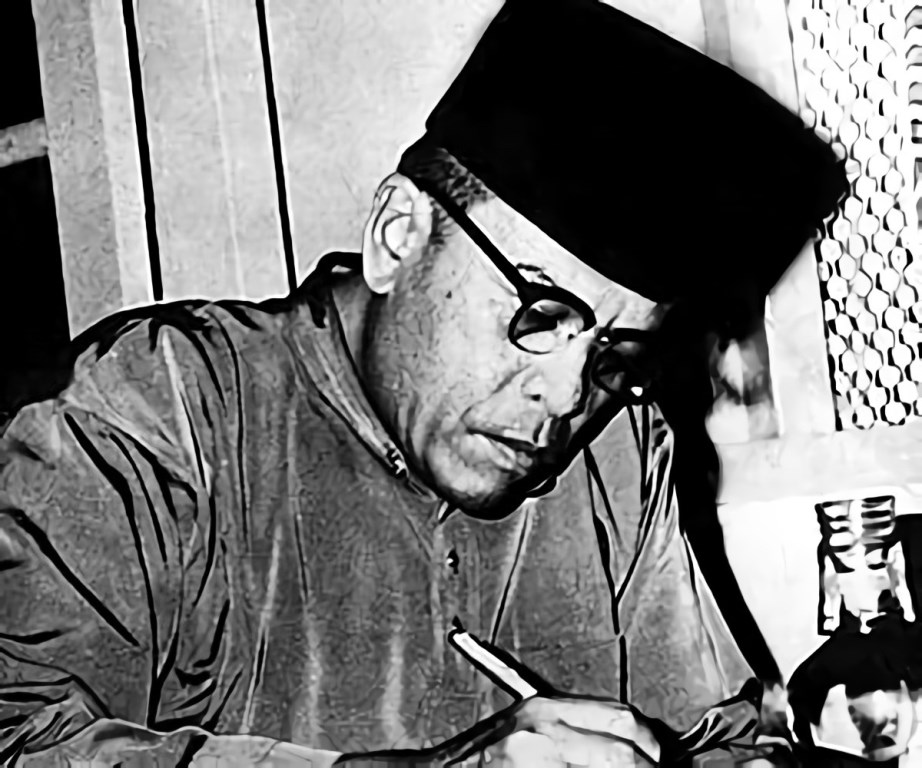
“Hamka can be said to be self-taught, a fighter brilliant with a unique voice and range as a writer. He was open-minded, and his writing was widely read. His window to the outside world wasn't Dutch, but Arabic, which he learned as a child at his father's strict instruction.”_ James R. Rush in Hamka's Great History: A Master Writer's Vision of Islam for Modern Indonesia
The name Hamka is certainly very familiar to the Indonesian people. The figure with the full name... Haji Abdul Malik Karim Amrullah This has opened up a horizon of knowledge that has attracted the attention of Indonesian intellectuals and influenced Western thinkers and researchers.
Is James Robert Rush An American researcher captivated by Hamka's fame, Rush then took on the challenge of conducting research to explore Hamka's thoughts, scholarship, literature, and influence on Indonesian society. Rather than being subjective, Rush attempted to examine Hamka from several objective sources.
According to Rush, he became interested in researching Hamka's thoughts after learning about the breadth of Hamka's knowledge, which resonated not only through his literary works but also through his writings. Hamka's ideas successfully enlightened the public through his writings on contemporary issues of religious discourse., faith, Sufism, philosophy to interpretation of the Koran.
Defining Hamka is the same as reading an encyclopedia of knowledge wrapped in... creed (religion). Hamka's thinking transcends local ideas and is capable of unraveling the threads of knowledge globally. Therefore, it is not wrong for Ahmad Syafii Maarif to acknowledge this; “Hamka is a time travel sketch that continues to amaze, challenge and inspire us all” (read, page xviii).
For Rush, the researcher, Hamka was not only skilled at writing, but his speeches and lectures were able to provide enlightenment to his listeners. Many figures or... figure like Hamka, but from Rush's point of view Hamka is different. Hamka's assertiveness, intelligence, and breadth of knowledge make him a person who outstanding.
Rush met Hamka in 1971-1972. At the time, Hamka was giving a lecture on Indonesian language to a graduate class. Rush saw Hamka as different from other figures because his thoughts and ideas always inspired and revitalized Indonesia.
“"The more I immersed myself in Hamka's collection of works, whether short stories, anecdotes, consultation columns, history, theology, and the Quran, I understood that Hamka wrote for a greater purpose."” That's Rush's confession. (read, p. xxiii)
Undeniably, Hamka's broad ideas and visions were never separated from his greater purpose. This greater purpose was later called Hamka's Islamic vision for modern Indonesia. This Islamic vision was inseparable from Hamka's life. His great hopes for Indonesia led Hamka to cast aside his fatigue and exhaustion.
Hamka willingly endured hardship, adversity, looting, and even torture for the sake of a great idea and vision for Indonesia. He never used ups and downs, experienced hardship, or gave up on that grand vision. Hamka's body and soul were dedicated solely to Islam, to the struggle for his beloved country, Indonesia.
Rush doesn't deny that, for a Westerner like him, when studying Southeast Asian figures, Rush doesn't want to be trapped in the shadow of colonial thinking. Rush tries to escape the perspective of the old imperial colonies. Because if Rush gets carried away by ideology... “ism” It is certain that this research will be 'trash' for readers.
Rush's research remains committed to its initial commitment: to trace Hamka's steadfast Islamic thought. Although Hamka was born in a village, his thoughts, ideas, and vision for life enlivened the lives of urbanites. Hamka's thoughts were largely dedicated to his country, Indonesia. Preserving the Islamic vision for Indonesia is an absolute must.
Hamka, writing after morning prayers. Type it yourself. Repeat reading the manuscript that will be sent to the media or printing press. In every stroke of his writing, Hamka always describes Islam as a great force that has helped every individual in Indonesian society. Islam is a religion that opposes colonialism. Only Islam is capable of bringing independence from any colonialism.
Rush wrote this book with a thickness of 322 pages. It filters six major themes summarized in: 1). Community Guidelines. 2). Father and Son. 3) Hamka-San and Bung Haji. 4). Islam for Indonesia. 5). Culture War. 6. The New Order. All the themes chosen by Rush provide a different explanation of Hamka's life story.
Hamka was a special figure. His grand vision was that one day, even in the shadow of a modern nation, Indonesia would be illuminated and surrounded by Islamic values and teachings.
This is James R. Rush's view in Adicerita Hamka. Many writers still speak about Hamka, not to mention young researchers who delve deeper into his influence on theses and academic journals on Indonesian campuses.
Talking about Hamka means talking about science, literature, reading and writing, family and most importantly about the strength of a principle.
Wallahua'lam bish shawa Ab
