
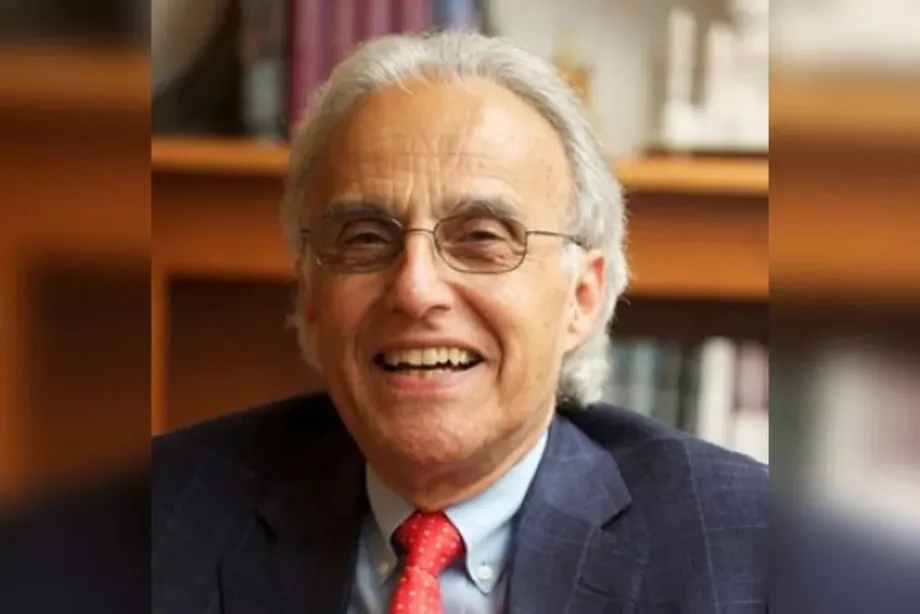
The academic world lost one of its greatest scholars in modern Islamic studies. On July 15, 2026, Prof. John L. Esposito passed away at the age of 86. His passing was a... the end of the beginning contemporary Islamic studies, especially in efforts to build dialogue between the Islamic world and the West.
I myself never met him in person, but I became very familiar with him through his monumental works, such as Islam: The Straight Path, The Islamic Threat: Myth or Reality?, The Future of Islam, What Everyone Needs to Know About Islam, Who Speaks for Islam?, as well as his encyclopedic project together Oxford University Press, The Oxford Dictionary of Islam and The Oxford Encyclopedia of the Islamic World.
These works are required reading for anyone who wants to understand Islam academically, far from prejudice and simplification.
As Distinguished University Professor at Georgetown University, as well as the founder Prince Alwaleed bin Talal Center for Muslim Christian Understanding (ACMCU), Esposito made Georgetown one of the most influential centers of Islamic studies in the world.
From this campus, various research projects emerged linking religion, politics, democracy, human rights, and international relations. He demonstrated that Islamic studies can serve as a bridge for dialogue between identities.
What I appreciate most about Esposito's thinking is his courage to reject the perspective that views Islam through the lens of conflict. After the tragedy of September 11th, when Islam was often reduced to terrorism and radicalism, Esposito consistently explained that the Islamic world is far more complex.
He reminded that over a billion Muslims cannot be represented by the actions of a handful of groups. For Esposito, understanding Islam must begin with the history, intellectual traditions, and social realities of its people.
His thought also has a strong impact in Indonesia. His books have been translated and studied at various Islamic universities, from IAIN (State Islamic University) and UIN (State Islamic University), to faculties of social sciences and international relations. His ideas on Islamic democracy, pluralism, the rise of Islamic politics, and the relationship between Islam and modernity have become part of academic discourse in Indonesia.
Many Indonesian intellectuals have engaged in dialogue with his ideas, both developing and critiquing them. Names like Nurcholish Madjid, Azyumardi Azra, M. Quraish Shihab, Bahtiar Effendy, Komaruddin Hidayat, Din Syamsuddin, and subsequent generations of UIN academics have all engaged in a global intellectual climate shaped, in part, by Esposito's contributions.
They may have different conclusions on a number of issues, but share a common commitment that Islam must be understood through serious research, open dialogue, and respect for diversity.
Esposito teaches that an academic is not tasked with being a defender or accuser of a religion. His job is to explain, clear up misunderstandings, and present honest knowledge. This kind of scientific attitude has made his name respected, both in the Western world and in the Islamic world.
Farewell, Professor…. Your greatest legacy is not just the dozens of books, hundreds of articles, or the thousands of students who studied under you. Your greatest legacy is the intellectual courage to bring together two worlds that have often been separated by prejudice.
Amidst the noise of identity politics, you chose the language of science. Amidst the clash of civilizations, you chose dialogue. That is why your name will live on in the history of contemporary Islamic thought.
May all the scientific dedication you have offered become a legacy that continues to illuminate the path for anyone who believes that science is the strongest foundation for the birth of a bridge of understanding between civilizations.
Wallahua'lam bish Shawab