
Hybridity Local Wisdom and Global Wisdom
Entering the era of globalization, marked by advances in science and technology, has undoubtedly brought significant impacts and challenges to local life and culture. This is especially true with the entry of mining companies into rural areas, particularly in West Sumbawa Regency.
If viewed from one side, globalization and technological progress seem to trigger the emergence of environmental problems and threaten the cultural ecosystem for rural communities, but from a different perspective, the era of globalization with the support of modern industrial technological progress is something that cannot be denied.
Its presence, because perhaps the presence of globalization in local culture is a sign that local wisdom and global wisdom can be integrated so that they can complement each other.
At this point, it's important to clearly position the global challenges facing the existence of local wisdom within a community. This is because, perhaps, a solution to the challenges we fear can be found without having to reject their presence. This echoes Heddy Shri Ahimsa Putra's opinion, which defines local wisdom as divided into two categories. First, traditional wisdom, (old). Second, contemporary wisdom (current).
Traditional wisdom is defined as a set of knowledge, thoughts, and actions within a community to solve the problems and issues it faces. This traditional wisdom is derived from previous generations and cultures, both through actions and verbally, and encompasses laws that have been collectively agreed upon. Meanwhile, contemporary wisdom is a new set of knowledge agreed upon and discovered within a community (Ade Makmur, ed. 2011: 213-214)
Highlighting the problem of local wisdom in the shadow of globalization, in-depth study standards are needed so that both types of local wisdom, both traditional wisdom and global wisdom, can be integrated to create a new hybridity in culture.
The hybridity of local wisdom must be taken into consideration. This means taking the positive values of global wisdom and blending them with traditional wisdom. This will create a new, harmonious local wisdom that doesn't conflict, overlap, or blame each other.
The hybridization of traditional and global wisdom could potentially provide a compromise to the problems faced. The influence of global culture should not always be viewed negatively or even condemn globalization, modernization, and advances in science and technology as serious threats to the loss of local wisdom values within communal cultures and traditions.
In biological terms, a hybrid is the result of crossing one species with another species carried out scientifically or through engineering.[1] Therefore, the steps to transform local wisdom into global wisdom can be carried out using the concept of hybridity.
Integration of Local Wisdom and Global Wisdom
This is what the West Sumbawa Regency Government is doing: integrating local wisdom activities into a more contemporary global wisdom framework. It's important to understand that global wisdom isn't a new, foreign value.
Instead, it remains grounded and based on local wisdom values that uphold the culture, thought patterns, and principles of community knowledge, although its practices and expression differ. The following are various forms of local wisdom still maintained in West Sumbawa Regency.
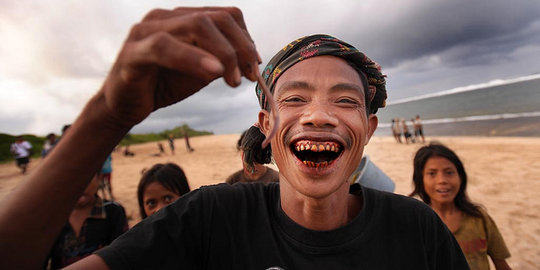
Festival The smell of Nyale (catching nyale)
Nyale according to biologists it is a type of worm (annelids) or sea animals that have spots on their legs and are included in the group of segmented animals (anthropods). Another expert opinion is that nyale are animals that live in holes in coral reefs beneath the sea surface. This type of worm is found only in South Lombok, Teluk Awang, West Sumbawa, Maluku, and Samoa in the Pacific Ocean (Baca; Lalu Wacana, 1982: 65).
The smell of nyale is the name of a local wisdom activity in West Sumbawa Regency. This local wisdom activity is an annual event that falls around February each year. The location of the activity smell of nyale This is done around the beaches in West Sumbawa Regency, such as in trophy beach (trophy beach) in Sekongkang District, beach Jelenga in Jereweh District, beach Ballad in Taliwang District, and several other small coastal areas.
Since the founding of West Sumbawa Regency (2004), this activity has been centered on the beach for generations. trophy which is located in Sekongkang District. The history of the birth of the 'festival' smell of nyale' This was born because the government saw that this local wisdom was being carried out individually, not yet carried out together, so the results were less than optimal.
This is especially true considering that the nyale fishing location is very close to the gold mining area that began operations in 1999 (PT. Newmont Nusa Tenggara), which is now fully acquired by (PT. Amman Mineral Nusa Tenggara). Before West Sumbawa Regency was established in 2004, the local wisdom of nyale fishing was routinely practiced by the local community.
Especially in the Trophy Beach area of Sekongkang District. Following the formation of West Sumbawa Regency, the government deemed it necessary to revive existing local wisdom activities, facilitated by the regional government, specifically the Regent and all levels. stakeholdershis.
The idea behind the birth of the festival smell of nyale It was then distributed and promoted through advertisements, banners, billboards, and print and electronic media. This was seen as successful in encouraging the public to enthusiastically welcome and support the Bau Nyale Festival.
The Bau Nyale Festival, a local wisdom event, features numerous competitions, uniquely designed by the government. Activities include a cultural parade, featuring participants dressed in traditional attire representing their respective tribes. All ethnic groups, including the Samawa, Sasak, Selayar, Mbojo, and Balinese, mingle.
The Bau Nyale local wisdom festival has finally become an annual mandatory event for the West Sumbawa Regency government, with the hope of becoming a tourism icon in the regency, particularly in Sekongkang. The main event of the Bau Nyale festival begins with congregational dawn prayers.
After performing the morning prayer, each of them prepared themselves with net equipment and the help of a flashlight, remembering that it was still dark after dawn. Then with enthusiasm the residents flocked to the beach to catch the nyale floating on the surface of the sea water.
[1] Redyanto Noor, Local Wisdom in the Hybridity of Modern Indonesian Literature, NUSA Journal. Vol. 15 No. 1 February 2020.

1 comment