
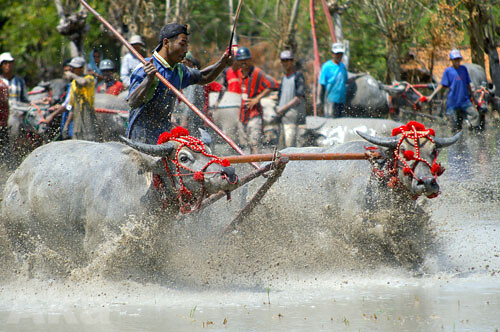
The Sumbawa Islands are administratively part of West Nusa Tenggara (NTB) Province. West Nusa Tenggara Province is divided into two separate islands: Lombok and Sumbawa. Sumbawa Island is divided into four Regency and one city: Sumbawa Besar Regency, Bima Regency, Dompu Regency, West Sumbawa Regency, and Bima City.
Each district and city has its own characteristic values local genius or more popularly known as the term local wisdom (local wisdom), Although there are some similarities, they are also different and varied from other districts.
Some examples of the unique diversity of local wisdom found in West Sumbawa Regency are the festivals. smell of nyale (catching nyale), how many buffalo' (buffalo racing), sleeping (hunt), soft (bare-handed fighting) and several other local wisdoms.
From local festivals smell of nyale until the berempuk still survives until now and has become a local cultural heritage from generation to generation as a form of local wisdom of the people of West Sumbawa in fostering culture and the spirit of mutual cooperation in society so that it is not eroded by the current of global modernization.
All types of local wisdom are the result of inheritance and are then celebrated with great fanfare, even though on the other hand, little by little, this culture is starting to be integrated by global currents that rely on technological modernization.
Within a decade the issue local wisdom (local wisdom) or formerly better known as local culture is starting to be openly studied, researched, and socialized by the government. This is certainly encouraging, as it raises hopes for the existence of local wisdom. local wisdom (local wisdom) which is slowly facing external challenges in the era of globalization.
The problems that arise are: quo-vadis Should local wisdom clash with each other? Or should they be allowed to develop separately? Or should we take a middle path by integrating local wisdom with global wisdom?
This paper attempts to analyze the existence of local and global wisdom in West Sumbawa Regency, which has begun to be promoted by the Regional Government. Using field practice analysis methods, the author attempts to read and examine the existence of local and global wisdom, particularly after the arrival of foreign gold mining companies from 1999 to the present in Taliwang, West Sumbawa Regency.
Quo-Vadis and Local Wisdom
Quo-Vadis is a new term or current linguistic trend in the contemporary world. Quo vadis is a Latin phrase that can literally be translated as a question. For example, quo vadis local wisdom in Sumbawa. This means where will the local wisdom of Sumbawa be taken? Or, in another example, quo vadis halal tourism in Indonesia. Where will halal tourism destinations in Indonesia be promoted?
Terms quo vadis Although somewhat unfamiliar in the world of Indonesian literature, it has been widely used in discussion forums, journals, books, and scientific papers in various media and universities. It is within this realm that the term quo vadis is intended to be understood in this article.
Furthermore, to avoid confusion in the discussion, it is necessary to first define the concept of local wisdom as used in this article. The concept of local wisdom is quite diverse and has different definitions and terms.
Some use the term local wisdom, local knowledge, local traditions, traditional knowledge, indigenous people, local community, primitive people etc. For this reason, further explanation of these terms and terms is needed in order to broaden our knowledge in understanding the meaning of these terms.
The term local wisdom is used by Clifford Geerts in his book Local Knowledge: Further Essays in Interpretive Anthropology. Originally a collection of Geerts' lectures at Yale Law School in 1981, this book was later compiled into a volume. In it, Geerts attempts to explain the changes in a nation that inherits traditions that are constantly changing from generation to generation.
In general, Geerts describes how the transformation of countries, cultures, and religions in the world such as America, Malay, India, Indonesia, Africa and so on. In the final section, Geerts concludes that his analysis of a culture represents an attempt to understand humans with the science of anthropology, how they survive with culture, environment and traditions and then try to shape their lives, (Clifford Geerts, 1983:14-16).
Although Geerts does not define it strictly obvious (clear, bright) the meaning of local wisdom, however the contents of the book clearly discuss traditions, culture, theories of life, and things that are still primitive cultural. So, Local Knowledge what is meant in the title of the book can be interpreted as a definition of local wisdom which is closely related to anthropology.
As for in the book Ethnobotany: Local Knowledge and Traditions, local knowledge (local wisdom) is defined as indigenous knowledge (indigenous knowledge) embedded in the life of a community based on the wisdom and experience of local communities that began in ancient times.
Over time, the knowledge acquired became a tradition within a particular local community or tribe. This knowledge was then passed down from generation to generation, focusing on agriculture, medicine, and other areas. (Jose L. Martinez, et al., 2019:1).
Temporary Rebecca Tsosie as quoted Melissa K. Nelson and Dan Shilling in the book Tradical Ecological Knowledge: Learning from Indigenous Practice for Environmental Sustainability, more appropriate to use the term traditional knowledge to explain the meaning of local wisdom which is then defined as a group that knows how the skills, innovations, training, learning and teaching of indigenous people, local communities, and a dynamic nation evolve and develop from generation to generation.
Tsosie doesn't even use one term to describe local wisdom; he also uses the term "indigenous peoples," which he believes is more contemporary and modern. Tsosie defines indigenous peoples as traditional populations who maintain traditional values, culture, and ways of life. (Mellisa K. Nelson & Dan Shilling, 2018: 233-234).
Researchers and observers of local wisdom in Indonesia also define local wisdom in a way that is not much different from what has been defined previously. The meaning of local wisdom (local wisdom) In linguistic terms, it means local wisdom which can be understood as local ideas which are wise, full of wisdom, have values contained in them and are followed and accepted by individuals in society.
Local wisdom is also known as local knowledge (indigenous or local knowledge) also known as local intelligence (local genius) which is the basis of cultural identity (cultural identity)This definition is understood from an anthropological perspective. (Ade Makmur, 2011: ix).
In another sense, local wisdom, according to (Sukari et al., 2016: 11), can also encompass the attitudes, perspectives, and abilities of a community in managing its natural and social environment, which fosters the community's capacity for development, resilience, and growth by utilizing the potential of natural and human resources. Alternatively, local wisdom is the accumulation of knowledge as a community strategy in responding to environmental issues.
The differences in the terminological definitions of local wisdom as explained above, generally accumulate into one meaning of local wisdom which is based on the knowledge, thoughts and abilities of a community in interacting with nature and its environment.
Thus, from this interaction, a desire arises and a process of awareness arises in humans to protect, preserve and maintain their environment and culture.
In simple terms, the ability to understand and preserve the culture and values of local wisdom that develop in society is important. Furthermore, the existence of ideas, concepts, and knowledge is needed to support local wisdom values, so that its definition does not shift to... “global wisdom”, which means that local wisdom values evolve due to factors of globalization and cultural modernization.
