
How Much is Kebo' (Buffalo Racing)
If in Madura there is bull racing, then it is local wisdom how many buffalo Buffalo racing can be found on the island of Sumbawa, particularly in Taliwang, West Sumbawa. The "Apan Kebo" (water buffalo race) is often held before the rice planting season and to welcome the arrival of the rainy season. This activity requires community participation in collaboration with the event committee.
Initially, the local wisdom of "apan kebo'" was limited to those who owned racing buffaloes. However, anyone who wanted to watch was welcome to do so as long as they adhered to the agreed-upon rules. Before the formation of West Sumbawa Regency, this activity involved all participants through deliberations, forming a committee, determining the location, date, prizes for the winners, and the time of the event.
The local wisdom of buffalo racing initially didn't attract much public attention because it only involved people who owned racing buffalo, and the number of local buffalo owners was relatively small. Previously, owning a racing buffalo was considered wealthy, as purchasing a pair of racing buffalo cost tens of millions of rupiah.
Naturally, this is a significant consideration for local communities in choosing to own racing buffalo. A unique aspect of the local wisdom of buffalo racing is that each racing buffalo has its own nickname. For example: Moon and Stars, Exchange Photos, Diamond Bulaeng, Flying Wheel, Buen Resong, Buraq, and many other unique names of famous racing buffaloes.
Seeing that the local wisdom of buffalo racing has bright prospects, finally the regional government of West Sumbawa Regency embraced and invited all the people to hold a joint discussion and decided that this local wisdom would be held annually and appointed eight sub-districts in West Sumbawa Regency as the implementing committee.
In fact, this local buffalo racing tradition attracts public interest with its fantastic prizes. The overall winner will receive an Umrah pilgrimage from the local government. This event has been proposed as a showcase of local wisdom to commemorate major events, such as the commemoration of August 17, 1945, Indonesian Independence Day, the anniversary of West Sumbawa Regency, and other major events.
Previously, the local wisdom of buffalo racing was limited to buffalo owners in West Sumbawa Regency. However, after the local government promoted it in more modern ways, such as creating promotional videos and advertising them on the internet, newspapers, billboards, banners, and so on, the local wisdom of buffalo racing, which was once considered shabby and primitive, has become more valuable and attracts its own appeal to anyone who sees, reads, or watches the advertisements. YouTube channel or the internet.
To support the event, the West Sumbawa Regency government awarded the overall winner an Umrah pilgrimage to Mecca. Other prizes included cash, a motorcycle, a television, a refrigerator, a fan, a goat, a mattress, a batik scarf, and other gifts at the local wisdom event. The local wisdom of "apapn kobo'" (buffalo racing), which was initially perceived as a local phenomenon, has become a global wisdom event without losing its sacred traditional values.
Nganyang (hunting)
Nganyang means hunting in the Taliwang language. This local wisdom is an individual activity that is still maintained today. Nganyang local wisdom is divided into two types: First nganyang mayung (deer hunting). Second, bau bai (catching pigs). This local wisdom, nganyang mayung, involves dogs specially trained for hunting and is equipped with a knife. Buja (spear). Approximately 5-10 dogs are brought by their owners to hunt in the wild forest. This local wisdom is carried out solely by individuals, with little involvement from others, unless there is prior agreement among the hunters.
Generally, the local wisdom of Nganyang is practiced in forests known for still being inhabited by herds of wild deer that still survive in the mountains and forests. nganyang mayung The hunt, conducted around mid-morning, begins to move through the targeted forest area. By dusk, the hunters return with slaughtered deer meat. Some is sold to local residents, while the rest is shared with their families.
As for local wisdom smells good This is done at night before and after the full moon, minimizing the use of flashlights. This is intended to help hunt wild boars, which frequently eat crops in farmers' gardens.
The local wisdom of "bau bai" (hunting) involves only wild dogs and a few specialized dogs, serving as experienced hunters. However, in recent years, the practice has expanded beyond nighttime to include daytime hunting. After capturing a wild boar, its meat is roasted for the dogs, not consumed as most residents of Taliwang, West Sumbawa Regency, are Muslim.
Even though local wisdom is starting to be eroded by global influences, where illegal logging or illegal logging is becoming increasingly rampant. As a result, the hunted deer that used to inhabit the forest are starting to move from place to place in order to survive, considering that they are greatly disturbed by the sound. chainsaw (sinsaw) which every day unknowingly drives away and disturbs their habitat.
Likewise with local wisdom smells good This activity is only carried out when the planting season arrives. Nowadays, wild boars are even rarer, perhaps because their habitat is disappearing, and farmers no longer hold such bau bai activities.
In the last two decades, local wisdom of Nganyang has begun to shift towards a more contemporary direction, namely the use of weapons is no longer using spears and hunting dogs, the current trend is to use long-barreled air guns, and using similar cars. ranger used to reach forests or mountain slopes. This makes things much easier for hunters, as they can easily immobilize prey by simply pulling the trigger from a distance of just a few meters.
Soft (bare-handed fighting)
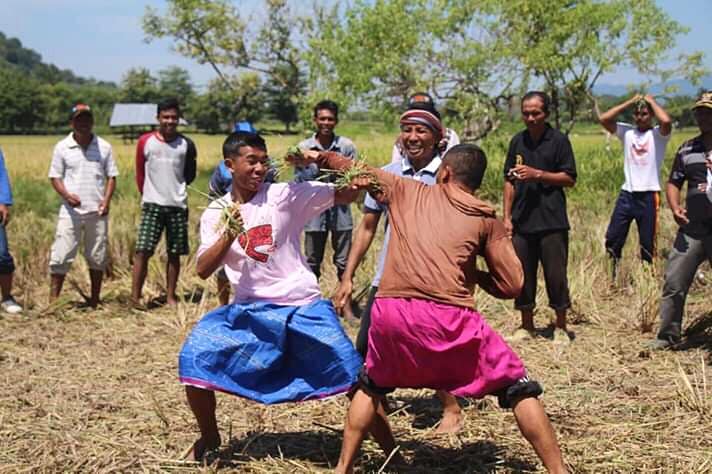
Berempuk, which in Indonesian means fighting with bare hands, is a local art form in West Sumbawa Regency that is still preserved, especially in the capital of West Sumbawa Regency, Taliwang City. In the Taliwang language, berempuk is called robber, The famous champions of each village competed in this traditional competition.
This local tradition of fighting has simple rules: two male participants, ready to fight, step into a circle surrounded by spectators. There's no registration required to participate, as all brave spectators are eligible to participate. Each prospective fighter must clench their fists. straw (dry rice stalks) in his hands. After receiving a signal from tau basengela (jury) consisting of three to eight judges, then they will fight each other.
Feet may not be used to kick an opponent. If someone falls or steps outside the circle, they automatically lose the match, while the winner must face another challenger who is waiting. Before the match, participants are asked to humming (replying to rhymes) in regional languages, its function is to shake the opponent's mental state and ignite enthusiasm for fighting
This local wisdom of berempuk is usually performed after the rice harvest, as entertainment and a break from the exhaustion of harvesting. Everything is done joyfully without any intention of mocking or holding grudges against each other. According to historians, the purpose of this local wisdom of berempuk is to select strong soldiers who will be the vanguard in protecting security. Sumbawa Kingdom.
Closing
When looking at the variety local wisdom or local wisdom that exists in the land of Taliwang. West Sumbawa, is a diversity that inherent (Complementing) global culture, not negating the progress of technological progress. Local wisdom is truly the foundation of culture in community life. Community culture is a reflection of a nation's progress and a mirror of the progress of a civilization. The diversity of local wisdom in West Sumbawa has endured for a long time and its diversity must be preserved.
Thus, society is not anxious about the emergence of global wisdom, which is not intended to compete or erode, but rather to complement each other. Therefore, the theory hybridity Local and global culture is a positive effort to integrate two cultures, namely local wisdom and global wisdom.
After reviewing and analyzing in more depth the existence of various local wisdoms and global wisdoms in West Sumbawa Regency, and quo-vadis This initial hypothesis question emphasizes the orientation of local wisdom in West Sumbawa. Cultural stakeholders are urged to further promote local wisdom human resources, not only at the local and regional levels, but also at the national and international levels.
Bibliography
Firmansyah, Hidayat. 2018. The Meaning of Signs in Sumbawa Community Arts in Taliwang District, West Sumbawa Regency, Thesis Journal, University of Mataram (UNRAM).
Geert, Clifford. 1983. Knowledge: Further Essays in Interpretive Anthropology. United States of America: Basic Books.
Makmur, Ade. et al. 2011. Local Wisdom in the Midst of Modernization, Jakarta: Ministry of Culture and Tourism of the Republic of Indonesia.
Martinez, Jose L. ed. 2019. Ethnobotany: Local Knowledge and Traditions. London: CRC Press.
Noor, Redyanto. Local Wisdom in the Hybridity of Modern Indonesian Literature. NUSA Journal. Vol. 15 No. 1 February 2020.
Shilling, Melissa K. Nelson and Dan. 2018. Traditional Ecological Knowledge: Learning from Indigenous Practices for Environmental Sustainability, United Kingdom: Cambridge University Press.
Sukari, et al., 2016. Local Wisdom in Building Food Security for Farmers in Lencoh Village, Selo, Boyolali, Central Java. Yogyakarta: Center for Cultural Preservation (BPNB).
Discourse, Then. 1983. Nyale in Lombok. Cultural Media Project, Directorate General of Culture, Department of Education and Culture, Jakarta.
Sources from the Internet
https://sumbawabaratkab.go.id/puluhan-jawara-adu-kuat-di-laga-berempuk/ Accessed July 18, 2023. At 1:26 AM)
https://id.wikipedia.org/wiki/Quo_vadis. Accessed July 18, 2023. At 1:52 AM
https://id.wikipedia.org/wiki/Pulau_Sumbawa. Accessed July 20, 2023, at 1:18 PM

1 comment