
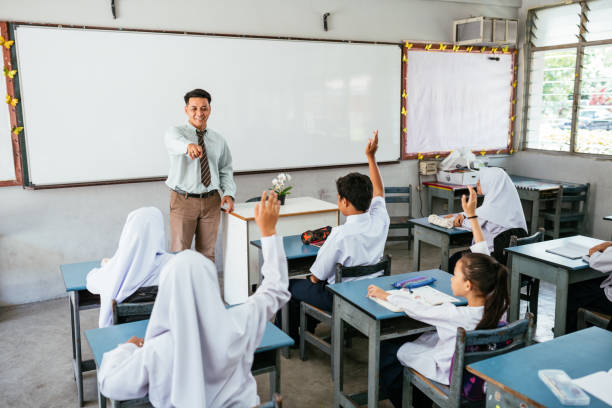
"If you spend your youth in a clean, honorable and obedient condition to God by devoting yourself to Islamic education, then that period will continue to be maintained, becoming a means of obtaining eternal heaven"
Bediuzzaman Sa'id Nursi, Guidance for the Young Generation, p. 22
The moral crisis is a core problem facing modern society today. This moral aridity is what fuels the gaps and inequalities in educational institutions. Fritjof Copra, an American author, observer of ecology and science, and founder of contemporary paradigm theories, concluded that the emergence of educational and character problems is a result of the moral crisis in modern society.
Problems like rebellion, student brawls, and violence arise because experts in various fields are unable to resolve emerging issues. For example, economists fail to understand economic inflation. Brawls are rampant among teenagers, indicating the inadequate role of educators. Security forces are powerless due to rising crime rates, and so on.[1]
Pitirim Sorokin, a Russian sociologist and academic, echoed this sentiment regarding the crisis of modern society. However, Sorokin didn't call it a moral crisis, but rather highlighted the increasing problems in families and interpersonal relationships caused by value-free school education.[2]
A value-free education system refers to schools that do not implement or practice involvement, and even abandon the teaching of values (religion) in their teaching. This is very relevant to current issues, particularly regarding value-free education, namely the rise of education systems that are tinged with values. secularism.
Meanwhile, the dichotomy of education as the product and the parent of secularism, known as the separation between religious education and general education in the context of shaping human personality, is fundamental to achieving complete education. (diniyah) which contains values, with general intelligence that gives birth to rationality (aqliyah).
It's important to note that, due to this educational dichotomy, schools are solely responsible for academic ability, neglecting knowledge of values (religion). Religious knowledge is left solely to the individual family or religious group. This clearly contradicts the concept of education in Islam, which does not distinguish (dichotomize) between religious knowledge and scientific knowledge. intellectual (rationality).[3]
In this regard, Ibn Khaldun argued that the method implemented or used by Easterners, integrating a mixed curriculum between teaching the Qur'an and the basic principles of general science, has been proven to be effective in educating individuals. (educated), rather than students only studying general knowledge.
So it must be understood that studying religious knowledge (sharia) is the main focus of the education system. However, this knowledge must be taught gradually, bit by bit, not all at once. If the religious knowledge being taught is not fully understood, it's okay to repeat it.
Thus, in an effort to overcome the moral crisis or value crisis that occurs in educational institutions or any institution, value education that originates from religion must not be compartmentalized or separated from the general science education system. (intellectual knowledge). If that happens, then Chapra, Sorokin or Erickson's analysis of the value crisis will never end.
In a different perspective, a value-free education system is secular, and it is impossible to provide solutions for the world of education. Conversely, Ibn Khaldun's view, which emphasizes religious learning without the dichotomy of general knowledge, offers a positive solution to the crisis plaguing adolescents and modern society, which tends toward materialism and the glorification of rationality.
In the end, the emergence of value-free education, which is essentially from the secular western education system, will become boomerang and diminishing the existence of religious education, particularly in Islamic educational institutions. Furthermore, the fatal consequence is a misunderstanding of the essence of education and human nature.[4]
Wallahua'lam bish shawa Ab
[1] Fritjof Copra, Turning Point of Civilization; Science, Society and Cultural Awakening. (Jakarta: Bentang pustaka, 2004), 8.
[2] E. Erickson, Character Development in Michael Belok et al, Approaches to value in Education, (Debuque: Brown Company Publishers, 1966), 288.
[3] Ibn Khaldun, Introduction, (Jakarta: Pustaka al-Kautsar, 2011), xiii
[4] Syed Muhammad Naquib Al-Attas, Aims and Objectives of Islamic Education (King Abdul Aziz: Jeddah, 1979). Read, al-Attas on The Concept of Education in Islam (Kuala Lumpur: ABIM, 1980), 35-40.
