
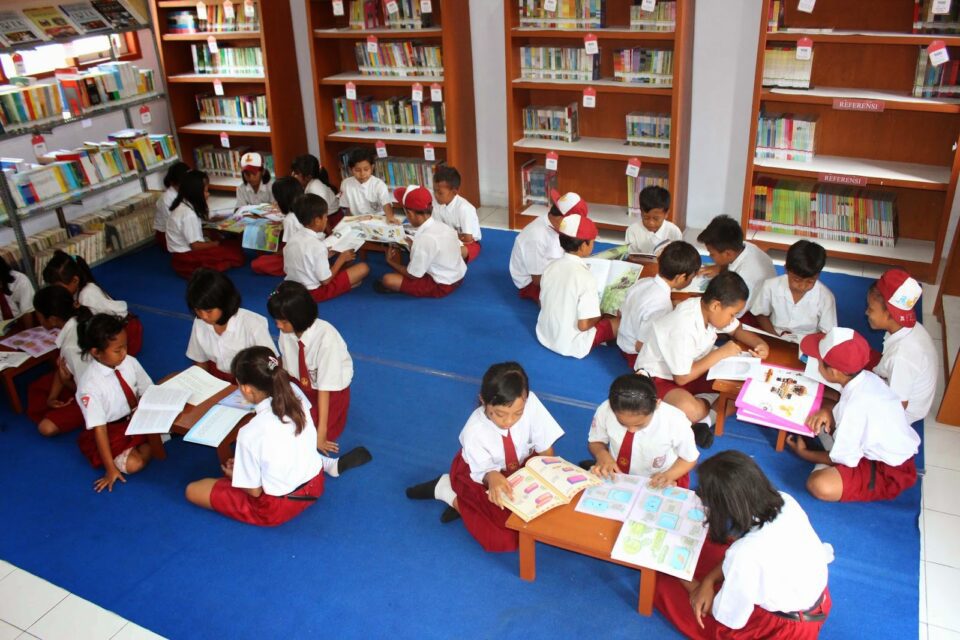
"Reading makes us smart, the benefits are clear." That's the message of a compilation of public service announcements produced by the National Library of Indonesia to promote reading in Indonesia. The underlying message of the ads is to foster a reading culture, or book literacy, not only in schools but also in the wider community.
The low reading interest of Indonesia's younger generation is deeply concerning, especially given the challenges of the millennial era. A generation caught up in the ever-changing digital landscape of technology and information.
The millennial generation is defined as a generation with psychological behavior and a lifestyle in the digital era that is highly dependent on the internet. As a result, this generation prefers to read SMS messages. Whatsapp, Facebook, Instagram rather than reading books. In this regard, this article will focus on discussing three steps to foster a love of books in elementary school students, before they are introduced to the world. gadgets.
The discussion that will be explained in this scientific article is; First, how to introduce books to students in elementary school (SD). Second, Education budget and quality books. Final, intensive teacher guidance and the use of technology as a reading tool in schools.
a. Introducing Books to Elementary School Students
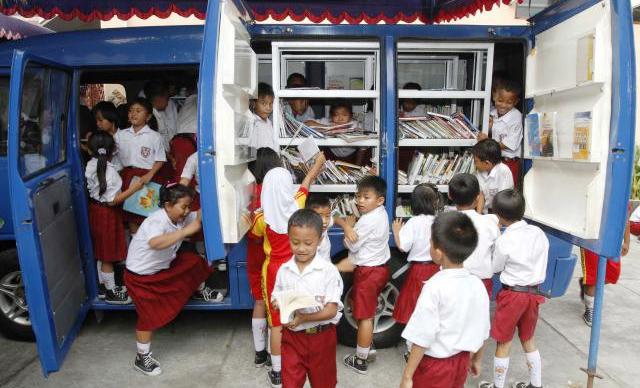
Understanding read or read, According to the Big Indonesian Dictionary (KBBI), seeing and understanding the contents of what is written (by saying it aloud or just silently). In order to realize the meaning of seeing and understanding the contents of what is read, the phenomenon of reading books in schools must be practiced, made a habit, created, and design, and prioritized primarily for elementary school children. This is evident in the fact that elementary school students spend more time playing than reading books or going to the school library.
– Introducing Books to Students from an Early Age
Introducing books and a reading culture to elementary schools requires the full commitment of parents, teachers, principals, and school committees. It requires sacrifices from parents and teachers, especially outside of school and during activities. extracurricular activities. How will a reading culture be created in the school environment, if the four domains above are not yet capable of creating it? milieu reading for students. This can be evaluated when children begin learning at the beginner level or Early Childhood Education (PAUD).
In general, the education that is taught is still mostly in the form of games or casual play, rather than being taught to open picture books or simply introducing them through books with pictures of animals, regional dances, the universe, or even pictures of celestial objects that can attract their brains to be interested in opening the book.
Introducing students to reading requires teacher creativity. Teachers are also required to be more active readers than their students. If teachers are reluctant to read, what will happen to their students? Worse still, if teachers encourage their students to read, but they themselves are reluctant to read.
Of course, this is completely contrary to a discipline built on "awareness." How can we raise awareness among others when teachers themselves lack it? It's undeniable that the reading interests of teachers and students in schools are far from the reality and ideals of the culture being promoted.
Former Minister of Education and Culture Anies Baswedan said, "For reading to become part of Indonesian culture, it requires an introduction and stages. The first step is to teach children to read, then get them used to reading, until reading becomes a habit, a character trait, and a hobby. Only then will reading become a culture."
– Stimulating Student Creativity with Empirical Activities and Competitions
Elementary school students should be trained more through practice than theory. By providing students with many real-life examples, they will more easily imitate the teacher's habits.
For example, when a teacher wants to take children to the school library, they should first find an interesting book. Then, they should show the book to the students and explain the many interesting things they can read. If the students are interested in the teacher's explanation, they will be enthusiastic about learning.
For elementary school students, real-world examples are crucial for influencing their simple thinking and training their intellectual capacity to critically examine what they see. By stimulating students' curiosity in this way, they gain new experiences in reading. Children are naturally more interested in the empirical than the abstract, as their brains are still highly receptive to absorbing information in concrete, rather than theoretical, ways.
Besides providing concrete examples from teachers in promoting students' interest in reading, another important step teachers should take is holding book-related competitions, whether it's writing competitions, reading competitions, or short reviews of books they find interesting.
Students will be more interested in reading if they are accustomed to competitive activities. This is because, indirectly, when they want to be the best, students will inevitably learn. And parents should play an active role in teaching their children to read and write as a form of responsibility towards them.
Therefore, it's crucial to introduce books to children from an early age by engaging them in engaging, empirical activities and games. This will help students become accustomed to books and develop an interest in reading them.
b. Education Budget and Quality Books

Agus M. Irkham, in his article "Interest in Reading Can't Wait" wrote a statement by former Minister of Education Anis Baswedan regarding Ministerial Regulation (Permen) Number 21/2015 concerning the Character Development Program (PBP). One of the program's priorities is reading non-textbooks 15 minutes before class begins. (Read: https://kolom.tempo.co/read/1001882/minat-baca-tak-bisa-menunggu)
The former Minister of Education's proposal is crucial for school principals and teachers to understand. To follow up on this proposal, it's necessary to examine the real-world aspects of book availability, library collections, and the quality of books students will read. This, of course, requires a budget for quality books for students.
– Representative Reading Place
Looking at the central government's budget allocation, there has been an increase. In 2017, the education budget was 416 trillion rupiah, and in 2018, it will increase to 441 trillion rupiah. According to the same source, the central government's budget allocations are focused on two key areas.
Focus First, for repairing school infrastructure. Many elementary schools still have damaged, leaking, and unfit-for-use buildings. Second, Prioritize the quality of education itself. This relates to the development, improvement, and advancement of both teachers and students in learning, including the provision of books in libraries.
If the substantial funding available for physical development and improving the quality of education in elementary schools is utilized effectively, it's possible to establish a reading culture for elementary school students. It would be virtually impossible to create a literate generation in this millennial era without the support of attractive reading infrastructure.
There are over 148,000 elementary schools in Indonesia. Only 50,000, or approximately 30 percent, have libraries. The availability of funding budgeted by the central government would significantly contribute to the development of quality library infrastructure, teachers, and students.
– Availability of Quality Books
Cultivating a reading culture in elementary schools requires more than just the school, teachers, families, and school committees. Adequate financial support is also needed. The availability of libraries and engaging reading materials is essential for fostering a reading culture in schools.
Of course, to fill a library, it's essential to provide high-quality and engaging books. Having books that interest students will naturally influence their reading and foster curiosity about the books they read.
As mentioned earlier, the availability of a school library is vital to fostering a reading culture among students. Without a school library or learning center, it's highly unlikely that children will read outside of school hours or before class begins.
Writing "Books are windows to the world" Frequently written outside or in front of the library, this will be a powerful incentive for students to learn to read. This is especially true with the availability of interesting books. Interesting books will automatically be frequently opened, read, and memorized, becoming tools and ideas for future knowledge.
With the improvement of infrastructure, the availability of quality books and attractive library management, it will increasingly attract students to visit and look for light reading sources.
c. Intensive Teacher Guidance and Utilization of Technology as a Reading Tool in Schools.

Building an interest in reading and creating a reading culture in elementary schools will stall if not nurtured and nurtured sustainably. This requires intensive, optimal, and dedicated guidance from teachers, principals, families, and school committees.
– Intensive Teacher Guidance
If elementary school students continue to be mentored in reading, this will improve the reading culture of Indonesians, which currently only reads 2-4 hours per day. As reported by Tempo.CO Research conducted by the Head of the Center for Library Development and Reading Interest Assessment at the National Library, Syarif Bando, found that the results of the 2012-2014 study were quite concerning, namely 2-4 hours per day. United Nations of Education Scientific and Cultural Organization (UNSCO) provides a standard of 4-6 hours per day.
This is in line with the opinion Mr. Hodgson published in 1960, pages 43-44, that reading is a process carried out by readers to get a message, which will be conveyed by the author through the medium of words or written language.
The process and guidance in developing interest are crucial to achieving maximum results. If teachers don't provide intensive guidance, students' reading habits will easily disappear. They'll return to play and spend their time having fun, forgetting about reading.
– Utilization of Technological Facilities

Currently, some programs such as books on line, read on line, library on line and so on are no longer foreign to teachers. Of course, all of these things would be more useful if the school created some kind of digital libraryThe digital library will provide a new reading experience for students. Children can also be encouraged to utilize technological tools such as reading apps on laptops and various online book reading apps.
By consistently guiding children, their interest in reading will grow as an awareness and a spiritual need in every learning activity. This is especially true when supported by various guided technological tools. This will significantly contribute to the creation of a reading culture, as is now widely promoted by the government under the name of the school literacy program.
d. Conclusion
From the above descriptions, it's undeniable that introducing elementary school students to books from an early age is crucial to fostering their interest in reading. Similarly, the availability of an education budget for the procurement of quality books tailored to students' reading interests is equally crucial. This is further enhanced by sustainable teacher guidance and the use of technology and the internet to stimulate students' interest and prevent boredom with reading. With these steps, it is hoped that a reading culture will be established, starting from schools and extending to the wider community.
The smart way to be smart is reading!
READING SOURCES
- Journal of Islamic Education. At-Ta'dib. 2011. (Faculty of Tarbiah Unida Gontor,), Vol. XVI, No. 01, June Edition. Page 95.
- Department of National Education. Big Indonesian Dictionary. 2008. (Jakarta: PT Gramedia) Fourth edition.
- Hasbullah. 2013. Basics of Educational Science. (Jakarta: May)
- Husaini, Adian, Jakarta. 2015. Realizing a Just and Civilized Indonesia, 1st Edition, Bina Qalam, Surabaya, INSISTS,
- Imron, Ali, 2012. Educational Policy in Indonesia: Process, Product, and Future, Jakarta, Bumi Aksara,
- Tempo Newspaper edition 21-27 August 2017.
- https://kolom.tempo.co/read/1001882/minat-baca-tak-bisa-menunggu
- Zuriah, Nurul, M.si. 2015. Moral Education & Character Education in the Perspective of Change. (Jakarta: Bumi Aksara)

1 comment