
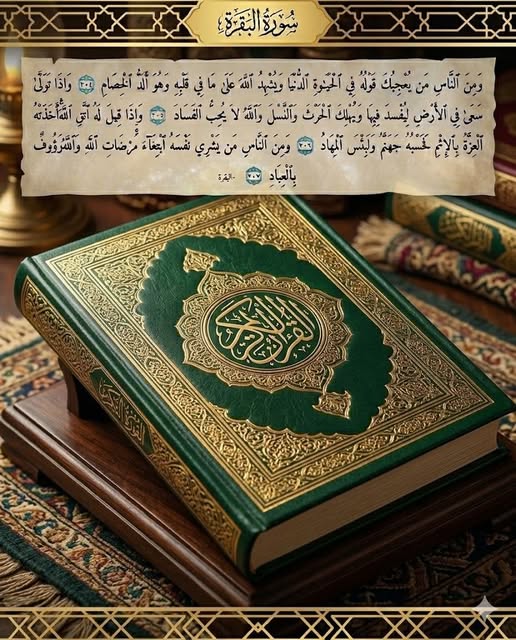
Vocabulary Explanation:
يُعْجِبُكَ
(amazes you): pleases you and you think it is good.-
فِي الدُّنْيَا
(in world affairs): when he speaks about worldly matters,
– أَلَدُّ الْخِصَمِ
(Very strong in hostility): very strong in disputes and quarrels, great because of the eloquence of his tongue.
تَوَلَّىٰ
(turn away): go away and return, or he has power (territory).
– الْحَرْثَ وَالنَّسْلَ
(plants and offspring): al-ḥarṡ are agricultural crops, and an-nasl are livestock.
God bless you
(pride dominated him because of sin): he was dominated by pride and unwillingness (to repent) due to his sins, so that he did not fear Allah.
– يَشْرِي نَفْسَهُ
(selling himself): he sells himself to Allah Ta'ala by fighting in His path using his soul and wealth.
Meaning of the Verses:
Allah SWT informed His Messenger and the believers about the condition of the hypocrites and the sincere believers. Allah said while speaking to the Messenger ﷺ: "And among humans there is a hypocritical man whose speech is good, and when he speaks, his speech amazes you because it is beautiful and sparkling.
This occurs when he speaks about worldly affairs, as opposed to the afterlife, because he is unaware of them and has no incentive to speak about them, as he is a disbeliever. When he speaks, he testifies to Allah that he believes in what he says.
He said to the Messenger ﷺ, 'Allah knows that I am a true believer and I love you,' and he testified to Allah that he was so... But when he rose from your assembly and left you, he {walked on the face of the earth}, that is, he walked spreading corruption to destroy crops and offspring by committing major sins.
He prevents rain from falling, causes crops to dry up, the land to become barren, livestock to die, and offspring to be cut off. This act is hated by Allah Ta'ala; He does not like it, nor does He like the person who does it.”
As Allah Ta'ala reports that this hypocritical person, if he is commanded to do good or prevented from evil, and it is said to him, "Be fearful of Allah, do not do this or abandon that," he will be overcome by pride and self-esteem due to the sins that surround him.
So he does not fear Allah and does not repent to Him. Sufficient for him as a reward for his hypocrisy, wickedness, and corruption is the Fire of Hell, which he will spread out as a bed; he will never move from it. And the worst bed is Hell.
As Allah Ta'ala also reported about sincere believers, He said: “"And among humans there is a male believer who is true in his faith, who sells himself and his property to Allah Ta'ala in order to seek His pleasure and life by His side in the Darussalam paradise."”
Allah says: {وَمِنَ ٱلنَّاسِ مَن يَشْرِي نَفْسَهُ ٱبْتِغَآءَ مَرْضَاتِ "“And among humans there are those who sell themselves to seek Allah's pleasure. And Allah is merciful to His servants."” He is Most Merciful to them.
It is said that the hypocritical man who is being talked about in the first three verses is al-Akhnas bin Shariq, and the male believer who is discussed in the fourth verse (QS. Al-Baqarah: 207) is Shuhaib bin Sinan ar-Rumi Abu Yahya.
When the polytheists learned that he was going to migrate to Medina to join the Prophet (peace be upon him) and his companions, they said, "You will not go with your life and wealth to Muhammad. We will not allow you to migrate unless you hand over all your wealth to us."“
So he gave away all his possessions and emigrated. When he arrived in Medina and the Messenger of Allah ﷺ saw him, he said to him: "Your business is lucky, O Abu Yahya, your business is lucky." Even though these verses relate to al-Akhnas and Shuhaib, the lesson is taken from the generality of the pronunciation, not from the specificity of the cause.
So al-Akhnas is a bad example for everyone who has his qualities, and Shuhaib is an example of goodness and perfection for everyone who has his qualities.
Instructions from the Verses:
First, a warning not to be deceived by someone's eloquence and clarity of speech if he is not a believer and sincere person.
Second, The worst of people are those who cause damage on earth by committing crimes that cause damage and destruction to humans and livestock.
Third, a person's words "Allah knows" and "I testify to Allah" are considered an oath. So let a believer be careful when saying it if he knows within himself that he is lying.
Fourth, If it is said to a believer, "Be fearful of Allah", it is obligatory for him not to be angry or hate the person who ordered him to fear Allah. Instead, he must admit his sins, ask Allah Ta'ala for forgiveness, and immediately abandon his sins.
Fifth, encouragement to strive for jihad with life and wealth, and the permissibility of a Muslim to spend all his wealth in the way of Allah Ta'ala. It is not considered wasteful or redundant, because waste and extravagance lie in spending on disobedience and sin.
And Allah knows best