
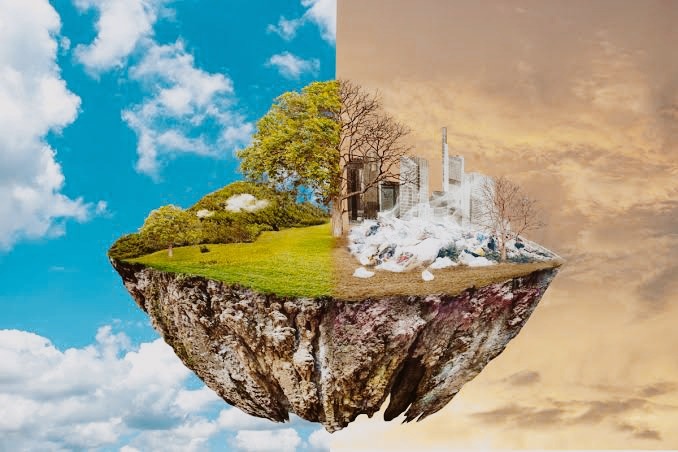
Magazine National Geographic The 10th anniversary edition of Indonesia (2015) once featured a sarcastic statement on its front cover: "Sorry. There's no pretty picture for climate change. Can we survive?" Indeed, no visual representation can fully convey the complexity and seriousness of the climate change problem we face today.
In Indonesia, the phenomenon of climate change has triggered various natural disasters. 1 For example, throughout 2023, there were approximately 4,938 incidents, consisting of 1,802 forest and land fires, 1,168 floods, and 1,155 extreme weather events. These disasters resulted in at least 265 deaths, 33 missing, and 5,783 injuries. Furthermore, a total of approximately 8.85 million people were displaced due to damaged homes (Budianto, 2024).
One of the most impactful disasters was extreme heat in several Indonesian cities in September 2023. A report from the Meteorology, Climatology, and Geophysics Agency (BMKG) recorded daily temperatures reaching 38 degrees Celsius (Budianto, 2024). The impact not only made the weather feel hotter but also caused fatigue and dehydration, leading to crop failure (Litbang Kompas, 2023).2
This irony underscores the importance of our awareness of the urgency of the impacts of climate change. This awareness extends beyond statistical observations and scientific predictions, but also directly into its impact on everyday life.
The Role of Humans in Climate Change
Climate change is fundamentally a natural phenomenon. However, what makes this situation ironic is how human activities significantly contribute to the acceleration and intensity of these changes. Worse still, the impacts of climate change are not always evenly distributed. Developing countries and communities most vulnerable to these changes are often the ones most affected.
We need to be honest that human activity since the Industrial Revolution around the 18th century has been a major catalyst for climate change, leading to the current critical phase. The burning of fossil fuels like coal, gas, and oil releases large amounts of emissions into the air, causing air pollution. The result is rising global temperatures, extreme changes in weather patterns, and melting polar ice caps, threatening ecosystems and human communities worldwide.
Industrial activities, intensive agriculture, and deforestation also contribute significantly to greenhouse gas emissions. Forests, which play a crucial role in absorbing carbon dioxide (CO2), are continually being cleared for agriculture, housing, and other industrial activities. The loss of these forests not only reduces nature's capacity to absorb CO2 and produce O2 but also damages ecosystems and the habitats of the various species within them.
Furthermore, excessive consumption patterns and uncontrolled use of natural resources have increased pressure on the environment. As a result, we have recently experienced firsthand the hardships of living in extreme weather patterns, such as strong winds, floods, and droughts. In some places, crop failures, infectious diseases, and even loss of life have occurred.
This fact strengthens the hypothesis that was once put forward by Michael S. Northcott in his book entitled '‘God and Gaia: Science, Religion, and Ethics on a Living Planet'. Northcott states that the general human view of the Earth as a neglected living entity is the main root of all environmental problems (Northcott, 2022).
Most humans tend to view the Earth as a living object that can be exploited according to need without considering its impact on the ecosystem and the survival of other creatures (Lovelock, 1982; Northcott, 2022).
We need to realize that the balance of life on Earth is currently under threat. Weather anomalies, warming global temperatures, unpredictable seasons, droughts, floods, rising sea levels, and even food shortages are valid arguments for a troubled climate. Truly, there are no beautiful words to describe climate change. Can we survive?
Recommendation
To address the increasingly real and detrimental impacts of climate change, awareness and a series of concrete and sustainable actions are required. Therefore, this section will outline several recommendations that can be implemented to address the challenges of climate change.
- Product Life Cycle: Adopting the practice of purchasing durable, eco-friendly items and repairing damaged items instead of buying new ones. This not only benefits long-term cost savings but also supports environmental sustainability by reducing carbon footprint and waste.
- Reducing Your Personal Carbon Footprint: Reducing your personal carbon footprint, such as using public transportation or walking, can be beneficial in reducing air pollution and dependence on fossil fuels. These measures not only reduce CO2 emissions but also help reduce air pollution, which directly impacts human health and the environment.
- Sustainable Diet: A sustainable diet involves increasing plant-based foods, reducing meat consumption, and supporting organic or local agriculture. For example, choosing to eat more vegetables, fruits, whole grains, and legumes will reduce the environmental impact of meat production.
- Educate Yourself: We can educate ourselves and others about climate change through reading, discussions, or attending environmental events such as exhibitions, workshops, or cleanups. We also need to learn directly from experts and interact with communities that care about the environment. By increasing awareness and knowledge, we can take more effective action in our daily lives and inspire others to do the same.
Conclusion.
The life cycle of goods, reducing your personal carbon footprint, a sustainable diet, and environmental education and awareness are concrete steps individuals can take to maintain the planet's sustainability. By adopting these practices, we not only improve our own quality of life but also ensure that existing natural resources can be enjoyed by future generations. Such lifestyles, when implemented collectively, have the potential to significantly impact efforts to combat the impacts of climate change.
- Simply put, climate change refers to long-term changes in temperature and weather patterns. Climate change can be a direct cause or a contributor to natural disasters such as floods, droughts, or tropical storms. Global warming can increase the intensity and frequency of extreme weather events such as hurricanes or heavy rainfall, which in turn can lead to flooding and landslides.
- Results of R&D analysis Compass in October 2023 showed that every 1 degree Celsius increase in air temperature per year would reduce rice production by around 4,500 tons in Indonesia.
Bibliography
Budianto, Y. (2024). The Public Increasingly Feels the Impact of Climate Change. KOMPAS. https://www.kompas.id/baca/riset/2024/01/10/publik-makin-merasakan-dampak-perubahan-iklim
Kompas Research and Development. (2023). Climate Factors Depress Rice Production. KOMPAS. https://www.kompas.id/baca/riset/2023/10/12/faktor-iklim-tekan-produksi-padi
Lovelock, J. (1982). Gaia: A New Look at Life on Earth. Oxford University Press.
Northcott, M. S. (2022). God and Gaia: Science, Religion and Ethics on a Living Planet (1st Editio). Routledge. https://doi.org/https://doi.org/10.4324/9781003110750
This article is the work of the winner of 1st place in the Batuter.com Anniversary Scientific Paper Competition.
Author: Yohanes Candra Sekar Bayu Putra Amuna

1 comment