
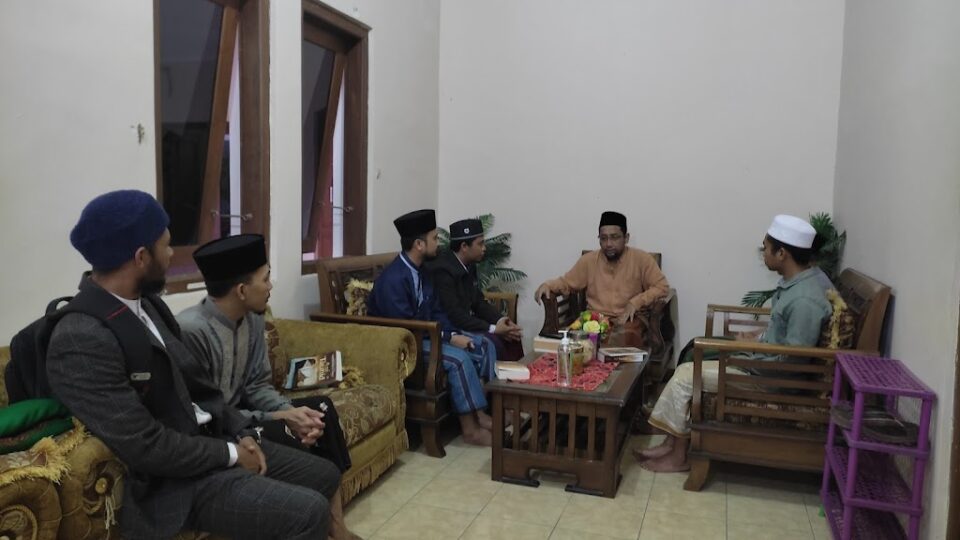
“"Glorify your children and correct their adab (behavior)"” (Narrated by Ibn Majah, Sunan Ibn Majah, No. 3671)
Meaning Education (Education)
In the explanation of the scholars regarding the word education, Ar-Raghib al-Ashfahani in Mufrodât fî gharîbil Qur'ân stated that the word touch the origin of the meaning is at-tarbiyah (education) is growing a condition towards perfection little by little until it reaches the level of perfection. It is stated in the sentence rabbahû, warabbâhu, warabbahu. It is also said in a sentence. Lian yarubbanî rajulun min quraisyîn ahabbu ilayya, min al yarubbanî rajulun min hawâdzinin. This means that I would rather be educated by the Quraysh than educated by the hawazhim.
Say rabbû is mashdar (infinitive) taken from the subject word (fa'il) and words Wednesday not spoken except for Allah who provides guarantees for the benefit of all existing creatures. For example, God's word in a letter Saba' verse 15, baldatun tayyibatun warabbun ghafûr “"(your country) is a good country and (your Rabb) is the Most Forgiving". So that there are no similarities in the meaning of words rabb, here Ar-Raghib al-Ashfahani emphasizes the meaning of the word rabb which is juxtaposed with other words, then the meaning is intended by Allah for the others.[1]
As for, Imam Bukhari narrated the sanad from Ibn Abbas ra, saying; Be people rabbani who is patient (wise) and understanding jurisprudence. Regarding the meaning rabbani As mentioned in the books of interpretation, he is a person who teaches people with easy knowledge first, before teaching them difficult knowledge. Another proof is the hadith narrated by Imam ath-Thabranî with his sanad from Abi Tsa'labah ra he said that one day he met the Messenger of Allah and said;
“"O Messenger of Allah, hand me over to people who are good at teaching." Then Rasulullah recommended me to Abu Ubaidillah Bin Jarrah, then he said; "Now I have handed you over to someone who is good at teaching and educating you.” [2] That is the meaning of tarbiyah according to the ulama.
Meaning Ta'lim (teaching)
According to Muhammad Fu‟ad Abd al-Baqi say ta'lim form Masdar from the word '‘Allah’ which in its derivative form is repeated in the Qur'an no less than 105 times. The word allama repeated five times and the rest using other forms such as ilman 14 times, twice with repetition, ulama', three times using the word religious leader, five times with the editor alimtum, and four times using the word Peace be upon you, and so on.[3]
When referring to al-Ashfahani, said ta'lîmu which means teaching or notification is self-motivation to describe meanings. While the word ta'allum which means learning to know is self-attention to describe these meanings. It is possible in words ta'allum which means learning, it can contain meaning i'lâm which means notification if the learning is carried out continuously.
Raghib Al-Ashfahani provides references from Al-Qur'an Surah Al-Hujarât verse 16, Surah Ar-Rahmân verses 1-2, Surah Al-A'laq verse 4 and Surah Al-An'am verse 16 and other letters. As for the letter Al-Baqarah verse 31 “"And He taught Adam the names of the names (things)"” Al-Ashfahani explains the meaning of Allah's teaching about names Adam is by giving him the power to speak and put names on things and this is done by conveying it in his heart. Likewise His teachings to the animals, each of these teachings is an act that God gave to them and by choosing a vote by Him.[4]
The Prophet's emphasis on the Urgency of the Prophet Muhammad SAW's Adab Education. emphasizes the importance of education manners in all aspects of life. There are many narrations from the Prophet Muhammad about the importance of studying manners. From Ibn Mas'ud he said; "Isn't an educator unless he is happy to be given his adab. And indeed Allah's adab is the Koran."[5] This means that an educator must be happy if the word of Allah SWT is conveyed to him.
In another history; “Glorify your children and improve them manners (their) behavior”[6] said Manners In this hadith, it refers to the meaning of behavior. According to scholars, the way to improve children's behavior is by teaching them morals who are good to them.
The Prophet Muhammad's message, especially to parents, was that parents should teach and provide the best education for their children. The best education the Prophet Muhammad meant was manners. He said; "There is no gift a parent can give to their child that is better than manners the good one.”[7]
About manners This, Imam al-Ghazali of the view that the source of all outward manners And inner is the Prophet Muhammad SAW. This is because the Prophet Muhammad SAW always prayed to Allah to be given manners the good one (mahâsin al-adab) And morals noble (praiseworthy). Then Allah revealed to the Messenger of Allah the Qur'an and educated him with the Qur'an. which then morals He is like the Qur'an.[8]
In other discussions of scholars, such as Ibn Al-Mubarak state; "If I am told about someone who has the knowledge of previous and future generations, I will not regret not having the opportunity to meet him, and if I hear that there is someone who has manners, good personality, I would really regret it if I didn't get to meet him.”[9]
With manners taught by the Prophet Muhammad. The ulama then explained and seriously practiced education manners This is actualized in the daily lives of the scholars themselves. Isn't this very important? urgent so that then we as a generation of Islam return to practicing it in our lives, our family lives, and teach it to our children?
Therefore, the urgency of education manners This must be our priority as parents, teachers, and scholars to teach manners and guide the future generation of Muslims so that they do not fall into destruction. manners (su'ul adâb). If the morals of the generation are lost, then it is our responsibility as parents, teachers, and educators who neglect the message of the Prophet Muhammad (peace be upon him).
Conclusion
By seeing the urgency of education manners which has been propagating Rasulullah SAW. So we should return to the role models and examples that the Prophet gave us. Good education manners, and in other terms, namely, study And education must be taught and practiced equally in educational institutions, families, communities, especially among parents and their family members. In order to achieve an educational orientation that is civilized which was exemplified by the Prophet Muhammad.
[1] Ar-Raghib Al-Ashfahani, Al-Mufradât: fî gharîbil Qur'ân, Volume 2. 11-13. [2] Ali Abdul Halim Mahmud, Tarbiyah al-Khulûkiyah, 22-23 [3] Muhammad Fu'ad Abd al-Baqi, al-Mu'jam al- Mufahras Li Alfaz al-Qur'an al-Karim, 488, 689 [4] Ar-Raghib Al-Ashfahani, Al-Mufradât: fî gharîbil Qur'âni, 775-776 [5] HR. al-Darimi in the book Sunan al-Darimi chapter on the virtues of people who read the Koran, No. 3364 [6] H.R. Ibn Majah, Sunan Ibn Majah, No. 3671 [7] HR. Ahmad, Musnad Ahmad, No. 15439 [8] Imam Al-Ghazali, Ihyâ Ulumuddîn, Juz III, 442 [9] Sheikh Abdul Qadir Al-Jilani, Al-Ghunyah lî Thâlibî Tharîq al-Haq, 54

1 comment