
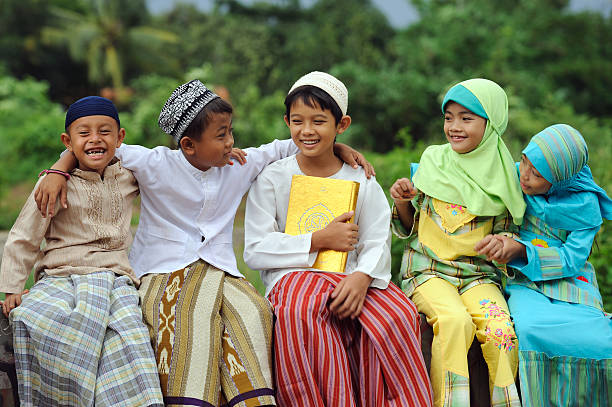
Islamic boarding schools (pesantren) are the oldest Islamic educational institutions in Indonesia and have played a vital role in shaping the nation's character. History records that pesantren have developed as centers of religious education, the spread of Islam, and the moral development of society, from the era of the Walisongo (Nahdlatul Ulama) to the modern era. The persistence of pesantren across generations demonstrates that this educational model has a strong and relevant foundation of values. (Bruinessen, M. van. (2015).)
Amidst globalization and technological advancements, character education has become an urgent need for the younger generation. Characters such as responsibility, integrity, discipline, and social awareness are essential to face the challenges of the times. Islamic boarding schools, with their systems that emphasize habituation and role models, have proven effective as character-building institutions compared to educational models that focus solely on cognitive aspects. (Ma'arif, S. (2018).)
Life in an Islamic boarding school also provides space for the internalization of moral values through worship habits, social interactions, and a structured environment. The dormitory system, religious study activities, and the close relationship between students and their religious leaders (kyai) create a continuous process of character education. This process is known as character embedded system, namely the instilling of values through daily life, not just through theory. (Ziemek, M. (2017).)
In addition to character education, Islamic boarding schools play a significant role in leadership development. The involvement of students in internal Islamic boarding school organizations, such as dormitory management, extracurricular activities, and religious events, provides real-world experience in leadership, program management, and decision-making. This learning aligns with the concept of experiential leadership learning, which emphasizes that leadership is built through direct experience. (Nuryadin, M. (2020).)
By combining character education and leadership development, Islamic boarding schools have the potential to produce a generation that is not only intellectually intelligent but also morally and socially mature. Amid the growing need for leaders with noble character, Islamic boarding schools are an ideal educational model for developing future leaders. Therefore, the role of Islamic boarding schools needs to be continuously strengthened and adapted to current developments without losing their traditional values. (Azra, A. (2019).)
Strengthening Character through Habits in Islamic Boarding Schools
The character formation of students occurs through the habituation of daily activities such as congregational prayer, wirid (recitation of the Koran), night study, and mutual cooperation. This pattern of habituation has proven to be an important foundation for building discipline, responsibility, and independence in students. Research by Rofiq & As-Siddik (2020) explains that character education in Islamic boarding schools is effective because of the culture. living values which is carried out consistently in every student activity.
The Role of Kyai in the Formation of Student Leadership
Kyai play a central role as spiritual, moral, and organizational guides. Kyai not only provide moral examples but also shape the managerial abilities of students through delegation of tasks, such as leading worship activities, student organizations, or rhetoric training. These findings align with research by Hasan & Barizi (2022), which found that kyai leadership creates patterns of leadership. character fostering which is strong in students.
The Islamic Boarding School Education Model as an Integrated Character Building System
Islamic boarding school education combines formal, non-formal, and informal education, integrated into a 24-hour environment. This integration creates highly effective character and leadership development. A previous study by Muthmainah (2021) confirmed that the controlled environment and values of Islamic boarding schools strengthen students' discipline and independence.
Internalization of Leadership Values Through Santri Organizations
The student organization (OSIM/OPP) serves as an important platform for leadership development. Students learn to organize activities, make decisions, communicate, and solve problems. This aligns with research by Saparwadi (2021), which asserts that Islamic boarding schools function as institutions for character and leadership development through hands-on practice.
Students are not only formed spiritually but also intellectually through formal learning activities and religious study. This integration of values creates students with religious character yet rational and capable of leadership.
Conclusion
The discussion above demonstrates that Islamic boarding schools (pesantren) play a strategic role as educational institutions, not only equipping students with religious knowledge but also developing character and leadership skills holistically. Through a 24-hour educational system, Islamic boarding schools instill the values of discipline, independence, responsibility, and noble character through structured daily activities.
As a central figure, the Kyai serves as a moral role model and the primary driving force in developing the students' leadership. Through guidance, mentorship, and delegation of tasks, the students gain hands-on experience in managing activities, leading organizations, and making decisions. This process fosters mature leadership character grounded in religious values.
Furthermore, Islamic boarding schools integrate formal, non-formal, and informal education within a harmonious environment, allowing students' character to develop naturally in their daily lives. Student organizations and extracurricular activities serve as effective tools for developing communication, management, responsibility, and practical leadership.
Thus, Islamic boarding schools have proven to be relevant and necessary educational institutions for producing a generation with morals, integrity, and leadership skills. The Islamic boarding school educational model, which combines religious and intellectual values, makes a significant contribution to the development of future leaders who are not only intellectually intelligent but also strong in character.
Written by: Dania Umul Quran. Fifth Semester Student. Faculty of Teacher Training and Education. English Language Education Department. Cordova University
Reference List
Affifah, R., Wulandari, S., & Puspika Sari, I. (2023). Building education with religious and intellectual character: Synthesis of Islamic boarding schools and modern schools.
Hikmah: Journal of Islamic Education and Islamic Studies, ARIPAFI.
https://ejournal.aripafi.or.id/index.php/Hikmah/article/view/1324
Hasan, A., & Barizi, A. (2022). The leadership of the kyai in shaping the civility of students at the Nurul Jadid Islamic Boarding School.
Darussalam: Journal of Islamic Education, Communication and Legal Thought.
https://ejournal.iaida.ac.id/index.php/darussalam/article/view/3112
Muthmainah, B. (2021). Character education based on Islamic boarding school values: A study of the formation of discipline and independence of Islamic boarding school students..
Didactics: Scientific Journal of Education and Learning.
https://journal.stkipsubang.ac.id/index.php/didaktik/article/view/7661
Rofiq, M., & As-Siddik, F. (2020). Islamic boarding school-based holistic Islamic education.
Ilmuna: Journal of Islamic Religious Education Studies.
https://jurnal.stituwjombang.ac.id/index.php/ilmuna/article/view/110
Saparwadi. (2021). Islamic boarding schools as a means of strengthening character education: A review of Islamic educational philosophy.
Al-Jadwa: Journal of Islamic Education.
https://ejournal.uiidalwa.ac.id/index.php/al-jadwa/article/view/1771
