
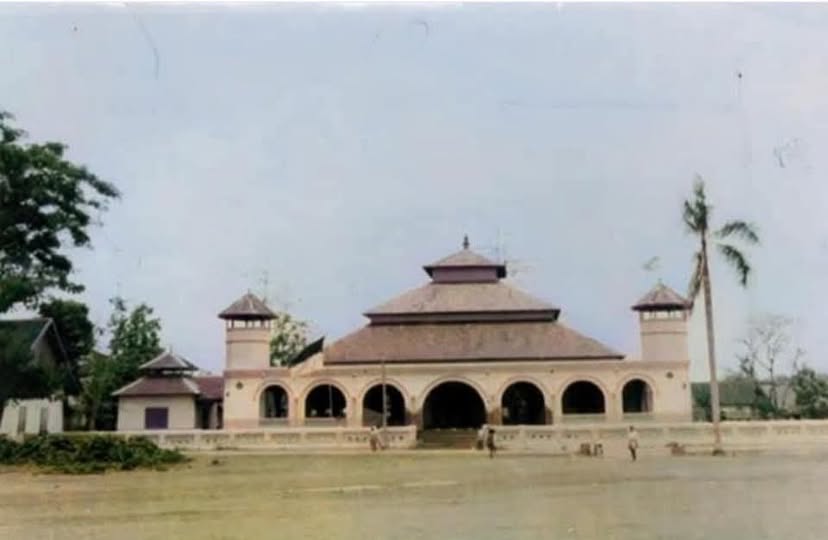
All Sumbawa people throughout the country adhered to Islam with great fanaticism. This fanatical tendency appears to have emerged even earlier. In his 1808 report, Mr. Tobias complained about the Sumbawa people's overly strict and excessive religious practices.
Tobias also reported that the Tambora eruption, which resulted in misery and hardship, made society highly vulnerable to returning to religious values as a guide. This was compounded by the emergence of a prominent cleric named Haji Ali, who continued to preach against all bad behavior that contradicted Islam.
Haji Ali stated that all the disasters, hardships, and the Tambora eruption were caused by people's behavior that had begun to drift away from religion and God's commands. Haji Ali held a special place in the hearts of people throughout the country. He had many disciples and was always surrounded by them, all of whom he inspired to a single spirit called the purification of Islam.
At Haji Ali's urging, the Sultan issued strict regulations, strictly banning the use of opium, alcohol, gold and silver jewelry, and free association with foreigners. He even abolished singing and dancing, successfully convincing the public that they were despicable and futile. The authority of the ulama (Islamic scholars) increased in public life, and religious activities increased.
All the gold and silver jewelry owned by the people was taken and collected to be sent to Mecca, according to Haji Ali's orders. However, I found many of the nobles and nobles entrusted their jewelry to their servants to prevent it from being taken by the kingdom. To this day, Haji Ali still lives in his old age and is revered by the Sumbawa people as a holy man. He has a son, who will inherit some of his influence.
The logical consequence of this religious fanaticism was that the ulama wielded immense authority, even controlling state policy. Their numbers also increased, as now everyone, young and old, was making the pilgrimage to Mecca. Previously, they had been thieves and con artists. The Arabs, though not religious scholars, mostly traders, enjoyed prestigious positions in society.
They became highly revered and accepted as saints. These Arabs continued to incite the people to expel the Christians. Even today, Arabs are believed to possess blessings, thus attracting numerous followers. Sultan Amrullah was completely controlled by the Arabs. The Sultan considered them his spiritual teachers.
However, the blind fanaticism of the beginning began to erode somewhat compared to the difficult beginnings of life after the Tambora eruption. The improving well-being of the people has rekindled their desire to have fun and celebrate. Being in Sumbawa during the fasting month, I had the opportunity to witness firsthand how strict the Sumbawa people are in their religious practices compared to other Muslim communities in the countries I've visited.
All prayer was consistently recited by everyone. The porters who accompanied me to every location in Sumbawa immediately stopped putting down all their belongings and immediately performed prayers in the middle of the road. No orders or threats could deter them from performing prayers when the time arrived.
Every night I am so disturbed that I can't sleep because the coolies who follow me keep making noise reading verses. Al-Qur'an and reciting prayers and mantras in Arabic. Thus, from every house in every village I visited throughout Sumbawa, the echo of people reciting the Quran so loudly echoed, disturbing the tranquility in the dead of night.
The holiday, a very festive time for the native Javanese, passes in Sumbawa in a very quiet and silent manner. Although here and there, a few people, dressed more well than before, can be seen walking along the streets. After the holiday, they fast again for six to twelve days, observing a fast that is no less strict than the previous one.
It cannot be denied that fanaticism does have a positive influence on societal morality. However, on the other hand, I see the Sumbawa people's strong adherence to religion as hindering their progress. This fanaticism grows alongside hypocrisy and spiritual arrogance. People tend to boast about all their religious activities. This not only makes them arrogant, believing themselves superior to non-Muslims, but also looks down on their fellow believers who lack religious knowledge.
Fanaticism in this religion will prevent the Sumbawa people from progressing, because they are more focused on their activities. superstition and the formalities of worship that have no value in changing one's destiny in real life. They focus more on worship than on ways to improve their lives and develop themselves.
Sumbawa will progress if the clerics who fuel religious fanaticism can be stopped. On the other hand, prosperity, economic growth, and increased well-being, along with increased interaction with other communities, will naturally erode people's escape to religion. Religion thrives in difficult social conditions because it provides a calming hope that encourages resignation and acceptance, which in turn leads to further deterioration because the situation remains unchanged.
Religious fanaticism prevents people from acting, facing reality, and improving their circumstances. Therefore, the well-being of people in Sumbawa must be improved, because prosperity is what stops people from seeking refuge in religious values, which distance them from the realities of life.
(Personal notes of the translatorOf the many passages in Zollinger's notes on Sumbawa that I have published, this one was initially difficult for me to publish. But I believe that Zollinger's thoughts on Islam in Sumbawa in 1847 should be a challenge for believers. This note is important for us to adhere to the principles of progressive Islam. That religion is not an escape from reality, but rather an energy and spirit to move forward and improve the situation. Religious life and worldly life must be balanced. And faith is positively correlated with wealth. As the letter says al-A'raf: 128, an-Nur: 55, al-Anbiya: 105:106 that the earth has sworn to inherit its contents and riches to those who do righteous deeds and are pious, who will gain power over their circumstances. So, the consequence of faith in Islam is both faith and wealth. Religion does not make people escape reality, but rather it imposes on us the obligation to nourish the earth, which means living in prosperity.)
Wallahua'lam bish shawab

1 comment
What are your thoughts on the role of fanaticism in religion as a barrier to or a driver of societal progress? Do you have any personal experiences that demonstrate the positive or negative impact of fanaticism in everyday life?